6G NTN [Innovation]
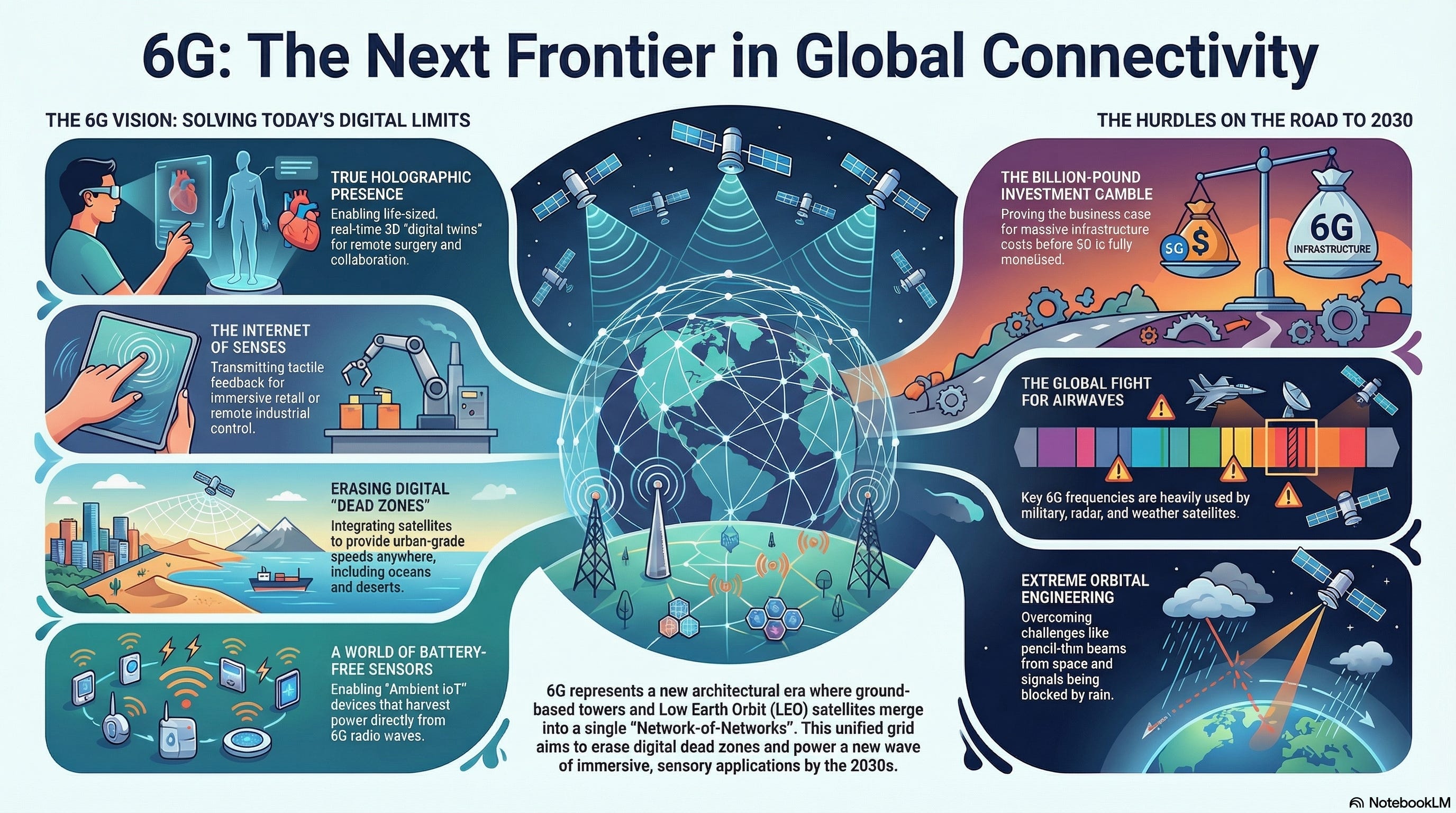
The 6G architecture is evolving into a “Network-of-Networks,” where Low Earth Orbit (LEO) satellites are integrated into the core Air Interface.

As we approach the limits of 5G and look toward the 2030s, the telecommunications landscape is shifting toward 6G (IMT-2030).
As 6G moves through its pre-standardization phase (Release 20/21), a key transformation is occurring in the Vertical Dimension.
The 6G architecture is evolving into a “Network-of-Networks,” where Low Earth Orbit (LEO) satellites are integrated into the core Air Interface.
I. Market Drivers
A. Digital-Physical Convergence
“Holographic Presence”
The Problem: Current video conferencing is two-dimensional and lacks the spatial depth required for high-stakes collaboration. High-fidelity 3D telepresence requires Terabit-per-second (Tbps) throughput and sub-millisecond jitter to maintain visual stability.
The 6G Solution: By delivering roughly 100x the peak data rate of 5G, 6G could enable “Digital Twins” of humans. These life-sized holograms could synchronize in real-time, removing the “uncanny valley” effect and allowing for remote presence that is indistinguishable from physical proximity.
Strategic Impact: This shift could transform industries like remote surgery, high-end engineering, and education, where “being there” spatially is more important than just seeing a video feed.
The “Internet of Senses” (IoS)
The Problem: Digital interaction is currently a “walled garden” for the eyes and ears. The inability to transmit tactile (touch), olfactory (smell), or gustatory (taste) data prevents true immersion in the Metaverse or industrial remote control.
The 6G Solution: 6G could provide the ultra-reliable low-latency communication (URLLC) required for multi-sensory haptic feedback. This could allow a user to “feel” the texture of a fabric in a digital store or sense the resistance of a valve in a remote power plant.
Strategic Impact: Replacing screens with thought-controlled, multisensory interactions via Brain-Computer Interfaces (BCI) and haptic skins, fundamentally changing human-computer interaction (HCI).
B. Infrastructure Efficiency
The Data Explosion vs. Sustainability
The Problem: Global data usage is growing at an average of 15% annually. If power consumption scales linearly with data, the energy cost of 5G/6G networks could become an environmental and financial liability for nations.
The 6G Solution: 6G targets a 100x improvement in energy efficiency per bit. Using “AI-Native” power management, the network could put specific hardware components into “deep sleep” for micro-intervals when no data is being transmitted.
Strategic Impact: This could lower the “cost per bit” significantly, allowing operators to remain profitable despite exponential traffic growth while meeting strict ESG (Environmental, Social, and Governance) mandates.
The “Dead Zone” Connectivity Gap
The Problem: 5G infrastructure is tethered to terrestrial fiber and towers, leaving 70% of the Earth’s surface (oceans, deserts, and high-altitude air) as digital dead zones. This limits the growth of autonomous shipping and global logistics.
The 6G Solution: Non-Terrestrial Network (NTN) Integration. 6G is being designed to be “orbit-native,” meaning the waveform is optimized for direct communication between standard handsets and Low Earth Orbit (LEO) satellites.
Strategic Impact: This could provide urban-grade speeds at sea or in remote mines without the multi-billion dollar cost of laying transcontinental fiber-optic cables.
Ambient IoT & Battery-Free Sensing
The Problem: The “Internet of Things” is currently limited by the “Battery Maintenance Trap.” Manually replacing or charging batteries for trillions of sensors in smart cities or agriculture is logistically and environmentally challenging.
The 6G Solution: 6G could enables “Ambient IoT” in the form of sensors that harvest energy directly from the radio waves emitted by the 6G network itself. These devices require no batteries and could remain operational for decades.
Strategic Impact: This could allow for the mass deployment of “deploy-and-forget” intelligence in everything from smart food packaging to structural monitors inside concrete bridges.
II. Commercial & Regulatory Challenges
1. The “5G ROI” Hangover & Capex Fatigue
The Monetization Gap: With 6G infrastructure costs expected to exceed $100B per major market, boards may be hesitant to approve massive capital expenditure (CAPEX) without a proven “Killer App” that 5G cannot handle.
Stranded Asset Risk: Massive investment in 5G “Standalone” cores is still ongoing. Launching 6G by 2030 risks making 5G equipment obsolete before it has reached its full depreciation cycle, potentially destabilizing the balance sheets of Tier-1 carriers.
Sensing-as-a-Service Uncertainty: A business case for 6G is “Spatial Intelligence” (selling radar-like data to cities and stores). However, there is no established market for this data yet, and operators lack the software expertise to compete with established silicon and AI giants in the “data insights” space.
2. Spectrum Geopolitics & The FR3 Battle
Incumbent Displacement: The 7–24 GHz “Sweet Spot” (FR3) is important for 6G because it offers a balance of coverage and capacity. However, these bands are heavily used by the Department of Defense (Radar), NASA (Deep Space Network), and weather satellites. Moving these incumbents could be a multi-decade, multi-billion dollar diplomatic nightmare.
Global Fragmentation (The Splinternet): If the US, Europe, and China cannot agree on which bands to use for 6G at the WRC-27 conference, we may return to the era of “regional phones.” A 6G device bought in New York might not work in Shanghai, destroying the global economies of scale for hardware manufacturers.
The Licensing Cost Barrier: If governments treat 6G spectrum auctions as “cash cows” (as they did with 3G and 4G), the high price of entry could leave operators with limited budgets to actually build the dense networks 6G requires.
3. Privacy, Trust, & the “Surveillance” Narrative
Radio-Based Eavesdropping: Because 6G “Network-as-a-Sensor” (ISAC) have the potential to detect heart rates and movement through walls without cameras, it could face “tech-lash” from privacy advocates. Regulatory bodies like the EU’s GDPR may classify 6G radio reflections as “biometric data,” making deployment legally treacherous.
Adversarial AI Attacks: Since 6G could be “AI-Native,” it may be vulnerable to “Prompt Injection” or “Data Poisoning” at the physical radio layer. A malicious actor could send a specific radio pattern that “tricks” the network AI into shutting down or misallocating all resources to a single rogue device.
Cyber-Sovereignty: Governments are increasingly viewing the “Core” of the network as a matter of national security. The exclusion of certain vendors from the 6G supply chain reduces competition, drives up prices, and slows down the global standardization process.
III. Technical Constraints: The Orbital & Computational Barriers
1. The “Terahertz Gap” (Propagation & Material Physics)
Atmospheric Attenuation & “The Vacuum Advantage”:
The Problem: At frequencies above 100 GHz (Sub-THz), radio waves are absorbed by atmospheric oxygen and water vapor. This creates “dead zones” for satellite-to-ground links during weather events (rain, clouds).
Space Context: While the atmosphere is a barrier, the vacuum of space offers a “Zero-Loss” environment. 6G innovators are utilizing Sub-THz for Inter-Satellite Links (ISL) to create ultra-high-speed orbital backbones that bypass atmospheric interference entirely.
Hardware Challenge: To penetrate the atmosphere from LEO, satellites require High-Power Amplifiers (HPA) using Gallium Nitride (GaN) to “punch” signals through the moisture layer.
The “Line-of-Sight” (LoS) Lockdown:
The Problem: Sub-THz waves behave like light. If a satellite passes behind a building, mountain, or even a dense flock of birds, the connection drops instantly.
Space Context: This creates a need for Orbital Mesh Architectures. If one satellite’s LoS is blocked, the 6G stack could perform a “Predictive Handover” to another satellite in the constellation in microseconds.
Solution: Integration of Reconfigurable Intelligent Surfaces (RIS) on satellite chassis to “bend” signals toward ground terminals that are not in a direct line-of-sight.
Radiation-Induced Phase Noise:
The Problem: Generating stable 300 GHz signals requires extreme precision. In space, cosmic radiation can degrade the semiconductor materials (InP or SiGe), causing “frequency drift.”
Space Context: Satellite oscillators must be “Rad-Hardened” to prevent jitter. Even a nanosecond of phase noise at 6G frequencies could lead to a total loss of data synchronization between a satellite and a ground station.
Innovation Need: Development of Optoelectronic Oscillators that use lasers rather than crystals to generate ultra-stable 6G frequencies in high-radiation orbits.
2. The Compute-Power Paradox (Orbital Edge Computing)
Throughput vs. The Vacuum Thermal Wall:
The Problem: Processing Tbps data rates generates immense heat. On Earth, fans or liquid cooling can manage this; in the vacuum of space, heat can be removed via Radiative Cooling.
Space Context: 6G satellite processors risk “Self-Melting” if they attempt to process Terabit-per-second streams without advanced thermal management.
Infrastructure Need: Satellites designed with Phase-Change Materials (PCM) and oversized radiator fins to dissipate the heat generated by 6G baseband processing.
The AI Energy Penalty in Orbit:
The Problem: “Native AI” requires constant GPU/NPU cycles to manage beamforming and interference. This creates a “Power Drain” on the satellite’s limited solar budget.
Space Context: Every Watt used for AI computation is a Watt taken away from the radio transmission power. This forces a trade-off between “Network Intelligence” and “Signal Reach.”
Innovation Need: Neuromorphic “Spiking” Neural Networks that process 6G signal data using 1/100th the power of traditional deep learning architectures.
The Orbital “Memory Wall”:
The Problem: 6G applications like “Digital Twin” synchronization require moving massive datasets from satellite storage to the transmitter.
Space Context: Standard space-grade memory (SRAM) is too slow for Tbps 6G. High-speed commercial memory (LPDDR5) is susceptible to “Single Event Upsets” (bit-flips) from cosmic rays.
Infrastructure Need: Radiation-Tolerant HBM (High Bandwidth Memory) stacks that can feed 6G transmitters at Terabit speeds without data corruption.
3. Extreme Beamforming & Mobility Management
The “Pencil Beam” Orbital Tracking Challenge:
The Problem: 6G beams at 100 GHz+ are ultra-narrow (centimeters wide). A satellite moving at 27,000 km/h must “hit” a ground terminal with a beam as thin as a pencil.
Space Context: This requires Hyper-Agile Beamforming. The satellite compensates for its own orbital velocity, the Earth’s rotation, and the movement of the user (e.g., a jet at Mach 1) simultaneously.
Technical Requirement: 6G payloads updating their beam-steering coordinates 10,000 times per second to prevent “Beam Miss.”
Relativistic Doppler Shifts:
The Problem: At Sub-THz frequencies, the high velocity of LEO satellites causes a massive Doppler Shift, effectively “changing the color” of the radio signal.
Space Context: If not corrected, the ground receiver will be “tuned” to the wrong frequency. 6G NTN requires AI-driven Doppler Compensation that predicts the frequency shift based on the satellite’s precise orbital ephemeris.
Antenna Array Complexity & “Massive MIMO” Drag:
The Problem: To achieve high gains, 6G satellites need arrays with thousands of antenna elements. This increases the satellite’s physical size (Surface Area) and mass.
Space Context: Larger antenna arrays increase Atmospheric Drag in Very Low Earth Orbit (VLEO), requiring the satellite to use more fuel to maintain its altitude.
Innovation Need: Flat-Panel Metasurface Antennas that are integrated into the satellite’s structural skin, providing high-gain 6G capabilities without increasing the spacecraft’s aerodynamic profile.
III. Emerging Technical Stack: The Orbital-Terrestrial Fabric
1. The Neural Air Interface (Hardware & AI)
Semantic Communication & Liquid AI:
Mechanism: Rather than transmitting raw bitstreams, 6G aims to use “Intent-Based” compression. In space, “Liquid AI” frameworks could allow satellites to partition neural networks, storing sub-models in orbit that adapt to available bandwidth.
Impact: Reduces satellite-to-ground data traffic, allowing ultra-low-bandwidth links to deliver high-fidelity “reconstructed” video or telemetry.
Innovators: Nvidia (USA) (AI-RAN hubs), University of Hong Kong (Liquid AI Research).
Reconfigurable Intelligent Surfaces (RIS) in Orbit:
Mechanism: Integrating programmable metasurfaces into satellite chassis to “steer” beams around atmospheric interference or urban blockages without moving the entire spacecraft.
Impact: Dramatically improves Signal-to-Noise Ratio (SNR) for THz-frequency space links, which are notoriously fragile.
Innovators: Greenerwave (FR), Metawave (USA).
Regenerative Satellite Payloads:
Mechanism: Shifting from “bent-pipe” (simple reflectors) to “On-Board Base Stations.” Satellites perform full signal modulation, demodulation, and routing in space.
Impact: Enables satellites to function as autonomous 6G nodes, reducing the need for costly and vulnerable ground stations.
Innovators: Thales Alenia Space (FR/IT), i2CAT (ES) (6GStarLab mission).
2. The Multi-Band Spectrum Layer (THz & Optical)
W-Band & D-Band (Sub-THz) Space Links:
Capability: Utilizing frequencies between 75 GHz and 170 GHz for ultra-high-capacity satellite backhaul.
Impact: Provides “Fiber-grade” speeds (up to 10 Gbps per link) in orbit, essential for handling the massive data loads of 6G urban cores.
Innovators: European Space Agency (ESA) (ARTES 4.0 program), Qualcomm (USA).
Optical Inter-Satellite Links (OISL):
Capability: Using laser terminals (like the LUCI system) instead of radio for satellite-to-satellite communication.
Impact: Creates a “Space Mesh” that bypasses atmospheric congestion and is immune to terrestrial radio interference (RFI).
Innovators: Mynaric (DE), Oledcomm (FR) (France 2030 program).
FR3 (7–24 GHz) Global Sharing:
Capability: The “sweet spot” for 6G that allows for both wide-area terrestrial coverage and high-altitude platform (HAPS) connectivity.
Impact: Harmonizes the frequency used by your phone whether it’s talking to a tower or a satellite.
3. The “Network-as-a-Sensor” Layer (ISAC)
Integrated Localization and Communication (ILAC):
Capability: 6G satellites use communication waveforms to simultaneously perform high-precision positioning, bypassing the limitations of traditional GPS/GNSS.
Impact: Provides centimeter-level tracking for autonomous drones and maritime vessels in “GPS-denied” environments.
Innovators: LILAC-6G Project (EU), Microsoft Research (SatSense project).
IV. Opportunities for New Innovators
The 6G infrastructure presents a “blue ocean” for solving the bottlenecks of power density, massive data orchestration, and extreme low-power sensing.
1. Ambient & Battery-Free Space-IoT
The industry is moving toward a “trillion-device” ecosystem with minimal maintenance.
The Opportunity: Developing Backscatter Echo-Terminals and Zero-Energy Gateways.
Innovation Focus:
Passive Modulation: Designing $0.50 tags that harvest energy from ambient 6G waves (terrestrial or orbital) to “reflect” data rather than broadcast it.
Sub-Noise Detection: Creating Software-Defined Radio (SDR) protocols that allow satellites to detect ultra-faint, passive reflections amidst the “noise” of the Earth’s surface.
Global Lifecycle Monitoring: Sensors capable of 20-year lifespans for maritime cargo, polar monitoring, and deep-soil agriculture.
Example Innovators: Wiliot (Ambient IoT), Everactive (Battery-free), Sateliot (IoT-specific NTN), Microsoft Research (Project Echo).
2. AI-Model “Shops” for Orbital RAN
As 6G satellites become “flying data centers,” the Radio Access Network (RAN) must adapt its logic in real-time based on the geography it is overflying.
The Opportunity: Creating a Marketplace for Space-Optimized AI Agents that satellite operators can “hot-swap” via secure downlinks.
Innovation Focus:
Rad-Hardened Machine Learning: Training AI models to remain accurate despite “bit-flips” in memory caused by cosmic radiation and solar flares.
Contextual Agentics: Developing “Atmospheric-Pierce” agents for monsoon regions or “Interference-Nulling” agents for dense urban centers like Tokyo.
On-Orbit Model Partitioning: Architectures that allow a satellite to run “Liquid AI” to adjust its compute load based on its current solar-power budget.
Example Innovators: Nvidia (Aerial platform), DeepSig (Neural receivers), Aispace (Edge AI for space), Antaris (Software-defined satellites).
3. Direct-to-Device (D2D) Infrastructure & Gateways
Connecting standard, unmodified smartphones and legacy industrial sensors directly to the orbital 6G grid.
The Opportunity: Solving the Link Budget Challenge; bridging the gap between a tiny handset antenna and a satellite 550km away.
Innovation Focus:
Virtual Transparent Bridges: Software patches or “active stickers” that act as 6G translators for legacy 4G/5G hardware, preventing billions in “e-waste.”
Massive Deployable Phased-Arrays: Designing antennas (like AST SpaceMobile’s BlueWalker) that fold into launch fairings and deploy to sizes exceeding 60 m^2.
Doppler-Compensating Waveforms: Signal processing that tracks millions of moving devices simultaneously while compensating for orbital velocity.
Example Innovators: AST SpaceMobile, Lynk Global, SpaceX (Starlink D2D), Skylo (NTN service provider).
4. Quantum-Safe Orbital & Thermal Management
As 6G moves into the Terahertz (THz) spectrum and integrates Quantum-Native security, the heat generated by these high-frequency chips creates a thermal crisis in a vacuum.
The Opportunity: Designing Compact PQC (Post-Quantum Cryptography) Chips and extreme thermal rejection systems for smallsats.
Innovation Focus:
GaN-on-Diamond Substrates: Utilizing diamond’s high thermal conductivity to prevent THz power amplifiers from melting during high-bandwidth operations.
Lattice-Based Encryption: Developing 6G “Space-to-Ground” links that are mathematically immune to quantum-assisted decryption.
Flexible Radiators: Oscillating heat pipes that can deploy from a 100kg satellite bus to manage 5 kW to 15 kW of power density.
Example Innovators: Carbice (Nanomaterials), QNu Labs (Quantum security), Isar Aerospace (Structural integration), Thermal Management Solutions (TMS).
V. Economic Scenarios & Market Impact
1. The “Sensing-as-a-Utility” Scenario (Data Monetization)
In this scenario, 6G Integrated Sensing and Communication (ISAC) reaches centimeter-level fidelity, effectively turning the radio network into “Global Radar.”
Impact on Innovation: Carriers shift from selling “Data Buckets” to Spatial Intelligence. A national railway pays a 6G operator for a “Safety Stream” that detects track obstructions 50 miles away using radio reflections alone.
Economic Strategy: “Sensing-as-a-Service” becomes the primary revenue driver, exceeding traditional voice and data subscriptions by a factor of 3 to 1.
Winner: Firms that own the Data Fusion Layer; AI that turns raw radio reflections into actionable alerts for insurance, logistics, and defense.
2. The “Unified Orbital Grid” Scenario (Geopolitical Disruption)
Satellite-to-cell becomes so seamless that the 100-year-old “Land-Based Carrier” model collapses.
Impact on Innovation: The Death of Global Roaming. Your “Home Network” is no longer a country; it is an orbital constellation. Connectivity becomes a global commodity similar to GPS.
Economic Strategy: Rise of the “Global Super-Carrier.” Satellite-terrestrial conglomerates (e.g., SpaceX/T-Mobile or Amazon/Verizon) dominate the market, leasing “downlink capacity” to local governments for local distribution.
Winner: Specialists in Inter-Satellite Laser Links (ISL) and cross-border regulatory compliance software.
3. The “Commoditization” Scenario (The Starship Effect)
As the cost to orbit drops from $2,000/kg to <$200/kg due to heavy-lift vehicles, extreme miniaturization becomes less critical than volume.
Impact on Innovation: A move toward COTS (Commercial Off-The-Shelf) industrial components in space. If mass is cheap, satellites can be built heavier, with more shielding and larger batteries.
Economic Strategy: “Volume over Complexity.” It becomes cheaper to launch a “6G Tanker” to refuel an existing satellite than to design a new ultra-efficient ion engine.
Winner: In-Orbit Servicing (ISAM) players and heavy infrastructure providers (orbital data centers and refueling depots).
VI. Example Five-Year Roadmap (Technical & Commercial)
2026: The Year of the Optical Backbone
Technical: Widespread adoption of Laser ISLs (Inter-Satellite Links) across 6G test-beds.
Commercial: Data bypasses terrestrial fiber entirely for transcontinental routes, providing “Dark Fiber in the Sky.”
Impact: Latency between London and New York drops significantly as signals travel through the vacuum of space at the speed of light rather than through glass fiber.
2027: The Edge-AI Standard
Technical: First-generation Neural Receivers become a standard utility for 6G satellite buses.
Commercial: Satellites no longer downlink raw telemetry; they downlink “Actionable Intelligence” (e.g., “Methane leak detected at Coordinate X”).
Impact: Reduction in required downlink bandwidth, allowing constellations to serve more users.
2028: Autonomous Space Domain Awareness (SDA)
Technical: Mandatory ISAC-based Collision Avoidance integrated into all 6G LEO architectures.
Commercial: Insurance premiums for satellites drop as constellations gain the ability to autonomously maneuver around debris using onboard radar/lidar waveforms.
Impact: Mitigation of the “Kessler Syndrome” risk, ensuring the 6G orbital shell remains viable for long-term use.
2029: The “Internet of Senses” Beta
Technical: Haptic-feedback protocols and Semantic Communication are integrated into the 6G NTN standard.
Commercial: The first “Holographic Presence” calls are conducted via satellite, enabling zero-lag 3D telepresence in remote disaster zones.
Impact: Telemedicine moves from “video calls” to “remote tactile surgery” in underserved regions.
2030: The Circular Space Economy
Technical: Transition to Refuellable 6G Propulsion Units becomes the industry norm.
Commercial: The birth of “Gas Stations in Space.” Satellite life is no longer limited by fuel but by component degradation.
Impact: Launch of the first Orbital Data Center, hosting 6G core network functions entirely in space to minimize terrestrial physical footprints.