
Active Dust Shields [Concept]
High-transparency graphene electrodes & solid-state electric field architectures to provide “active force fields” that could keep surfaces pristine without water, chemicals, or mechanical wipers.

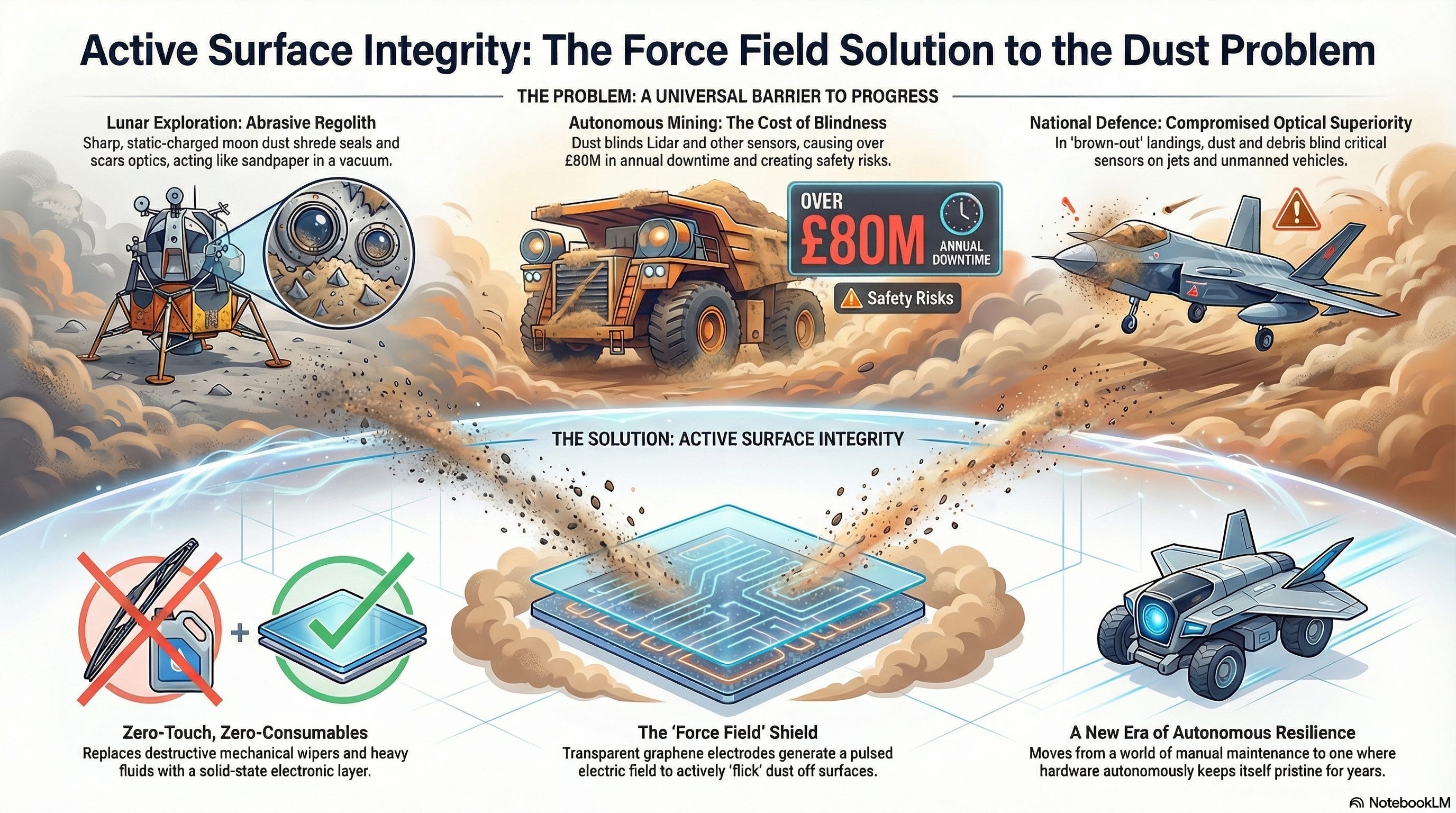
A key bottleneck for high-frontier operations, whether on the lunar south pole, in the sub-zero mines of the Arctic Circle, or in a high-debris forward combat zone, is dust.
Fine particulate matter is the “universal killer” of hardware.
Current cleaning methods are generally either mechanical (abrasive), fluid-based (logistically heavy), or passive (ineffective against static).
The Extreme Environment Resilience Group (EERG) is a proposed strategic consortium designed to commercialize Electrodynamic Dust Shields (EDS) and Active-Repulsion Textiles.
By utilizing high-transparency graphene electrodes and solid-state electric field architectures, the EERG could provide “active force fields” that keep surfaces pristine without water, chemicals, or mechanical wipers.
This could move us from a world of “manual maintenance” and “component erosion” to a new era of Autonomous Surface Integrity.
The EERG could aim to address the challenge of particulate interference across three key domains:
Lunar Exploration: Providing the critical “resilience layer” for the Artemis and Moonlight missions, preventing abrasive regolith from shredding suit seals and keeping solar arrays at 100% efficiency during long-duration stays.
Terrestrial Mining: Enabling the “blind” autonomous mines of the High Arctic and deep deserts, replacing manual cleaning rotations for Lidar and Infrared sensors with solid-state repulsion that eliminates $100M+ in annual downtime.
National Defense: Maintaining “optical superiority” for the Global Combat Air Programme (GCAP) and Unmanned Ground Vehicles (UGVs) by protecting precision sensors and pilot visors in “brown-out” landing zones and debris-heavy combat theaters.
I. The “Particulate Attrition” Barrier
The EERG could address the physical and economic limits of current surface maintenance in “denied” environments where traditional cleaning is challenging.
Lunar Regolith: Lunar dust is chemically sharp and electrostatically charged. In the vacuum of the Moon, using a mechanical wiper on a visor or lens acts like sandpaper, scarring the surface.
“Zero-Sight” Mining: European mining (e.g., in Kiruna, Sweden) is shifting toward 100% autonomy. Fine mineral dust “blinds” Lidar and Infrared sensors. Manual cleaning cycles cause $100M+ in annual downtime and safety risks for human technicians.
The Defense “Brown-Out” Hazard: For the Global Combat Air Programme (GCAP) and European UGV (Unmanned Ground Vehicle) initiatives, maintaining optical clarity on sensors and pilot visors in high-debris combat zones is a critical tactical requirement.
The Weight of Consumables: Traditional cleaning requires pressurized air or water. In space or remote deserts, the mass of these “cleaning consumables” is a massive logistical burden. EERG could replace mass with Solid-State Electrons.
II. The Potential Technical Stack
A modular framework combining material science with high-precision engineering to create “Active Surface Integrity.”
Graphene-Enhanced Transparent Electrodes: Utilizing the UK’s capabilities in CVD graphene to create ultra-transparent, highly conductive surface coatings that act as the “engine” for the electric field.
High-Frequency Dielectrophoretic (DEP) Pulsing: Solid-state power electronics that generate non-uniform electric fields, exerting a force on particles to lift and “flick” them off the surface.
Active-Repulsion Textiles: Weaving conductive micro-yarns into the outer layers of EVA (Extravehicular Activity) suits to prevent dust from embedding in the fabric weave or clogging mechanical joints.
Nanoscale Piezo-Vibration: A secondary layer of high-frequency ultrasonic vibration to “loosen” heavy debris before the electromagnetic field ejects it.
III. Intellectual Property (IP) Generation
“Aegis-Wave” Waveform Logic: Algorithms that adjust the electric field frequency in real-time based on the moisture content and dielectric constant of the dust (e.g., adapting from dry lunar regolith to damp terrestrial mine dust).
Atomic-Layer Deposition (ALD) Coatings: IP surrounding the application of ceramic-polymer hybrids that protect the electrodes from mechanical impact while maintaining electrical efficacy.
“Active-Seal” Architecture: A design for mechanical joints (suit seals/hatch locks) that creates an “exclusion zone” for dust using a localized, high-intensity repulsion field.
Radiation-Hardened Digital Twin: A real-time monitoring protocol that tracks surface degradation and electrode health over a 15-year lifespan in high-radiation environments.
IV. Alternative Approaches & Competitors
1. Mechanical Wipers & Pneumatic Clearing Systems
The Model: Adaptation of terrestrial automotive cleaning systems, utilizing physical friction (wipers) or pressurized fluid and air “puffs” to clear debris.
The Industrial Landscape: Standard integration by Lidar OEMs and autonomous vehicle developers like Waymo or Tesla for road-based weather clearing. In mining, this is seen in the manual high-pressure washing stations for haulage fleets.
The Problem: In extreme environments, this model becomes a “destructive” cycle. On the Moon, the lack of an atmosphere makes air-clearing impossible, and the abrasive nature of regolith means mechanical wipers act like sandpaper, permanently scarring Lidar lenses in a single shift. In terrestrial mining, the water requirement for fluid washers is a logistical nightmare in desert or Arctic sites where liquid water is scarce or subject to freezing.
EERG Value: “Zero-Touch” Asset Preservation. By eliminating mechanical friction, EERG removes the primary cause of optical degradation. The system potentially replaces heavy fluid tanks and compressors with a solid-state electronic layer, reducing total system mass by 90% and extending the operational life of sensors from weeks to years.
2. Passive Hydrophobic & Omniphobic Coatings
The Model: Chemical surface treatments (silanes, fluoropolymers, or nano-textured “Lotus-effect” surfaces) designed to reduce the surface energy of a lens so dust cannot “stick.”
The Industry Landscape: Companies like NeverWet and LiquiGlide, or specialized aerospace coatings developed by Boeing for insect-residue mitigation.
The Problem: Passive coatings rely on external kinetic energy such as gravity, wind, or vibration to shed particles. In the low-gravity, vacuum environment of the Moon, or the stagnant air of a deep underground mine, there is no “clearing force.” Furthermore, these coatings do nothing to counteract Electrostatic Bonding. Lunar dust is highly charged; it will “lock” onto a passive coating regardless of how “slick” the surface is. Additionally, chemical coatings degrade rapidly under the intense UV radiation and atomic oxygen found in space.
EERG Value: Active Dielectrophoretic Ejection. EERG does not wait for gravity or wind. There is an opportunity to actively generate a dielectrophoretic force that overcomes electrostatic bonding, “flicking” particles off the surface even in zero-gravity or stagnant environments. It could provide a Radiation-Hardened solution that is integrated into the material, not just wiped on.
3. NASA Swamp Works & US-Centric EDS Research
The Model: The Electrodynamic Dust Shield (EDS) originally pioneered by NASA for solar panel protection on Martian and Lunar missions.
The Competitors:
NASA Kennedy Space Center (Swamp Works): The primary research body for space-based EDS.
Blue Origin: Developing internal dust mitigation for their “Blue Moon” lander.
Honeybee Robotics: Investigating dust-tolerant mechanical joints and seals.
The Problem: Much of US-led research is currently “Mission-Bespoke.” It is designed for specific NASA hardware and is often locked behind ITAR (International Traffic in Arms Regulations), making it inaccessible or prohibitively expensive for European defense and commercial mining sectors. These US solutions lack a high-volume, terrestrial “dual-use” path, resulting in extremely high per-unit costs and a focus on low-vibration space environments rather than the violent, high-shock world of heavy industry.
EERG Value: The “Industrial-Scale” Alternative. By utilizing the UK’s capabilities in CVD Graphene, EERG could move the tech from “lab-scale space glass” to “mass-produced industrial laminate.” The consortium could target the 10cm–1m “sweet spot” for autonomous mining and the GCAP fighter program, offering an ITAR-free, Commercial-Off-The-Shelf (COTS) approach that allows European companies to integrate dust resilience into their own hardware without foreign regulatory bottlenecks.
V. Potential Consortium Deliverables
The EERG consortium could provide a comprehensive ecosystem spanning specialized hardware, autonomous control software, and international regulatory frameworks to ensure surface integrity is as reliable as a mechanical wiper but with the durability required for the deep-space and deep-earth frontiers.
1. The “Shield” Integrated Optic (Hardware)
The primary physical deliverable could be a modular, EDS-enabled lens cover designed for rapid retrofit onto existing Lidar, Infrared, and HD camera systems used in autonomous haulage and aerospace.
Technical Specification: A multi-layered Aegis-Laminate comprising a 98% transparent glass/polymer substrate with embedded CVD Graphene electrodes. The unit could be powered by a miniaturized 12V-to-5kV solid-state converter capable of clearing 99% of accumulated dust in <1 second using <5W of peak power. It could feature a Multi-Spectral Window optimized for wavelengths from 400nm to 14μm, ensuring no signal distortion for Lidar or Thermal IR sensors. The hardware could be encased in a vibration-dampened titanium housing, rated for the high-frequency shocks of rock-drilling or jet-engine resonance.
Commercial Utility: This unit could seek to eliminate “visibility downtime” in remote mining and defense by allowing operators to snap a protective shield onto a sensor and have immediate, maintenance-free clarity. It could enable a Swedish iron mine or a UK-led GCAP squadron to operate in “blind” conditions without risking a technician’s life to manually wipe a lens.
2. The “Sentinel-OS” Surface Manager (Software)
A resilient, AI-driven firmware package designed to operate without human intervention for years at a time in communications-denied environments like the lunar poles or deep-crust mines.
Technical Specification: A decentralized Backscatter-Analysis Algorithm that performs real-time sensor fusion of optical clarity data and atmospheric static charge. The OS could utilize Adaptive Waveform Logic to modify the repulsion pulse based on the specific dielectric properties of the debris (e.g., dry regolith vs. damp mineral dust). It could include an Energy-Saving “Sleep-to-Pulse” Mode, which only draws power when a “Transparency-Drop” threshold is breached. For defense applications, it could feature an Anti-Tamper Logic Layer that detects physical lens obstruction (sabotage) and alerts central command.
Commercial Utility: For lunar ISRU, “Sentinel-OS” could ensure that automated solar-panel cleaning never draws more power than the panels generate. For terrestrial mining, it could allow for a “Lights-Out” autonomous fleet that self-manages its sensor health, adjusting pulse intensity to seasonal shifts in the Arctic tundra without requiring a resident software team.
3. The “Aegis-Weave” & Lunar Cryo-Gaiters (Deployment Kits)
Specialized environmental integration packages that adapt the core EDS technology to flexible materials and punishing thermal gradients.
Technical Specification: A conductive textile “shroud” utilizing Graphene-Coated Micro-Yarns woven into a ripstop-Kevlar matrix. For lunar use, the kit could include Active-Repulsion Gaiters for astronaut suit joints (knees/shoulders/wrists) and habitat airlock seals, using low-power pulses to prevent abrasive particles from embedding in the seal interface. For terrestrial mining, the kit could feature Vacuum-Insulated Shield Sleeves to protect sensor electronics from -60°C Arctic winters, coupled with an inductive power pad to allow for “Plug-Free” integration onto existing vehicle chassis.
Commercial Utility: This “ruggedization” allows a single electrodynamic architecture to be sold into two vastly different markets. It could enable a space agency to protect multi-billion dollar pressurized modules from “dust-leakage” while simultaneously allowing a defense firm to protect the sensitive “eyes” of an unmanned ground vehicle (UGV) in the high-vibration environment of a desert combat zone.
4. The “Clarity-Chain” Resilience Standard (Compliance & Audit)
Developed with the National Physical Laboratory (NPL) and the European Space Agency (ESA), this could be a formal “Surface-Integrity” certification and audit framework for autonomous hardware.
The Deliverable: A blockchain-backed Operational Clarity Ledger known as the “Pristine-Surface Standard.” This protocol could define the requirements for “Resilience-as-a-Service” (RaaS), where the consortium guarantees a 95%+ transparency rating for the life of the asset. It could include a Terminal Health Blueprint; a digital twin of every deployed lens that records every cleaning cycle and impact event, providing an immutable audit trail for insurers and safety regulators.
Commercial Utility: This framework could de-risk the adoption of autonomous tech for mining giants and defense ministries. It provides banks and insurers with a “Guaranteed Visibility” metric, turning a complex environmental hazard (dust) into a standardized, “tick-box” commercial agreement that ensures the mining company is never held liable for a “blind-sensor” accident.
VI. Example Consortium Partners
1. Airbus Defence and Space (UK/EU)
The “Systems Prime”: Aerospace Integration & Orbital Infrastructure
Business Case: Airbus is the primary European architect for the Artemis Gateway and the Moonlight communications constellation. As lunar exploration shifts from “visiting” to “staying,” dust-induced hardware failure is their largest mission-risk variable. By leading EERG, Airbus could bake “Active Resilience” into the fuselage of every lander and the optics of every satellite.
Value Contributed: Unmatched systems engineering expertise, access to European Space Agency (ESA) qualification standards, and the infrastructure to lead the Global Combat Air Programme (GCAP) integration. They provide the “Master Blueprint” for how dust-shielding interfaces with complex avionics and life-support systems.
Value Received: A proprietary technological “moat.” By owning the integration IP for EDS, Airbus ensures that future European space and defense contracts are able to leverage their resilient architecture, helping set the standard for “Lunar-ready” or “Desert-ready” hardware.
Potential Alternatives: Thales Alenia Space (UK/France). The primary competitor for European space infrastructure, offering deep expertise in pressurized habitat modules.
2. University of Manchester - GEIC (UK)
The “Materials Lead”: Graphene IP & Nano-Scale Conductors
Business Case: The Graphene Engineering Innovation Centre (GEIC) is a leader of 2D material commercialization. After a decade of UK sovereign investment, the GEIC is seeking “Killer Applications” that require the unique transparency and conductivity of CVD Graphene. EERG could provide the high-value vehicle to move graphene from the lab into the most extreme environments.
Value Contributed: World-leading IP in the application of transparent conductive films (TCFs) and smart-textile weaving. They could provide the fundamental chemistry for the Aegis-Laminate and the conductive micro-yarns for Active-Repulsion Textiles, bridging the gap between raw physics and industrial materials.
Value Received: A direct, high-margin commercialization pathway for their graphene patents. This could elevate the GEIC from a research hub to a critical upstream supplier for the global aerospace and mining supply chains, proving the ROI of the UK’s “Graphene City” initiative.
Potential Alternative Partner: Cambridge Graphene Centre (CGC). A leading UK academic rival with extensive IP in liquid-phase exfoliation and flexible printed electronics.
3. Rio Tinto (UK/Global)
The “Industrial Anchor”: Operational Scaling & Field Validation
Business Case: As a leader in the “Mine of the Future,” Rio Tinto is pivoting toward 100% autonomous operations to reach Net Zero and improve safety. Their current autonomous haulage fleets in the Pilbara and the High Arctic are throttled by sensor “blindness” in dust-heavy environments. EERG technology could allow Rio Tinto to unlock “Lights-Out” mining in regions previously deemed too harsh for robotics, removing the human maintenance burden from dangerous or remote locations.
Value Contributed: A multi-billion dollar operational footprint and access to the world’s most punishing terrestrial test beds (e.g., the Diavik Diamond Mine in the Arctic). They provide the “Real-World” requirements for vibration-hardening and the high-volume demand needed to move EDS from a space-grade boutique item to a mass-produced industrial standard.
Value Received: Early-access to “Pristine-as-a-Service” hardware, providing a ROI through reduced vehicle downtime and increased safety. By eliminating manual sensor cleaning, Rio Tinto could accelerate their decarbonization goals (removing water/diesel-heavy maintenance) and lower the “Cost Per Tonne” for critical minerals like Lithium and Copper.
Potential Alternative Partner: Anglo American. A London-based mining giant with a heavy focus on “FutureSmart” mining technologies and sustainable mineral extraction.
4. Qioptiq / Excelitas (UK/Germany)
The “Precision Partner”: Optical Fabrication & Thin-Film Excellence
Business Case: Qioptiq is a leading European supplier of night-vision optics and fighter-jet visors. In the modern battlespace, “Passive Glass” is no longer enough; their customers (the MOD and NATO) are demanding sensors that don’t fail in sandstorms or high-debris urban environments. They are pivoting from being a “Lens Maker” to a “Smart-Optic Provider.”
Value Contributed: Decades of experience in high-precision optical coatings, IR-transparent materials, and the mass-manufacture of ruggedized visors. They could provide the manufacturing facility to integrate the GEIC’s graphene layers into high-spec glass and polymer assemblies without losing optical clarity.
Value Received: Future-proofing their defense portfolio. By integrating EERG technology, Qioptiq could secure the contracts for the next generation of pilot helmets and autonomous ground vehicle (UGV) sensor pods, moving from a commodity component supplier to a Tier-1 “Active-Vision” partner.
Potential Alternative Partner: Leonardo (UK/Italy). A defense powerhouse specialized in Infrared search-and-track (IRST) and Lidar systems for the UK’s frontline combat aircraft.
VII. Sample Work Packages (WPs)
The EERG Work Packages could be structured to bridge the gap between advanced 2D material science and the operational realities of the lunar surface and heavy industry.
WP 1: The Graphene Electrode Matrix (Miniaturization & Transmittance)
Objective: To optimize the nanostructure and geometry of the CVD Graphene mesh to maximize electrical conductivity for 5kV repulsion pulses while maintaining >98% optical transmittance across visible and Infrared (IR) spectra.
Example Partners: University of Manchester - GEIC (Lead), Qioptiq / Excelitas, National Physical Laboratory (NPL).
Example Deliverables:
The “High-Transparency” Conductive Mesh: A proprietary, topologically optimized graphene grid that minimizes photon scattering. This could ensure that Lidar and Infrared sensors maintain high-fidelity ranging and thermal imaging without the “screen-door” interference common in traditional metal-mesh electrodes.
Atomic-Layer Deposition (ALD) Dielectric Barrier: A nanometer-thin ceramic-polymer hybrid coating applied over the graphene. This barrier prevents electrode “arcing” in high-humidity terrestrial environments and protects the graphene from atomic oxygen erosion in Low Earth Orbit (LEO).
Gradient Charge-Distribution Logic: A multi-phase circuit design that allows the electric field to vary in intensity across the lens surface. This prevents dust from “pooling” at the edges of the sensor, ensuring particulates are ejected completely clear of the optical housing.
WP 2: The “Arctic-Proof” Shield (Ruggedization & Field Power)
Objective: To engineer the solid-state high-voltage (HV) power electronics and housings to survive extreme vibration, thermal shock, and the -60°C gradients of Arctic and Lunar environments.
Example Partners: Rio Tinto (Lead), Airbus Defence and Space, Leonardo.
Example Deliverables:
The “Cold-Start” HV Converter: A specialized power module utilizing Silicon Carbide (SiC) semiconductors designed to strike high-voltage arcs at cryogenic temperatures. This ensures the dust shield is functional the moment a lunar rover wakes or a mining truck starts in a sub-zero tundra.
Vibration-Isolating Titanium Housing: A ruggedized, 3D-printed chassis for the lens assembly that utilizes internal lattice structures to dampen the high-frequency “chatter” of deep-earth rock crushers or jet-engine resonance, preventing micro-fractures in the graphene laminate.
Inductive “Power-Skin” Interface: A wireless power transfer system that allows the EDS unit to be retrofitted onto existing vehicle hulls without drilling through armored plating or pressurized seals, maintaining the structural integrity of the host platform.
WP 3: The “Sentinel-OS” (Autonomous Surface Integrity)
Objective: To develop a tamper-proof, AI-driven firmware suite that autonomously manages surface cleaning cycles based on real-time sensor fusion and environmental demand.
Example Partners: Airbus Defence and Space (Lead), University of Manchester (Computer Science), CGI UK.
Example Deliverables:
The Backscatter-Analysis Engine: A machine-learning algorithm that uses a secondary “reference laser” to measure the degree of light scattering on the lens. It distinguishes between “benign” frost and “hazardous” abrasive regolith, triggering the precise pulse-energy required for the specific debris type.
“Silent-Mode” Pulse Scheduling: For defense applications, a firmware protocol that synchronizes the high-voltage dust pulses with the sensor’s “dead-time” between frames. This ensures that the electromagnetic pulse (EMP) does not interfere with sensitive radio communications or signal intelligence (SIGINT) collection.
Predictive Maintenance Digital Twin: A cloud-linked diagnostic tool that tracks electrode wear and transparency degradation over time, providing Rio Tinto or the MOD with a “Time-to-Failure” estimate for every lens in the fleet.
WP 4: The “Pristine-Surface” Standard (Governance & Certification)
Objective: To establish the legal, safety, and logistical framework for “Resilience-as-a-Service” (RaaS), ensuring the consortium retains responsibility for the performance and recycling of the active optical layers.
Example Partners: BSI Group (British Standards Institution), ESA (European Space Agency), Rio Tinto (Field Logistics).
Example Deliverables:
The EERG “Clarity-Passport”: A blockchain-backed digital ledger that records the “Environmental Exposure Hours” for every unit. This provides an immutable audit trail for insurers, proving that an autonomous accident was not caused by sensor blindness.
The Unified Dust-Tolerance Metric (UDTM): A new industrial standard developed with the ESA to certify hardware for “Lunar-Ready” or “Arctic-Ready” status. This standard replaces vague “ruggedized” marketing with quantified “Particles-Per-Square-Centimeter” ejection ratings.
The Circular-Optic Recovery Protocol: A design for a centralized UK-based facility that receives “spent” or impact-damaged shields, recovers the precious graphene/titanium components, and refurbishes the units for terrestrial re-deployment, ensuring a zero-waste lifecycle.
VIII. Strengths, Limitations, & Risks
A. Core Strategic Strengths
The “Frictionless” Advantage: Unlike mechanical or chemical cleaning, the EERG system provides Active Surface Integrity without physical contact. This potentially preserves the optical clarity of Lidar sensors for decades, effectively removing the “maintenance tax” from autonomous operations.
Sovereign Supply Chain Security: By utilizing UK-produced CVD Graphene and European high-precision optics, the consortium eliminates reliance on ITAR-restricted US tech or vulnerable Asian supply chains, ensuring “Strategic Autonomy” for the UK and EU.
Dual-Use Amortization: The R&D costs of space-grade dust mitigation are subsidized by high-volume terrestrial sales to the global mining and defense sectors, creating a “virtuous cycle” that drives down the unit price for lunar missions.
B. Structural Limitations
Energy-to-Area Floor: While potentially highly efficient for small precision optics, scaling EDS to cover massive areas (like entire habitat domes or 100-meter solar fields) could require significant power distribution infrastructure and increases the risk of surface “dead spots.”
EMC/EMI Footprint: Generating 5kV pulses in proximity to sensitive communications arrays can create radio-frequency interference. While pulses are brief, they may require precise synchronization to avoid “blinding” the very sensors they are protecting.
The “Zero-Gravity” Assumption: While EERG could be 99% effective in vacuum/low-gravity (Moon), its efficiency on Earth is lower due to atmospheric drag and moisture, which can cause particles to “clump” and require higher energy pulses to eject.
C. Critical Risks & Mitigation Strategies
Dielectric Breakdown (Environmental Risk): In high-humidity terrestrial mines, the high-voltage “shield” could arc, causing a short circuit or damaging the underlying sensor electronics.
Mitigation: The “Sentinel-OS” could utilize integrated humidity and pressure sensors to autonomously modulate pulse voltage and frequency, ensuring the system operates below the “Arcing Threshold” for the local atmosphere.
Surface Erosion & Micrometeoroids: Long-term exposure to the lunar environment or high-velocity sand in deserts can “pit” the protective ALD coating, eventually exposing the graphene mesh.
Mitigation: Utilization of a Self-Healing Polymer Laminate developed by the GEIC that can close microscopic fissures under UV exposure, maintaining the hermetic seal of the electrode matrix.
Cyber-Physical Sabotage: An adversary could attempt to “spoof” the transparency sensors to trigger constant cleaning pulses, draining the host vehicle’s battery.
Mitigation: Implementation of a Hardware-Root-of-Trust at the sensor head. The “Sentinel-OS” could use encrypted, air-gapped logic that requires a physical handshake between the lens and the vehicle’s central computer to authorize high-power cycles.
IX. The ROI & Strategic Interest
1. The “Lunar Gateway” Safety Layer
The EERG could be the “Vital Organ” protector for the Artemis era, ensuring that the critical “eyes” of the mission never fail.
Economic Unlock: By maintaining solar array efficiency and preventing seal failure in airlocks, the EERG reduces the need for “Maintenance Sorties.” A single 1-meter shield could save $50M in equipment replacement and EVA labor costs over a 5-year mission profile.
2. The “Green Mineral” Catalyst (Arctic & Desert)
For miners like Rio Tinto, the EERG could be a tool for Operational Decarbonization and throughput maximization.
Direct Cost Savings: Eliminating “Sensor-Blindness” downtime in an autonomous mine can increase fleet utilization by 15-20%. In a Tier-1 iron or lithium mine, this equates to hundreds of millions of dollars in additional annual revenue.
ESG Leadership: By removing the need for high-pressure water washing in arid or frozen regions, EERG allows mining firms to meet aggressive Water Stewardship targets, a key requirement for securing the “Social License to Operate” in the 21st century.
3. Sovereign Defense Superiority (UK/EU)
The MOD and European defense partners potentially gain “Optical Superiority” in degraded environments.
Tactical Freedom: EERG-equipped UGVs and aircraft (like GCAP) could operate in “Brown-Out” conditions (sand/smoke/debris) where adversaries are blinded. This provides a decisive edge in reconnaissance and target acquisition.
Logistical Tail Reduction: By moving to solid-state cleaning, forward-deployed units no longer need to transport and protect thousands of liters of cleaning fluids or spare optical glass. The ROI could be measured in Mission Endurance and the survival of high-value stealth assets.