
Arkisys: Modular Spacecraft [Case Study]
By developing The Port, a long-duration modular robotic platform, Arkisys is seeking to transition the industry from static hardware to an upgradable, reusable, and interoperable orbital ecosystem.

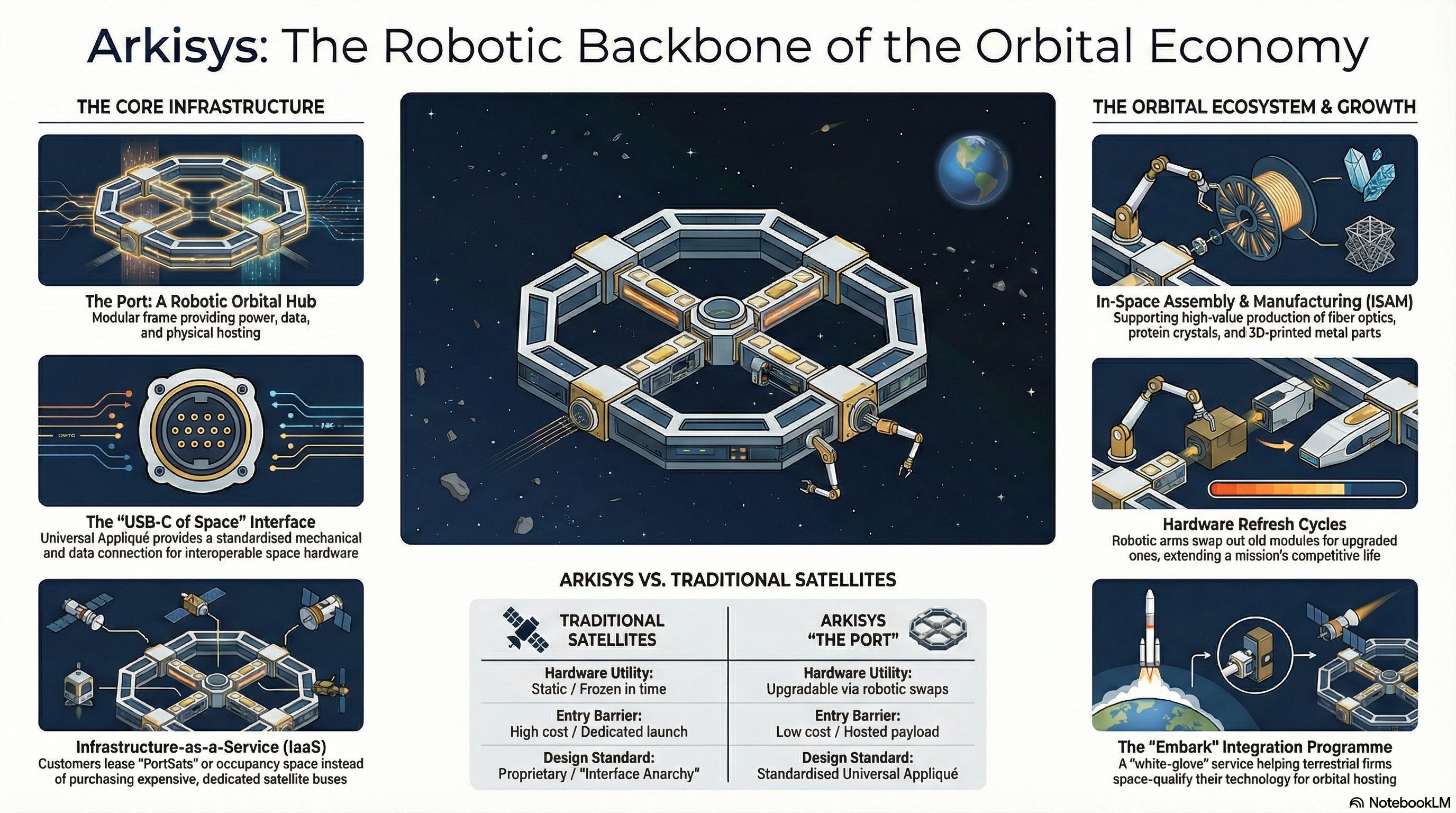
By developing The Port, a long-duration robotic platform, Arkisys is seeking to transition the industry from static hardware to an upgradable, reusable, and interoperable orbital ecosystem.
With over $1.6M in Space Force contracts and partnerships across the “NewSpace” supply chain, Arkisys is moving beyond hosting to become a backbone of in-space assembly and manufacturing (ISAM).
I. Business Overview
Core Value Proposition:
A robotic “garage and data hub” in orbit.
Arkisys provides the physical interface (The Appliqué), power, and data for hosted payloads, allowing customers to fly missions without building a dedicated satellite bus.
Revenue Model:
Infrastructure-as-a-Service (IaaS) and Lease-based services.
This includes “Lease-back” options where customers pay for occupancy and “PortSats” (modular satellites) that can be leased rather than purchased.
Key Assets:
The Port architecture (modular ESPA-Grande based frame)
Universal Appliqué interface (standardized mechanical/data connection),
Embark Program (low-cost flight opportunities for SBIR/STTR winners).
Limitationz:
Early-stage deployment.
Until the first “Port” is fully operational in LEO (targeted 2026), the revenue is primarily R&D contracts and “pre-flight” integration fees.
The model requires high initial CapEx to establish the “anchors” of the network.
II. Relevant Potential Industry Pain Points
While the demand for on-orbit servicing is growing, several friction points hinder the transition from Earth-based manufacturing to In-Space Assembly (ISAM):
“Interface Anarchy”:
Many satellite manufacturers use proprietary docking and data ports.
Opportunity: Arkisys can establish the Appliqué as the “USB-C of Space,” monetizing the licensing of this interface to component manufacturers so they are “Arkisys-Ready” before launch.
High Barrier to Entry for “Non-Space” Tech:
Companies with great terrestrial tech (e.g., AI chips, biotech) find the cost of a dedicated satellite launch prohibitive.
Opportunity:
Use the Embark Program as a “Boutique Accelerator,” offering end-to-end integration and “space-qualification-as-a-service” for non-traditional aerospace firms.
The “Static Asset” Risk:
Once a satellite is launched, its hardware is frozen in time.
Opportunity:
Arkisys can offer Hardware Refresh Cycles.
Customers can send up upgraded modules (via cargo missions) that robotic arms on The Port swap out, extending the mission’s competitive life.
Debris & Sustainability:
Increasing LEO congestion makes “disposable” satellites a liability.
Opportunity:
Position The Port as an Orbital Recycling Center.
By providing a place where old satellites can be “parted out” or refueled, Arkisys could capture value from the circular space economy.
III. Possible Growth Strategies
A. “Orbital Marketplace” Model
Arkisys could evolve into a platform that facilitates the exchange of resources in orbit.
Resource Monetization (Power/Data/Storage):
Implement a “Pay-as-you-go” utility model.
A customer might lease 100W of peak power during an experiment or 1TB of edge computing storage, similar to AWS Spot Instances.
On-Platform Marketplace:
Facilitate “Lease-back” revenue sharing.
If a customer’s hosted camera is idle, another customer on The Port (or on Earth) could “rent” its data stream for a fee, with Arkisys taking a transaction cut.
B. Data & “Digital Twin” Integration
Pre-Flight Digital Sandbox:
Provide a high-fidelity simulation environment where engineers can “digitally dock” their payload to The Port.
This reduces integration risk and onboards customers into the Arkisys ecosystem months before hardware is shipped.
Mission Intelligence:
Sell data on orbital environmental conditions (thermal, radiation, vibration) collected by The Port’s sensors to help future manufacturers design more resilient components.
C. Deep Robotic Integration
“Cutter” Fleet Expansion:
Deploy a fleet of small “Cutter” tugs (Orbital Transfer Vehicles) that can retrieve satellites from different orbits and bring them back to The Port for servicing.
Assembly-as-a-Service:
Instead of launching a massive, folded telescope, Arkisys could launch it in “flat-pack” modules and use The Port’s robotics to assemble it in a zero-gravity environment, bypassing rocket fairing constraints.
IV. Growing Supplier & Payload Categories
Arkisys could prioritize onboarding partners in these “hyper-growth” categories to maximize occupancy and utility of The Port:
In-Space Manufacturing (ISM) Modules:
Payloads designed to grow protein crystals, manufacture fiber optics, or 3D-print metal parts in microgravity.
Edge Computing & AI Accelerators:
As satellites generate more data, they need local “cloud” processing. The Port can act as an Orbital Data Center.
Optical/Laser Comm Terminals:
High-speed data backhaul for the mega-constellations. The Port can serve as a “Network Switch” in the sky.
Refueling & Propellant Depots:
Hosting “tanker” modules that allow visiting vessels (OTVs) to top off their propellant, extending their mission life.
Biotech & Pharmaceutical Labs:
Automated labs that take advantage of the unique microgravity environment for drug discovery, with the potential for “return-to-Earth” capsule services.
V. Target Customer Segments & Acquisition Strategy
A. Possible Early Adopters
The “Valley of Death” Component Innovators
These are the hundreds of startups developing NewSpace hardware such as electric propulsion systems, star trackers, or laser communication terminals that have reached a technical plateau.
They have successful ground-test data but cannot secure Tier-1 prime contracts because they lack “flight heritage.”
For these companies, Arkisys could be a validation engine. They are desperate for low-cost, high-frequency access to space environments to prove their hardware works in a vacuum.
In-Space Assembly and Manufacturing (ISAM) Pioneers
Companies focused on microgravity-enabled production (fiber optics, protein crystals, or 3D-printed structures) represent the highest-value long-term tenants.
Unlike a traditional satellite that needs to move, these labs require stability, high power, and massive heat dissipation; all things that are difficult to manage on a small standalone satellite but easy for a large-scale Port.
They are likely early adopters because they need the “garage space” and robotic assistance that only a persistent platform can provide.
Department of Defense (DoD) & Tactical Edge Units
Government agencies like the Space Development Agency (SDA) or AFRL are increasingly moving toward “Hybrid Space Architecture.”
They require “persistent tactical nodes” that can host classified sensors or edge-computing stacks.
Arkisys could represent a “Neutral Ground” where the government can rapidly swap out sensor packages as geopolitical needs change, without the three-year lead time of a traditional satellite procurement cycle.
B. The “Interface-First” Attraction Strategy
Standardization as a Sales Moat
Arkisys key challenge is to lower the “engineering friction” of space access.
The core strategy could be the aggressive distribution of the Universal Appliqué interface.
By providing the CAD models and electrical specifications of this interface for free to the industry, Arkisys could create a “Design-In” effect.
Arkisys can essentially aim to become the “Operating System” that the hardware runs on.
The “Embark” Integration Program
To maximize early adoption, Arkisys uses its Embark Program to act as a technical concierge.
This strategy involves “white-glove” service where Arkisys engineers assist the customer in miniaturizing their terrestrial tech for orbital hosting.
By reducing the complexity of thermal management and power regulation for the customer, Arkisys accelerates the sales cycle from years to months.