Commercializing Space Plant Breeding [Strategy]
To maximize the Return on Investment (ROI) of an orbital mission, researchers may choose to focus on “Strategic Staples” and “High-Value Specialty” crops.

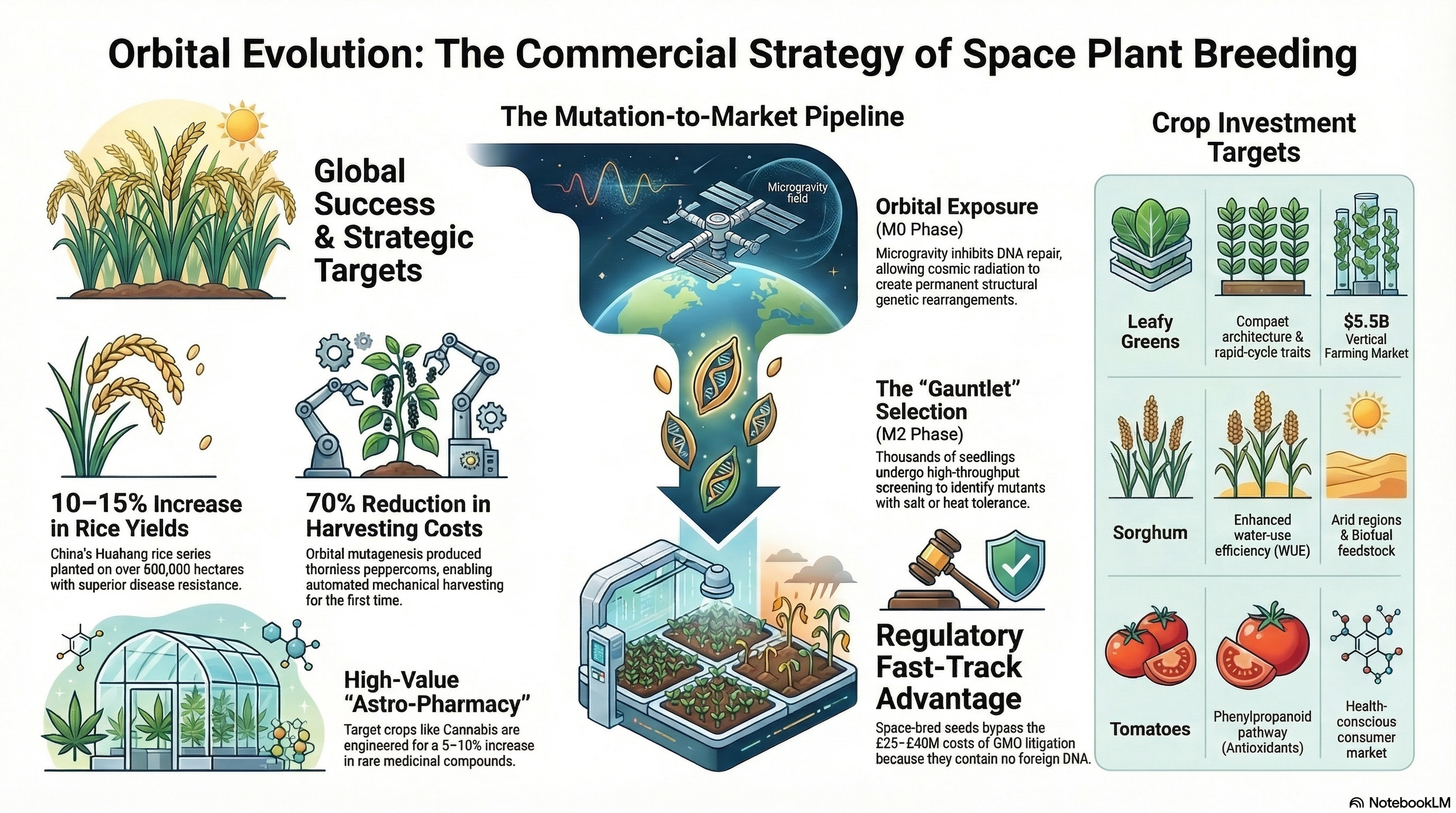
This article outlines the emerging frontier of Orbital Plant Breeding, a high-leverage strategy that utilizes the extreme environment of space to accelerate agricultural evolution.
We analyze the global success stories where space-bred crops have already achieved industrial scale, identify high-probability crop targets for investors and researchers (ranging from climate-resilient staples to vertical farming accelerators) and detail an example end-to-end operational protocol.
By synthesizing the biological mechanics of space radiation with a commercial “Mutation-to-Market” pipeline, this framework provides a roadmap for developing the next generation of resilient, high-yield germplasm.
I. Global Success Stories (From Orbit to Field)
While many nations participate in space biology, the commercial translation of space-bred crops has reached industrial scale primarily in Asia, with recent expansion by international agencies.
1. China’s “Huahang” Rice Series
China is the world leader in space breeding, having launched seeds on over 30 missions since 1987.
The Success:
The Huahang-1 and Huahang Simiao rice varieties were developed from seeds flown on Shijian satellites.
Commercial Translation:
Huahang Simiao is estimated to have been planted on over 600,000 hectares.
It offers a 10–15% yield increase and superior disease resistance.
Farmers report earning significantly more per hectare due to the “premium” grain quality and reduced need for chemical pesticides.
2. The “Thornless” Peppercorn (Big Red Robe)
Mutagenesis often yields unexpected morphological changes that simplify industrial processing.
The Success:
Seeds of the Piperis dahongpao (Big Red Robe peppercorn) were sent into orbit to improve yield. Researchers discovered a mutant where the sharp thorns on the stems had completely disappeared.
Commercial Translation:
This variety is currently undergoing mass field testing.
The removal of thorns allows for automated mechanical harvesting, which is expected to reduce labor costs by 70% and revitalize the peppercorn industry in Shaanxi province.
3. Singapore’s “Space Coriander”
In 2021, the “Asian Herb in Space” (AHiS) project sent coriander seeds to the ISS.
The Success:
Upon return, the space-flown seeds produced plants with 25% higher luxuriant yield (41.4g vs 33.1g) compared to Earth-bound controls.
Commercial Translation:
Genetic analysis revealed hundreds of activated genes associated with growth.
This has sparked a “Space-to-Salad” commercial pipeline aimed at high-efficiency vertical farming in land-scarce Singapore.
II. Strategic Crop Selection (High-Probability Targets)
To maximize the Return on Investment (ROI) of an orbital mission, researchers may choose to focus on “Strategic Staples” and “High-Value Specialty” crops.
1. Sorghum (The Climate Vanguard)
Rationale:
Sorghum is already a “tough” crop, naturally resilient to heat.
Space-induced mutations that further enhance its water-use efficiency (WUE) or C4 photosynthetic pathway could create a “zero-irrigation” cereal for arid regions.
Commercial Value:
Highly relevant to the African and Australian markets; serves as both a food staple and a high-energy biofuel feedstock.
2. Rice and Wheat (The Caloric Anchors)
Rationale:
As the source of 60% of human calories, even a 2% yield increase via mutation has massive economic implications.
Space radiation is particularly effective at altering panicle architecture (number of grains per head).
Commercial Value:
Universal demand ensures that any stable “Space-Variant” could be integrated into global seed supply chains (e.g., Bayer or Syngenta portfolios).
3. Tomato and Pepper (The “Astro-Pharmacy”)
Rationale:
These crops have high phenotypic plasticity, meaning they show mutations easily.
Researchers target the Phenylpropanoid Pathway to boost antioxidants (Lycopene) and vitamins.
Commercial Value:
“Space-Fortified” produce may command a premium in the health-conscious consumer market and provide essential nutrition for future long-duration space missions.
4. Leafy Greens & Micro-Brassicas (The “Vertical Farm” Accelerators)
Rationale:
These crops are the backbone of modern indoor agriculture.
Researchers use space mutagenesis to target “Compact Architecture” genes (dwarfism) and “Rapid-Cycle” traits.
In microgravity, plants often experience altered cell wall tension; by selecting for mutants that thrive under these stresses, we could develop varieties that require less physical space and possess a higher “Harvest Index” (ratio of edible biomass to waste).
Commercial Value:
Directly targets the $5.5 Billion Vertical Farming market.
Reducing the time-to-harvest by even 15% significantly lowers electricity and HVAC costs for urban farm operators, making local greens more price-competitive with field-grown produce.
5. Medicinal Cannabis & High-Value Aromatics (The “Metabolic Bioreactor”)
Rationale:
High-LET radiation is uniquely capable of disrupting complex metabolic pathways.
For medicinal crops, the goal is to trigger “Secondary Metabolite Over-Expression.”
By damaging the genes that normally suppress terpene or cannabinoid production, space-flown seeds could produce offspring with “extreme” chemical profiles; increasing the concentration of rare compounds like CBG or THCV that are difficult to synthesize terrestrially.
Commercial Value:
The pharmaceutical and wellness industries pay high premiums for concentrated botanical extracts.
A space-mutated strain with a stable 5–10% increase in active compounds potentially represents a massive IP advantage for biopharma companies looking to optimize extraction efficiency.
III. Strategic Protocols (From Selection to Market)
Transitioning a seed from a terrestrial “Elite Line” to a space-born commercial variety is a multi-year, precision-engineered process. Each stage from M0 (Original Seed) to M5 (Certified Variety) is designed to isolate rare, beneficial mutations from the “genetic noise” of space radiation.
1. M0 Phase (Selection and Pre-Flight Optimization)
Before a seed leaves the atmosphere, it must be prepared to survive the physical stressors of launch and the vacuum of orbit.
Elite Parental Line Screening:
Researchers do not typically use “wild” seeds.
They select varieties that are already high-performers (Elite Lines) but possess a single specific deficit, such as a lack of heat tolerance or a “lodging” issue (plants that grow too tall and fall over).
Uniformity Check:
Seeds must be genetically homogeneous to ensure any post-flight variation is a result of space exposure rather than pre-existing diversity.
Moisture Equilibration (Desiccation):
Seeds are kept in desiccators (often with glycerol) to reach a moisture content of 12–15%.
This is the “Goldilocks Zone”: dry enough to prevent internal ice crystals or “pressure-boiling” in a vacuum, but hydrated enough to allow the chemical DNA-repair signaling required for “stable” mutations.
2. Orbital Exposure (The Genetic Forge)
Once in orbit, the seeds act as biological targets for High-LET (Linear Energy Transfer) cosmic rays.
Passive Dosimetry Mapping:
TLDs (Thermoluminescent Dosimeters) and CR-39 plastic trackers are interleaved between seed layers.
This creates a “Radiation Topography,” allowing scientists to identify which specific vials received the highest energy “hits” from heavy ions like Iron.
Synergistic Stress:
The seeds aren’t just hit by radiation; they are in Microgravity.
Research suggests Microgravity inhibits the plant’s Nucleotide Excision Repair (NER) proteins.
This “stalls” the cell’s ability to fix DNA breaks, allowing complex structural rearrangements (mutations) to become permanent.
3. M1 Generation (The Somatic Screen)
The first generation grown on Earth is the M1. At this stage, the plant is a “chimera”; different cells contain different mutations.
Lethality Titration:
Not every seed survives.
Breeders look for a 30–50% mortality rate (the LD50).
If too many seeds survive, the radiation dose was too low; if too few survive, the damage was too “deleterious” (destructive).
Somatic Observation:
M1 plants often show “shook” phenotypes; stunted growth, leaf spotting, or sterility.
These are usually not heritable.
The goal of the M1 is simply to reach flowering and produce the M2 seeds, which carry the stable germline mutations.
4. M2 & M3 Generations (The Breakthrough Selection)
The M2 generation is the most critical. This is where recessive mutations (the most common type) finally pair up and become visible.
High-Throughput Phenotyping (HTP):
Thousands of M2 seedlings are screened using “Plant-Eye” sensors and UAVs (drones).
Salinity Gauntlet:
Seedlings are grown in saline-doped hydroponic trays.
High-speed cameras identify “Salt-Sponge” mutants; plants that maintain green, active leaves while others turn yellow.
Architecture Screening:
For vertical farming, AI identifies “Dwarf Mutants” that exhibit high leaf density but a 20% shorter stalk.
M3 Stabilization:
Selected M2 plants are self-pollinated to produce the M3 generation. This step confirms the trait is “fixed” and not just a one-off environmental fluke.
5. M4 to M5: Anchoring and Global Market Launch
By the M4 generation, the breeder has a stable “Space-Line.” Now, it must be refined for commercial reality.
Marker-Assisted Backcrossing (MABC):
The space mutant is crossed back with the original M0 Elite Parent.
This “anchors” the new space-trait into the parent’s high-yield background while stripping away any “Background Noise” (unwanted random mutations that might affect flavor or grain size).
Regional DUS Trials:
To be registered, the seed must pass DUS Testing (Distinctness, Uniformity, and Stability).
The M5 generation is grown in multiple climatic zones (e.g., coastal vs. arid) to prove the trait holds up in real-world soil.
Intellectual Property & Registration:
The variety is submitted to national registries and international bodies like UPOV (International Union for the Protection of New Varieties of Plants).
Once certified, the “Space-Seed” can potentially be licensed to commercial distributors like Bayer or regional cooperatives.
IV. Hypothetical Case Study
This hypothetical case study outlines a high-efficiency strategic mission to engineer salt-tolerant Sorghum bicolor using the Genesis SFL GEN-1P recovery capsule.
By targeting the coastal regions of sub-Saharan Africa, this mission aims to generate a “Space-Hardened” variety capable of thriving in marginal, saline-heavy soils.
1. ROI Rationale
Target Market:
$30 million hectares of saline-degraded land in sub-Saharan Africa.
Value Add:
A 10% yield increase in these regions represents a $200M annual increase in regional food security value.
Cost Efficiency:
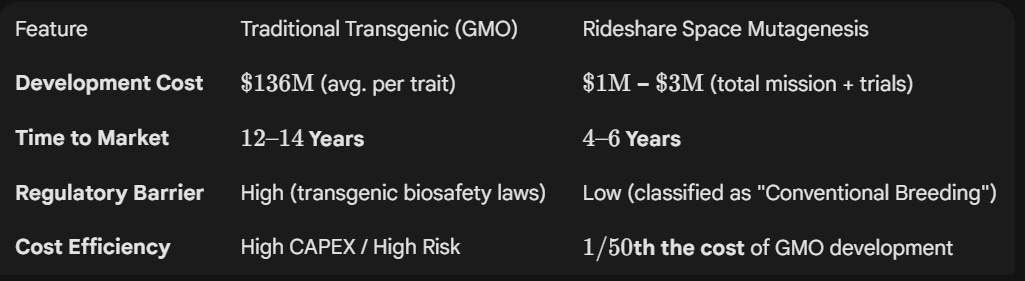
By using a Rideshare Mutagenesis model on a GEN capsule, the cost per “successful mutation” is estimated to be 1/50th the cost of traditional transgenic (GMO) development.
The “Rideshare” Advantage:
By utilizing standardized reentry capsules (like the Genesis SFL GEN-1P), researchers no longer need to launch dedicated satellites.
They pay for a “seat” on a shared mission, reducing launch costs to a fraction of traditional aerospace budgets.
Regulatory Fast-Track:
Space-mutated seeds do not contain “foreign” DNA (transgenes).
Because they are created through physical radiation (a process that mimics natural cosmic mutation but at an accelerated rate) they are generally regulated as Conventional Varieties.
This eliminates the $30-50M typically spent on GMO biosafety litigation and testing.
2. Payload Specifications
Primary Biomaterial: 5,000 elite seeds of Sorghum bicolor (Variety: BTx623 - fully sequenced genome).
Mass: 2.5 kg (inclusive of housing and sensors).
Orbital Profile: Sun-Synchronous Orbit (SSO), 550 km altitude.
Mission Duration: 180 Days (Approx. 2,800 orbital revolutions).
Radiation Target: 15-20 mGy (estimated cumulative dose of HZE particles).
3. The Hardware (“The Orbital Nursery”)
The seeds will be housed in a specialized Genomic Exposure Module (GEM) within the GEN capsule, utilizing the following enabling technologies:
Z-Gradient Shielding:
The canister uses a 3D-printed aluminum-polyethylene lattice.
This allows high-energy Iron ions to penetrate while filtering out low-energy solar protons that cause thermal damage without genetic benefit.
Atmospheric Buffer:
A semi-permeable ceramic membrane maintains a 101.3 kPa internal pressure with 20% O2 to prevent embryo desiccation in the vacuum of space.
In-Situ Dosimetry:
Passive CR-39 plastic detectors will be interleaved with the seed layers to record the “track” of every heavy-ion strike, providing a map for post-flight genetic targeting.
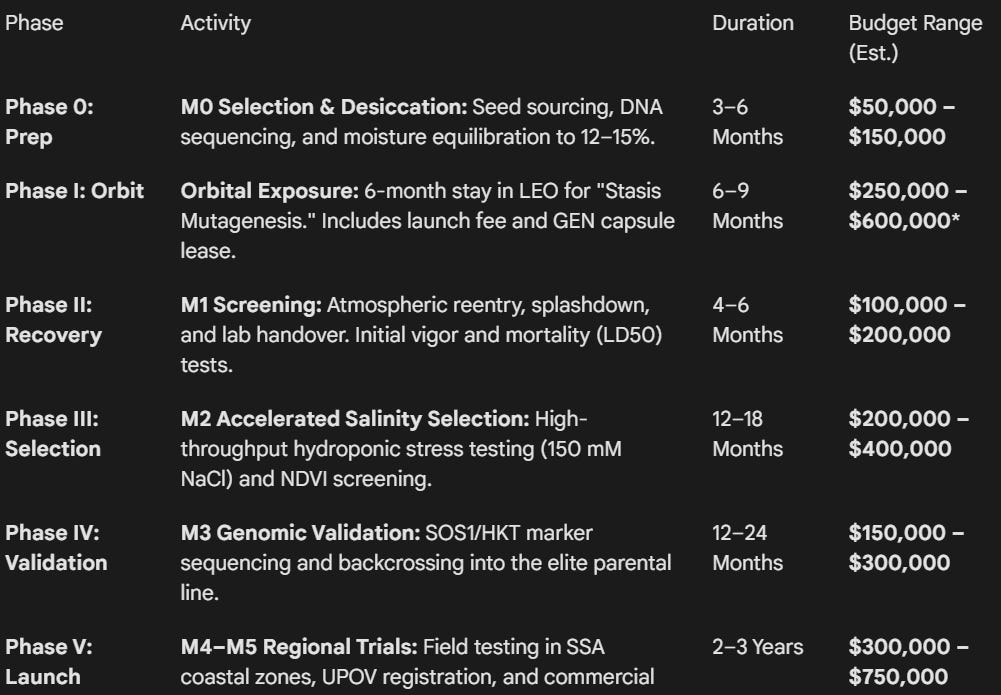
4. Experimental Protocol (The “Mutation-to-Market” Pipeline)
Phase I: Orbital Exposure (M0 Phase)
During the 6-month stay, the seeds undergo “Stasis Mutagenesis.”
Unlike terrestrial labs, the Microgravity environment inhibits the seed’s natural Nucleotide Excision Repair (NER) pathways, allowing complex double-strand breaks to remain “open” for structural rearrangement.
Phase II: Post-Flight Recovery & M1 Screening
Upon splashdown and recovery of the GEN capsule:
Vigor Testing:
Seeds are germinated in a controlled environment. We expect a 40% “M1 Mortality Rate”; the indicator of high-impact mutagenic success.
Biomass Analysis:
M1 plants are grown to maturity.
While they may appear “messy” (chimeric), their seeds (M2) carry the stable, heritable changes.
Phase III: Accelerated Salinity Selection (M2 Phase)
This is the critical commercial gate. 100,000 M2 seeds are subjected to “The Gauntlet”:
Hydroponic Stress:
Seedlings are grown in water with a 150 mM NaCl concentration (simulating high-saline coastal soil).
Automated NDVI Screening:
Using infrared sensors to identify the top 0.1% of “Green Survivors”; plants that maintain high photosynthetic activity despite salt stress.
Phase IV: Genomic Validation (M3 Phase)
The survivors are sequenced to identify the specific genetic “hits.”
Targeted Trait:
Looking for mutations in the SOS1 (Salt Overly Sensitive) gene or the HKT transporter family.
Marker-Assisted Backcrossing:
The “Space-Hit” is crossed back into the original parental line to ensure the plant retains its high yield while keeping the new salt-tolerance trait.
Est. Timelines & Budgets