
Digital Twins for Microgravity Experiments [Strategy]
Rather than just a 3D visualization, high-value missions could treat Digital Twins (DT) as a multi-functional tool that enhances every stage of the experiment lifecycle.

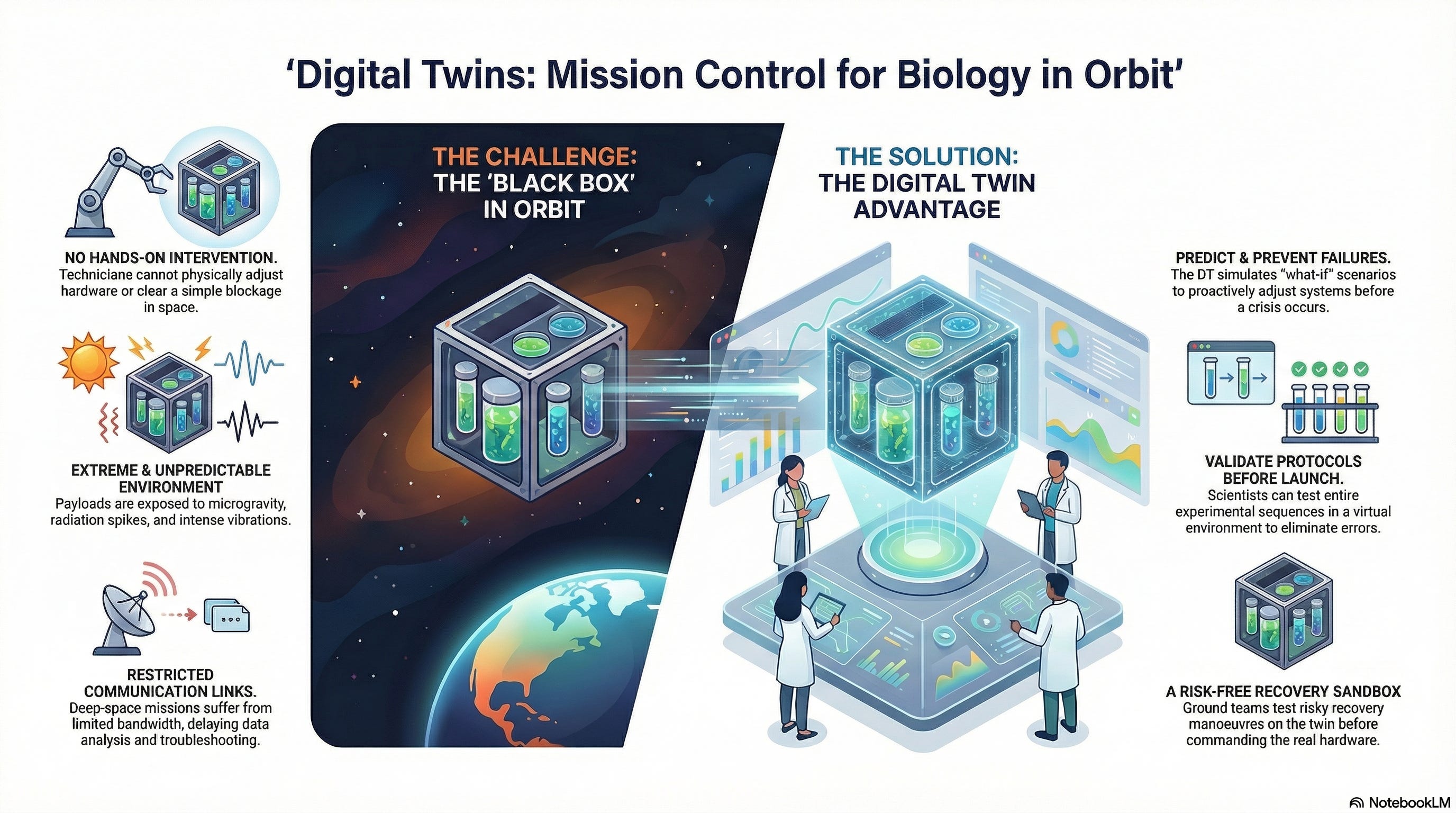
Unlike terrestrial labs, where a technician can clear a clogged pipette or reboot a centrifuge, space-based biological experiments tend to operate within an autonomous “black box.”
In orbit, the Digital Twin (DT) is a primary interface through which we can understand and protect delicate biological payloads.
Unlike terrestrial labs where a technician can manually intervene, space-based systems must prioritize predictive autonomy.
By rigorously identifying biological and mechanical failure modes and managing the “data-fidelity” trade-off, innovators can potentially build digital twins that don’t just monitor, but proactively “heal” the experiment through predictive adjustments.
I. Strategic Benefits of DT integration
Rather than viewing a DT as just a 3D visualization, high-value missions could treat it as a multi-functional tool that enhances every stage of the experiment lifecycle.
Predictive Biology & “What-If” Modeling: The DT simulates how cellular cultures might react to radiation spikes or fluid shifts before the physical change occurs. This can allow the system to preemptively adjust nutrient flow or thermal setpoints, reducing sample loss due to late-stage biological anomalies.
Virtual Commissioning & Protocol Validation: Scientists can “test run” the entire experimental protocol in a simulated microgravity environment. This eliminates logic errors in automated pipetting, centripetal movements, or complex fluidic sequences before the hardware ever leaves the ground.
Intelligent Telemetry Compression: In deep-space missions with restricted bandwidth, the DT serves as a filter. Instead of sending raw data, the system only downlinks “deviations” from the twin’s predicted model. This maximizes data throughput on low-bandwidth links like the Deep Space Network.
Remote Expertise & Risk-Free Sandboxing: Ground teams can interact with the twin to troubleshoot anomalies in real-time. This provides a safe “sandbox” to test risky recovery maneuvers or software patches before uploading commands to the physical hardware.
II. DT Features to Consider
1. High-Fidelity Physics & Microgravity Modeling
Terrestrial twins often assume constant gravity (1g), but a space-bio twin must account for the physical shifts that occur when buoyancy and convection disappear.
Delta-to-Gravity Analytics: Extract and measure gravity-driven differences in cellular morphology and fluid behavior. This feature allows you to quantify exactly how your experiment deviates from Earth-based controls.
Surface Tension & Capillary Dominance: In microgravity, the Reynolds number remains relevant, but the lack of buoyancy makes surface tension the primary force. The DT must model bubble formation and gas-liquid interfaces to prevent “dead zones” in microfluidic channels.
Reduced Order Modeling (ROM): Compress complex 3D fluid simulations into lightweight, mathematical “compact models.” These ROMs can run on low-power flight hardware in real-time, providing high-fidelity physics without the high-compute cost.
2. Autonomous Resilience & FDIR
Because of the “Black Box” nature of space payloads, the DT must be able to act when the ground team is out of contact.
Adaptive Anomaly Classification: Instead of simple “out-of-range” alerts, the DT could use machine learning (similar to the AI4LS frameworks) to distinguish between a sensor failure and a biological crisis.
Closed-Loop “Self-Healing”: If the twin detects a temperature drift or a nutrient pH shift, it should autonomously adjust the heater duty cycle or pump speed before the biological sample reaches a point of “metabolic drift.”
Virtual Redundancy (Sensor Fusion): If an Optical Density (OD) sensor fails, the DT should “reconstruct” the missing data by fusing inputs from electrical impedance and metabolic heat-map sensors.
3. Predictive Biology & In-Silico “What-If” Analysis
The twin can serve as a sandbox to test interventions before they are executed on the physical hardware.
Metabolic Forecasting: By integrating multi-modal data (gene expression, imaging, and sensor telemetry), tools can predict cellular deconditioning. This allows the DT to forecast when a culture will reach its peak viability.
Radiation-Induced Drift Modeling: The DT should track the cumulative radiation dose (in Grays) and simulate how high-LET (Linear Energy Transfer) particles might induce DNA damage or metabolic oxidative stress.
Sandboxing Recovery Maneuvers: If a mechanical jam occurs, ground teams use the DT to simulate a high-pressure pulse to clear the blockage. This ensures the pulse won’t rupture delicate cellular membranes before the command is sent to the station.
III. Maximizing Value Through the “Digital Thread”
The true value of a DT is realized when it is treated as a living document that evolves throughout the experiment lifecycle, rather than a static model.
1. Accelerated R&D Cycles via Virtual Prototyping
Instead of building five expensive physical prototypes to test thermal insulation or fluidic pressure, engineers can run thousands of “Monte Carlo” simulations on the DT.
Optimization of the “Sweet Spot”: Simulations can identify the exact point where mass is minimized without sacrificing the strict thermal stability required for protein crystallization or mammalian cell health.
Stress Testing Environmental Extremes: Virtual twins allow teams to subject the experiment to “worst-case” radiation or vibration profiles that would be too costly or dangerous to replicate physically on Earth multiple times.
2. Latent Data Mining & Post-Mission Forensics
The most significant scientific breakthroughs often come after the mission by analyzing the “Delta” between the twin’s prediction and the actual telemetry.
Identifying Microgravity Signal: By comparing the “Perfect Mission” twin data with the “Actual Mission” data, scientists can isolate subtle microgravity effects that weren’t the primary focus of the study, such as unexpected changes in cellular signaling or fluid viscosity.
Failure Forensics: If a mission fails, the DT provides a high-fidelity playback environment. By re-running the telemetry through the twin, engineers can pinpoint whether the failure was a mechanical fatigue issue or a biological response to an unforeseen environmental variable.
3. Knowledge Transfer & “Meta-Twins”
High-value DT architectures are designed to be modular, allowing the intelligence gained from one mission to bootstrap the next.
Retrainable Models: A fluidic model designed for a yeast experiment on the ISS can potentially be “retrained” using AI for a human heart-on-a-chip experiment on the Lunar Gateway.
Reducing Cost-Per-Science-Unit: By reusing the underlying software backbone (the “Meta-Twin”), organizations drastically reduce the engineering overhead for subsequent launches, moving toward a “plug-and-play” model for orbital biology.
IV. Minimum Viable Fidelity (MVF)
Innovators must avoid “Over-Engineering.” The goal is not to simulate every atom, but to achieve enough fidelity to prevent the most common failures in microgravity experiments:
Mechanical Failure: Clogged fluid lines, pump cavitation, and thermal runaway.
Biological Failure: Nutrient starvation, CO2 toxicity, and unexpected cellular mutations.
Example requirements:
Fluidic Fidelity:
Baseline (Insufficient): Binary “Flow On/Off” data.
MVF (Target): P-Q Curve modeling with air-bubble detection logic.
Excessive (Over-Engineered): Full Navier-Stokes Computational Fluid Dynamics (CFD).
Biological Fidelity:
Baseline (Insufficient): Temperature and pH monitoring only.
MVF (Target): Metabolic Flux modeling plus $CO_2$ diffusion simulation.
Excessive (Over-Engineered): Real-time single-cell RNA-seq simulation.
Power & Environmental:
Baseline (Insufficient): Simple Voltage/Current logs.
MVF (Target): Thermal Gradient Safety Envelope with predictive throttling.
Excessive (Over-Engineered): Atomic-level battery degradation or solar-cell efficiency modeling.
V. Buy vs. Build
In the context of space biology, the decision to build a proprietary twin versus purchasing a commercial license hinges on the uniqueness of the biological payload and the mission’s risk tolerance.
A. Building Proprietary Digital Twins
Novel Biological Logic: If the experiment involves a proprietary cell line or a “first-of-its-kind” tissue-on-a-chip, building a custom twin allows for the integration of unique metabolic pathways that commercial tools may not yet support.
Deep Hardware-Software Co-Design: Building is essential when the sensors are experimental (e.g., custom quantum sensors for gravity detection). A custom DT can be mapped 1:1 to the hardware’s unique electrical architecture.
Absolute Data Sovereignty: For missions involving classified research or high-value pharmaceutical IP, building an in-house twin ensures that sensitive “Digital Thread” data never crosses into a third-party cloud environment.
Optimization for Edge Compute: Custom twins can be “lean-coded” to run on specific radiation-hardened flight processors with limited RAM, avoiding the overhead of heavy commercial software suites.
B. Buying Off-the-Shelf (COTS) DT Tools
Standardization & Speed: Leveraging existing platforms can reduce the development lifecycle from years to months, utilizing pre-validated physics engines for fluid dynamics and thermal regulation.
Proven Reliability: COTS tools have been “vetted” by thousands of terrestrial use cases. In space, where software failure is as dangerous as hardware failure, using a mature platform reduces “logic risk.”
Lower Upfront Capital Expenditure: Buying allows teams to shift costs from R&D (hiring specialized software engineers) to Operational Expenditure (licensing), which is often more palatable for grant-funded or venture-backed missions.
Access to Ecosystems: Many “Buy” solutions come with pre-built APIs for the International Space Station (ISS) or commercial stations (like Axiom or Orbital Reef), simplifying the “Last Mile” of integration.
VI. Service Providers & Specialized Tools
1. Space-Native Simulation & Optimization Platforms
These tools could bridge the “Gravity Gap” between Earth-based labs and orbital reality.
G-Space (ATOM Platform): G-Space is a potential critical “Buy” option for those focusing on microgravity manufacturing and biology. Their ATOM (Advanced Theoretical Orbital Manufacturing) platform uses AI to predict how materials and biological samples behave when gravity is removed. It serves as a “Pre-Flight Twin,” allowing scientists to optimize experimental parameters on Earth to ensure success in orbit.
Yuri Gravity: Offers “Science-as-a-Service,” providing modular bioreactor hardware and the digital interface to manage them. Their platform acts as a bridge, offering standardized DT capabilities for protein crystallization and cell culture.
2. High-Fidelity Physics & Multiphysics Engines
These tools could be used to build the “Physics” of the Digital Twin.
Ansys Twin Builder: A leader in creating “Reduced Order Models” (ROMs). This is vital for space biology because it allows complex fluid simulations (like blood flow through a microfluidic chip) to be compressed into a lightweight model that can run on a satellite’s “Edge” computer.
Siemens Simcenter (Xcelerator): Excellent for “Mechanical Twins.” It allows engineers to simulate the vibrational stresses of launch and the thermal shifts of the orbital day/night cycle on the biological payload.
Dassault Systèmes (3DEXPERIENCE): Their “Living Heart” and “BIOVIA” platforms allow for the creation of high-fidelity biological twins, simulating how human tissues react to drugs in a simulated environment before physical testing.
3. IoT Backbone & Data Orchestration
These platforms could handle the “Telemetry Thread” between the physical experiment and the ground-based twin.
AWS IoT TwinMaker: This tool allows teams to aggregate data from disparate sensors (visual, thermal, pH) and create a 3D visual representation of the experiment that ground teams can use for troubleshooting.
Azure Digital Twins: Provides a robust framework for modeling the relationships between different subsystems. For example, mapping how a power dip in the satellite’s main bus will affect the incubator’s temperature stability.
4. Predictive Biology & In-Silico Discovery
These tools could provide the “Predictive Brain” for the Digital Twin.
Schrödinger: Used for molecular-level twins. It could simulate how molecules interact in microgravity, which is essential for pharmaceutical experiments focusing on protein crystal growth.
Insilico Medicine: Uses Generative AI to predict biological “drift.” This could help the Digital Twin identify when a cell culture is deviating from its expected growth curve due to microgravity-induced stress.
VII. Example Implementation
Phase 1: The Design Twin (Pre-Flight): Use tools like G-Space to simulate the impact of microgravity on your specific fluidic or biological setup. This identifies “Dead Zones” in microfluidic channels before the hardware is even manufactured.
Phase 2: The Operational Twin (In-Orbit): The twin runs on an Edge Computing module (like an NVIDIA Orin or a rad-hardened equivalent). It uses Ansys ROMs to compare real-time sensor data with the predicted model.
Phase 3: The Recovery Twin (Anomaly Management): If a sensor fails, the AWS IoT TwinMaker dashboard alerts ground teams. The system then uses “Virtual Redundancy” (e.g., using thermal data to estimate oxygen consumption because the O2 sensor died) to keep the experiment viable.
Phase 4: The Meta-Twin (Post-Flight): The data from the mission is fed back into the G-Space ATOM or Siemens engine to refine the models for the next mission, reducing the cost of future R&D.
VIII. Innovations to Reduce DT Costs
1. Standardization & Open-Source Frameworks
The “Build” phase is currently expensive because many teams potentially reinvent the wheel.
Universal Microgravity Physics Libraries: Similar to how the gaming industry uses “Unreal Engine,” the development of open-source libraries specifically for 0g fluidics and surface tension would eliminate the need for custom development.
Standardized Sensor APIs: If commercial providers (like Axiom or Voyager) enforce a standardized data protocol, DTs could be reused across different flight platforms without expensive driver rewrites.
2. Edge-AI & Low-Code DT Builders
The cost of hiring specialized software engineers to translate physics into code is a major bottleneck.
Automated Reduced Order Modeling (ROM): New tools are emerging that can automatically ingest high-fidelity Ansys or Siemens simulations and “shrink” them into flight-ready ROMs with minimal human intervention.
Synthetic Data Generation: Using AI to generate “failures” in a virtual environment allows researchers to train their DT’s anomaly detection without needing years of real-world flight telemetry.
3. Shared Infrastructure (Consortium Models)
Infrastructure sharing allows small labs to access enterprise-grade DT tools.
Multi-Tenant Orbital Edge Compute: Rather than launching a dedicated computer, researchers can rent “slices” of high-performance, rad-hardened servers already on-orbit (like the HPE Spaceborne Computer), paying only for the compute cycles used by their DT.
The “Meta-Twin” Marketplace: A future exchange where researchers can buy or license “pre-validated” digital twins of standard hardware (e.g., a standard peristaltic pump or incubator) to use as building blocks for their specific experiment.