
Intellectual Property (IP) and Space Technology [Strategy]
This guide details a strategic blueprint for managing intellectual property within the rapidly evolving space technology sector.

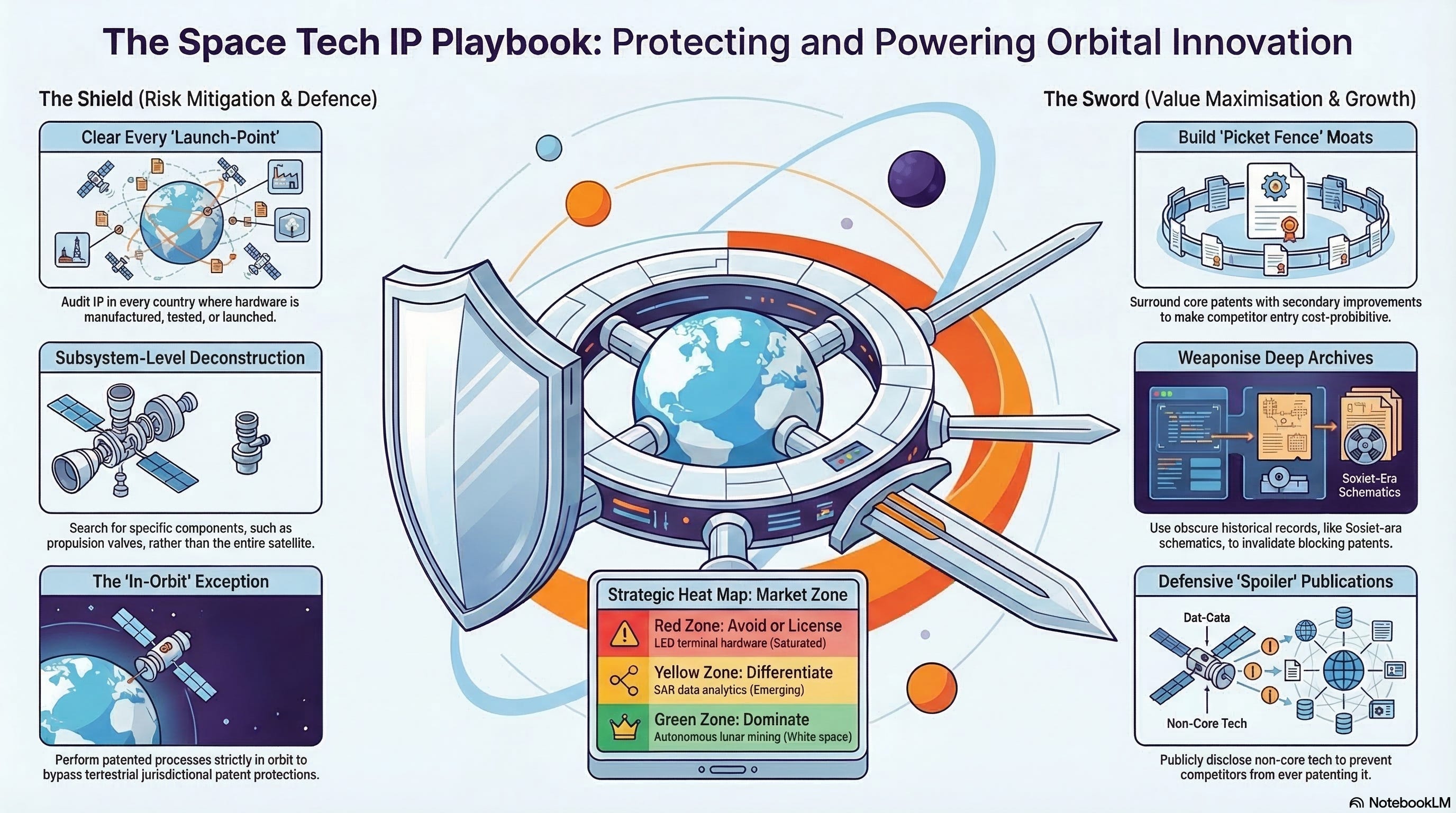
This guide details a strategic blueprint for managing intellectual property within the rapidly evolving space technology sector.
It highlights the importance of Freedom to Operate searches to mitigate legal liabilities and identifies methods for invalidating competitor patents using historical archives.
The text also explains how competitive landscape mapping can reveal untapped market opportunities and potential for collaborative cross-licensing. Furthermore, it distinguishes between patentable innovations and trade secrets, offering advice on cost-effective filing in key global jurisdictions.
Finally, it emphasizes the role of IP insurance and rigorous internal security to protect proprietary advancements from infringement or talent poaching.
I. Key Objectives of a Space Tech Patent Search
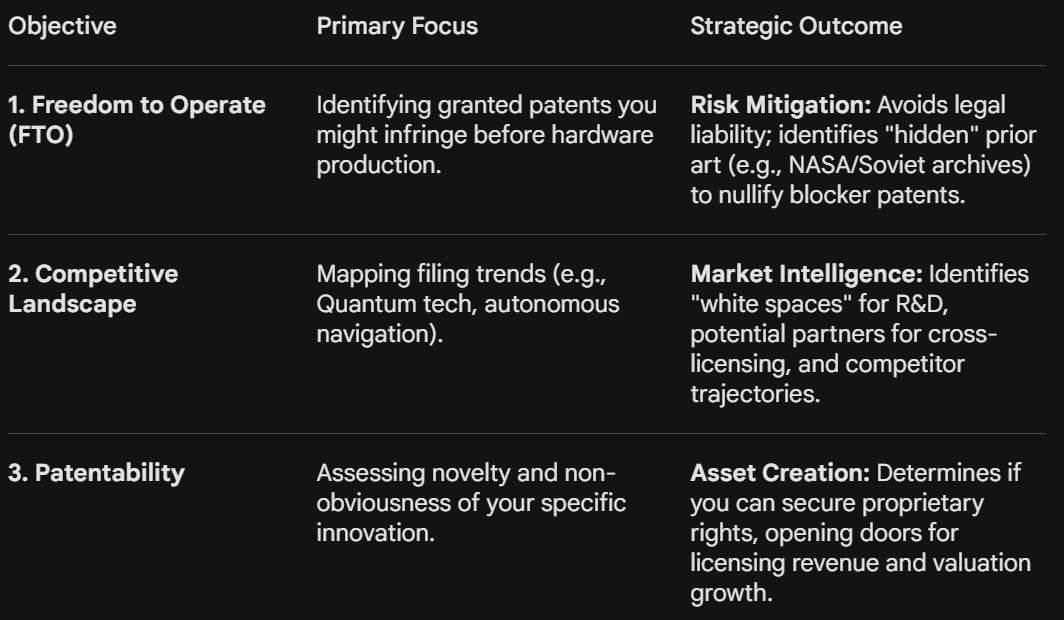
1. Freedom to Operate (FTO)
Before committing to hardware production, an FTO search identifies granted patents that a proposed product might infringe and increase risk to legal liability.
If a competitor’s patent blocks your path, a validity search can seek out “hidden” prior art (old NASA technical reports, Soviet-era schematics, or obscure academic papers) to challenge and potentially nullify that patent to free up your path to commercialization.
2. Competitive Landscape Mapping
Landscape searches provide a bird’s-eye view of who is filing what. In 2026, we see a surge in space-related quantum tech and autonomous navigation patents. Mapping these clusters helps:
Spot potential partners for cross-licensing.
Anticipate the R&D trajectories of competitors like SpaceX, Blue Origin, or emerging state actors.
Identify white spaces (unclaimed technology areas).
3. Patentability (Assessing Novelty & Inventiveness)
This search determines if your innovation (e.g. a new Hall-effect thruster modification or an AI-driven debris tracking algorithm) is truly “new” and “non-obvious” compared to existing public knowledge. This opens up possibilities for patenting and alternative licensing revenue streams.
II. Freedom to Operate (FTO)
Requires moving beyond the “checklist” mentality and treating it as a dynamic risk-mitigation engine.
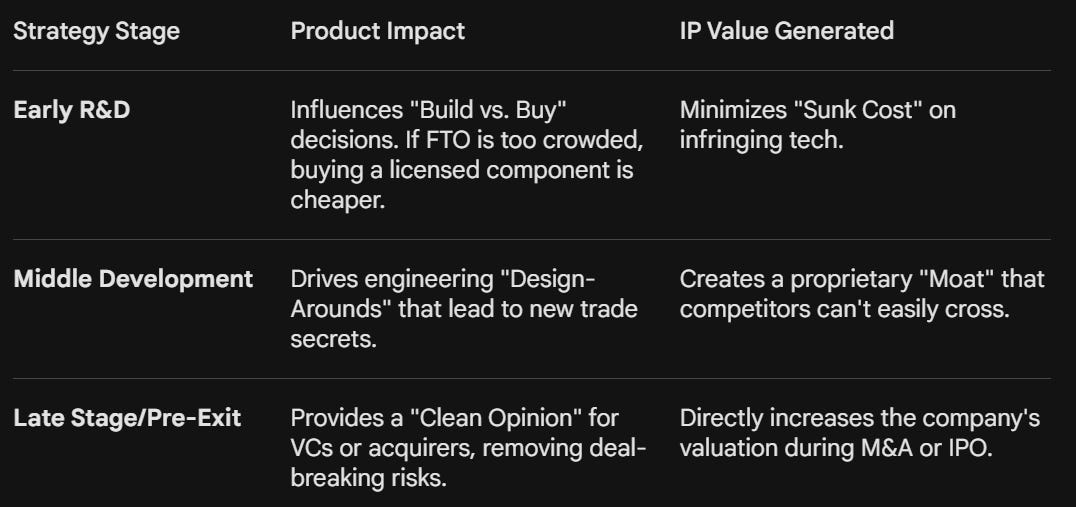
1. Foundational FTO (Minimize Litigation Risks)
At this level, the goal is simple: ensure you don’t get sued the moment you reveal your prototype.
Component-Level Searching:
Do not just search for “the satellite.”
Deconstruct the system into subsystems (e.g., the propulsion valve, the solar array hinge, the telemetry encryption).
The “Launch-Point” Audit:
Because of the Territoriality Gap, you must clear the patent landscape for every country where the hardware “touches the ground.”
If you manufacture in Germany, test in the UK, and launch from French Guiana, you need a search covering the EP (European Patent) and relevant national filings.
Maximizing Value:
Use these early searches to identify expired patents.
Building your “core” on expired, public-domain tech (like 1990s-era NASA designs) provides an absolute “Safe Harbor” and slashes R&D costs.
2. Intermediate FTO (The “Design-Around” Pivot)
Once you identify a potential “blocker” patent, the strategy shifts from avoidance to engineering.
Claim Mapping & Gap Analysis:
Look at the Independent Claims.
If a competitor claims a thruster using a “xenon gas propellant,” can you achieve the same thrust using “krypton”?
White Space Identification:
During the search, you will inevitably find areas where no one has filed.
This “White Space” is your strategic playground.
Maximizing Value:
Instead of seeing a blocker as a dead end, use it as a prompt for Secondary Innovation.
Designing around a competitor’s patent often results in a more efficient, proprietary solution that you can then patent, effectively “fencing in” your competitor.
3. Advanced FTO (The “Global Orbit” Strategy)
This is where the “New Space” legal complexities could turned into competitive advantages.
A. Exploiting the “In-Orbit Exception” (Art. VIII of the Outer Space Treaty)
If a technology is only used in space and never “practiced” on Earth, you may have a jurisdictional loophole.
Strategy:
If a competitor has a patent in the U.S. but not in Luxembourg, and you register your spacecraft in Luxembourg and perform the patented process strictly in orbit, you may bypass infringement.
Warning:
This is high-risk.
If the “control signals” are sent from a ground station in a protected jurisdiction, a court may rule that the infringement happened on the ground.
B. Strategic Invalidity Attacks (The “Offensive” FTO)
If a patent is truly in your way and a design-around is impossible, you go on the offensive.
Strategy:
Conduct a “Deep Archive” search for prior art that the patent office missed (e.g., obscure Cold War-era papers from the Soviet Space Program).
The Goal:
File an Inter Partes Review (IPR) or an opposition to kill the patent.
Maximizing Value:
Successfully clearing a blocker doesn’t just help you; it disrupts the competitor’s entire valuation, potentially making them a candidate for a cheap acquisition.
4. Summary of Strategic Moves
De-risk early by focusing on terrestrial jurisdictions of the entire supply chain.
Engineers should read claims, not just lawyers. If the engineering team understands the boundaries of a competitor’s patent, they can innovate away from them.
Weaponize History. Don’t assume a granted patent is valid. If a competitor blocks you, look to the past (NASA/Soviet archives) to reclaim your future.
Monitor the Registry. Keep a live watch on which countries your competitors are registering their satellites in; this dictates where you need to perform your FTO.
III. Competitive Landscape Mapping
Competitive Landscape mapping is evolving from a static quarterly report into a real-time strategic radar.
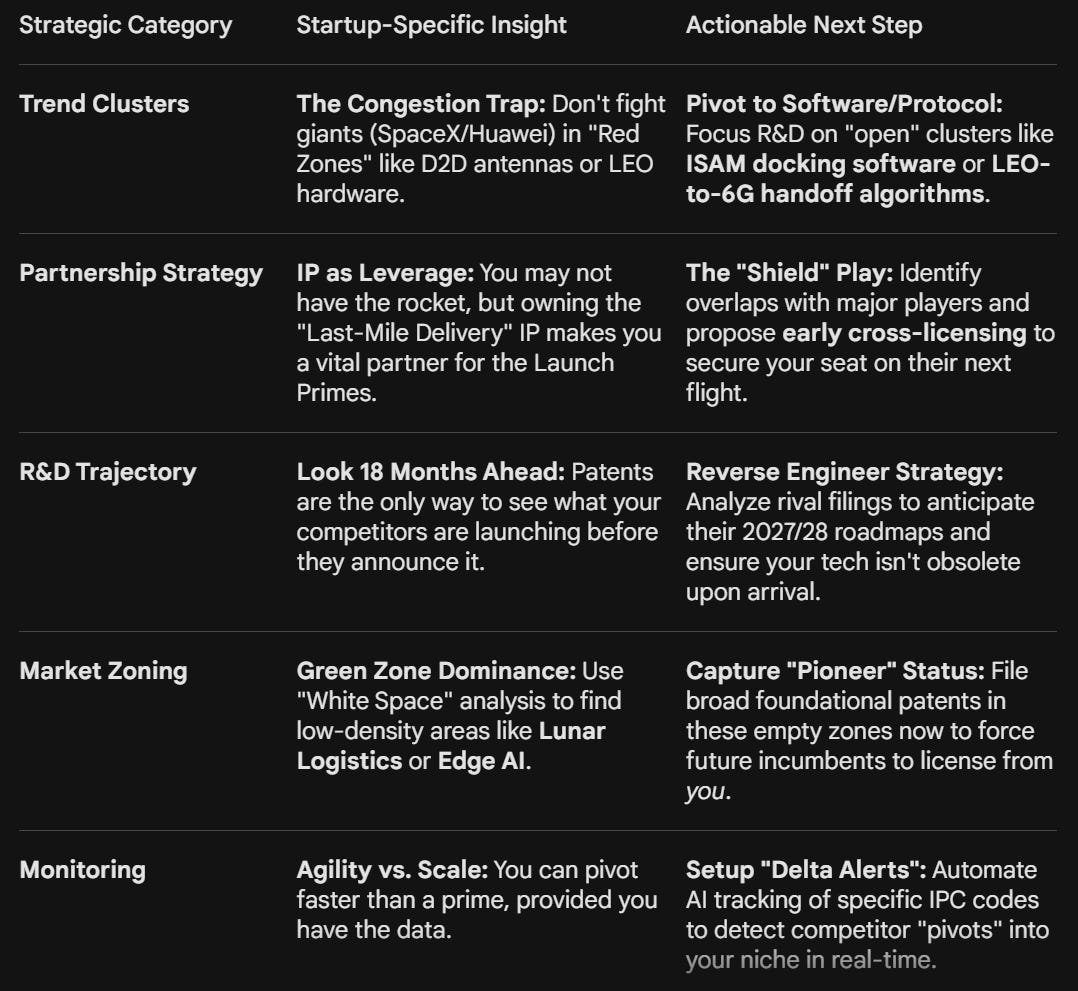
1. Mapping the High-Density Clusters (2026 Trends)
A landscape search allows you to see where the “gravity” of the industry is pulling. Current mapping reveals three massive clusters:
Quantum Key Distribution (QKD):
Led by sovereign-backed entities and startups like BitRezus, this cluster focuses on unhackable satellite-to-ground encryption.
Mapping this shows a high density of filings in China and the EU, signaling where the future of secure defense comms could reside.
Direct-to-Device (D2D):
A crowded “super-cluster” involving Qualcomm, SpaceX, and Huawei.
Landscape analysis here reveals that while the hardware (antennas) is congested, the software (network handoff protocols between LEO and terrestrial 6G) is more open.
In-Orbit Servicing & Manufacturing (ISAM):
Companies like Astroscale and Blue Origin are filing in robotic docking and microgravity 3D printing.
2. Spotting Partners (The Cross-Licensing “Constellation”)
Landscape searches can identify Complementary IP.
The Strategy:
If your landscape search shows that SpaceX owns the “Launch” IP but you own the “Last-Mile Delivery” (orbital transfer vehicle) IP, you may have a natural basis for a partnership.
Cross-Licensing as a Shield:
By identifying who holds patents that overlap with your future roadmap, you can engage in cross-licensing early.
This turns a potential legal threat into a collaborative “moat” that keeps other competitors out.
3. Anticipating Trajectories
Patent filings are a leading indicator of corporate strategy; often appearing 18 months before a product launch.
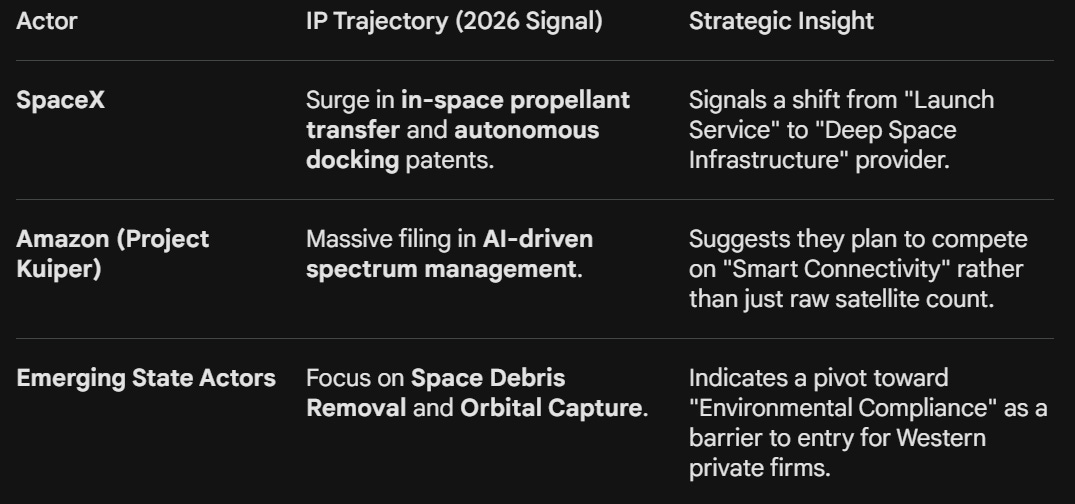
4. Actionable Steps (Dashboard)
To maximize value, a competitive landscape search should result in a Strategic Heat Map used by the C-Suite:
Red Zones (Avoid/License):
Saturated tech where entry is expensive (e.g., LEO terminal hardware).
Yellow Zones (Differentiate):
Emerging tech with moderate competition (e.g., SAR data analytics).
Green Zones (Dominate):
White spaces with high TRL potential (e.g., autonomous lunar mining logistics).
Tip: Use search tools (like the Lens.org (see last section), Patsnap or Orbit Intelligence) to set “Delta Alerts.” These notify you the moment a competitor moves into a new classification code, allowing you to pivot your R&D before they lock down the sub-sector.
IV. Patentability (Assessing Novelty & Inventiveness)
A patentability search (or “Prior Art Search”) is a proactive investigation to determine if your specific technical solution has been disclosed anywhere in the world—in any language—before your filing date.
1. Novelty vs. Non-Obviousness
To be patentable, space tech must clear two distinct legal hurdles:
Novelty (The “New” Test):
Does an identical technology already exist? If a 1974 NASA paper describes your exact satellite deployment hinge, your tech is not “novel.”
Non-Obviousness (The “Inventive Step”):
This is the battleground.
Even if your tech is “new,” would a “Person Having Ordinary Skill In The Art” (PHOSITA) (e.g. a propulsion engineer at ESA) find your modification to a Hall-effect thruster obvious?
Example:
Simply swapping a stainless-steel bolt for a titanium one on a lunar rover is “new,” but likely “obvious.”
However, developing a multi-stage ionization chamber for a thruster that allows it to use atmospheric breathing in Low Earth Orbit (LEO) is a non-obvious inventive leap.
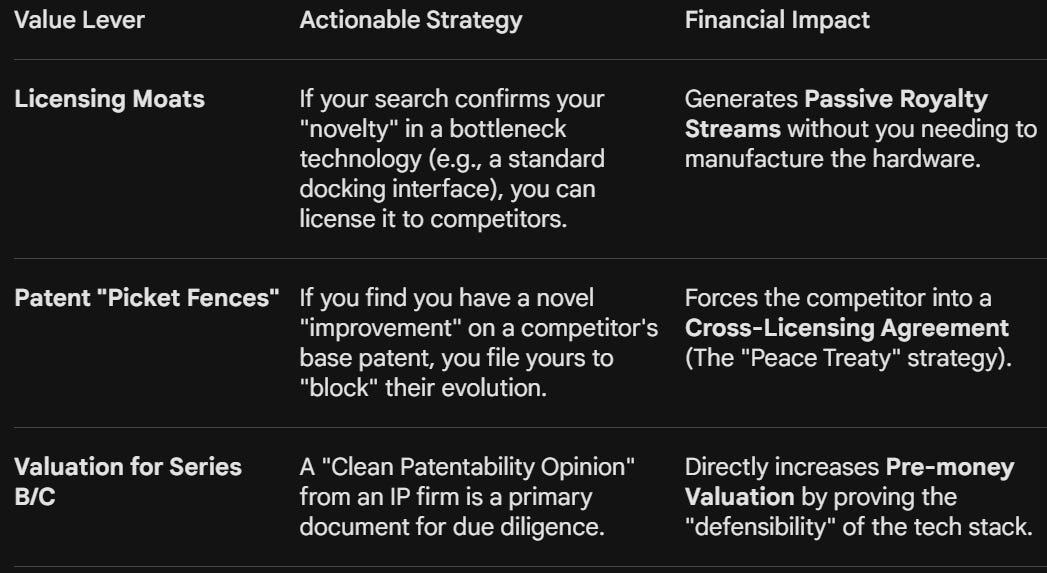
2. Maximizing Value (Turning “Novelty” into Revenue)
A successful patentability search can result in a filing that helps create a financial roadmap.
3. Evaluating Next Steps (The Go/No-Go Pivot)
The results of your patentability search could trigger these strategic paths:
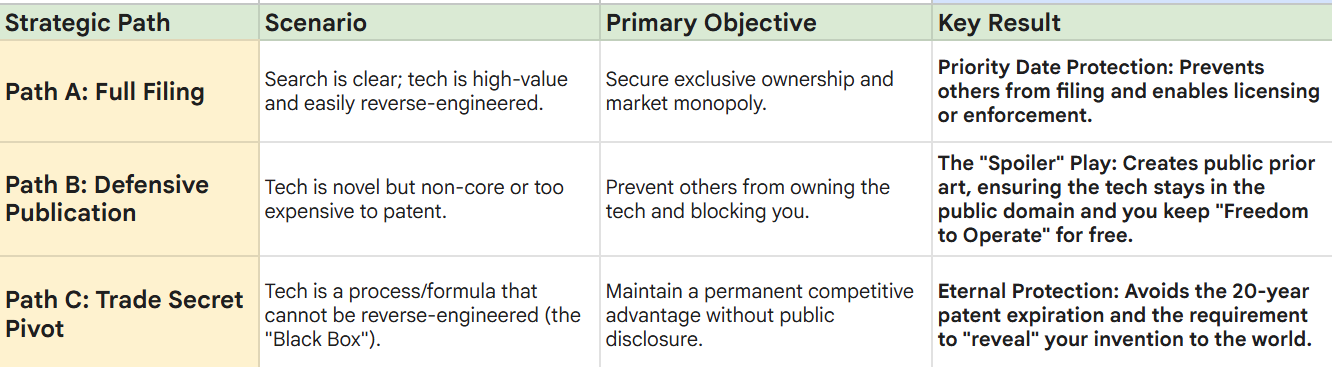
PATH A: Full Filing (The Green Light).
The search is clear.
File a Provisional Patent Application immediately to lock in your “Priority Date” before presenting at an aerospace conference.
PATH B: Defensive Publication (The Spoiler)
You find that while your tech is novel, it’s not valuable enough to spend c. $20k on a patent. You publish the details in a technical journal.
Result:
This creates “prior art” that prevents anyone else (including competitors) from ever patenting it.
You keep the “Freedom to Operate” for free.
PATH C: Trade Secret Pivot.
The search reveals that your “innovation” is actually a process that can’t be reverse-engineered by looking at the satellite (e.g., a secret chemical coating process).
Result:
Don’t file a patent. Keep it as a Trade Secret.
Patents expire in 20 years; trade secrets last forever (or until someone leaks them).
V. IP Cost Minimization & Value Maximization
To balance the high costs of international patent protection against the need for a robust “moat,” companies can move from a reactive filing model to a tiered value strategy.
1. Cost Minimization
Space tech is global, but filing everywhere is a recipe for bankruptcy. Minimize costs by narrowing the geographic and technical scope of your IP efforts.
The 80/20 Rule for Jurisdictions:
Instead of a “Global” filing, focus only on the “Big Five” of Space: U.S., China, EU (Germany/France), Luxembourg (for favorable space mining/finance laws), and India.
If a competitor cannot manufacture or launch in these hubs, their ability to bypass your IP is severely neutralized.
Utilizing the PCT “Wait-and-See”:
Use the Patent Cooperation Treaty (PCT) to secure a “Priority Date” globally for a relatively low fee.
This buys you 30 months of time to validate the technology (reaching TRL 6+) or secure funding before you have to pay the heavy “National Phase” filing and translation fees.
The “Defensive Publication” Pivot:
Not every innovation needs a patent. For non-core components, publish the technical details in a public forum (e.g., a NASA Tech Brief).
Effect:
It creates prior art that prevents any competitor from patenting that specific tech, ensuring your future Freedom to Operate without the $20,000+ price tag of a patent.
2. Value Maximization (IP as a Revenue Engine)
High-value IP should do more than sit in a drawer; it should defend your margins and open new doors.
Claiming “Ground-to-Space” Continuity:
Maximize value by drafting claims that cover the terrestrial control system and the orbital hardware as a single system.
It is far easier to sue a competitor for an infringing ground-station server in Texas than it is to prove infringement on a satellite passing over the Pacific.
Building “Picket Fences”:
Surround your “Star Patent” (your core thruster or sensor) with smaller, cheaper “improvement patents.”
Strategic Value: Even if a competitor finds a way to challenge your core patent, they still have to navigate the “picket fence” of secondary patents, making it too expensive for them to copy your system.
The “Standard-Essential” Play:
If your landscape mapping shows the industry moving toward a specific interface (e.g., a new docking ring standard), aim to patent the standard.
Revenue: This allows for FRAND (Fair, Reasonable, and Non-Discriminatory) licensing, where every other player in the industry pays you a small fee for every unit they launch.
VI. IP Risks & Countermeasures
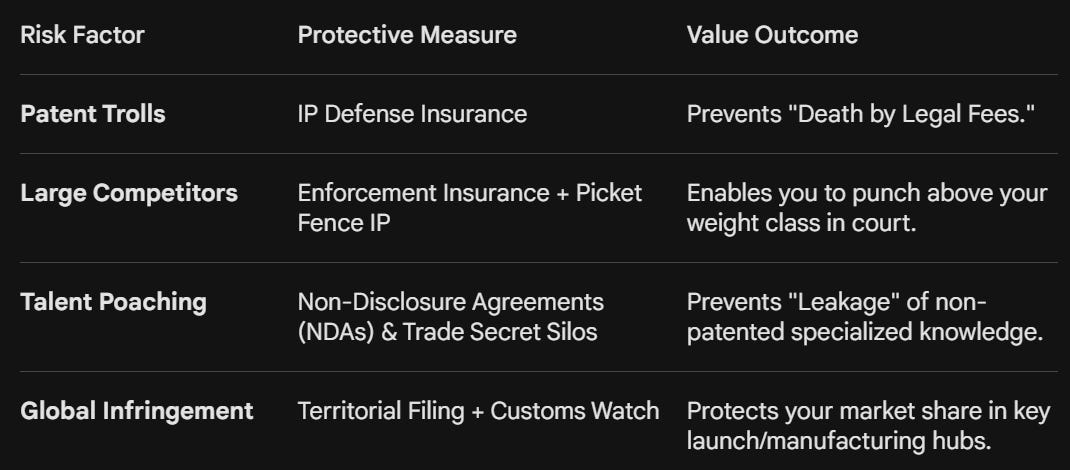
A. IP Insurance
IP insurance serves two primary roles: Defensive (protecting you from being sued) and Offensive (providing the capital to sue others who steal your tech).
1. Defensive (Abatement & Defense Coverage)
This covers the legal costs if a competitor or a Non-Practicing Entity (NPE/Patent Troll) claims your satellite subsystem infringes their IP.
Legal Defense Costs:
Covers attorney fees, expert witness costs (critical for complex thruster or AI mechanics), and court fees.
Damages & Settlements:
Provides a payout if you lose the case or choose to settle to avoid a “grounding” injunction.
Strategic Value:
Having this coverage often deters “predatory litigation” from larger competitors who might otherwise try to outspend you in court to force a cheap acquisition.
2. Offensive (Enforcement Coverage)
Smaller innovators may see their designs “borrowed” by larger primes or state-backed entities.
The “War Chest”:
This policy pays the legal fees for you to sue an infringer.
Without it, a startup may have a winning case but no capital to sustain a 3-year legal battle.
Cross-Border Enforcement:
Vital for the space sector where infringement might happen across multiple jurisdictions (e.g., manufacture in Asia, launch in South America).
B. Guarding Against Infringement
Protecting the company requires a balance of legal barriers and operational security.
1. External Guarding (Monitoring & Enforcement)
To maximize the value of your IP, you must actively police your “Star Map.”
Automated Watch Services:
Use AI-driven monitoring to get alerts when competitors file patents with similar IPC (International Patent Classification) codes.
Customs Recordation:
If your hardware is terrestrial-based (ground stations, receivers), register your patents and trademarks with customs authorities.
This allows for the seizure of infringing hardware at the border before it ever reaches a launch site.
The “Paper Trail” Strategy:
Ensure all R&D is timestamped and logged in a secure, immutable PLM (Product Lifecycle Management) system.
This provides the “Prior User Rights” evidence needed to win a defense in many jurisdictions.
2. Internal Guarding:
Not every innovation should be patented. Some of the most valuable Space Tech (like SpaceX’s proprietary alloys) is guarded as a Trade Secret.
The “Need-to-Know” Silo:
Limit access to core source code or chemical formulas to specific engineers. Use “Clean Room” development protocols for high-sensitivity subsystems.
Robust Off-Boarding:
The greatest threat is talent poaching.
Use “Garden Leave” and specific IP-assignment clauses that clearly state any “in-orbit” discoveries belong to the company, not the individual.
C. Summary (The “Shield & Sword” Approach)
The Shield:
Use Defensive Insurance and FTO searches to ensure you are unencumbered during your launch window.
The Sword:
Use Enforcement Insurance and Offensive Validity Attacks to clear competitors from your path and protect your proprietary “moat.”
VII. The Lens (Open Source Tool)
Lens.org is a powerful, free open-access platform that aggregates patent data and scholarly works. It is uniquely suited for Space Tech because it links patents to non-patent literature (like NASA technical reports).
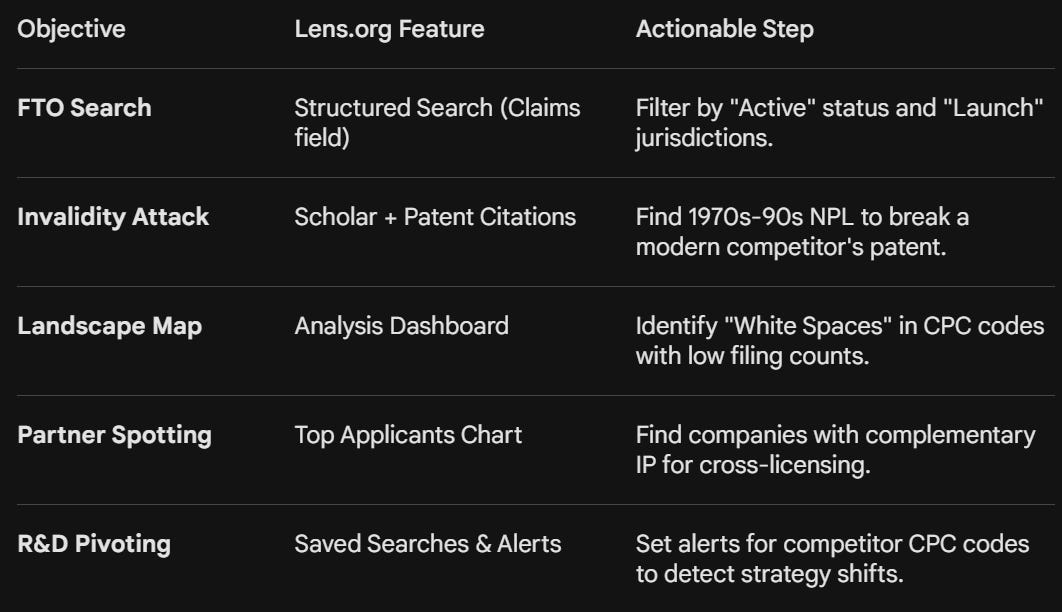
Here is how to potentially use Lens.org to execute the key objectives outlined above.
1. Freedom to Operate (FTO)
To perform a dynamic FTO search, use the Structured Search to deconstruct your solution into subsystems.
Go to Lens Structured Search.
Search in Claims:
Use the “Claims” field instead of “Full Text.”
This is critical for FTO because the claims define the legal boundaries of a patent.
Jurisdiction Filter:
Use the “Jurisdiction” filter to select only your manufacturing and launch points (e.g., US, EP, CN, FR).
Legal Status:
Use the “Legal Status” filter to show only “Active” or “Pending” patents.
Maximizing Value:
Filter for “Expired” or “Discontinued” patents in your tech area (e.g., “Hall-effect thrusters”).
This helps you identify “Safe Harbor” technologies; designs you can use for free because the patent term has ended.
2. Competitive Landscape (Mapping “Red” and “Green” Zones)
To generate the “Strategic Heat Map”, use Lens’s Analysis Dashboards.
Run a broad search for a cluster (e.g., “In-Orbit Servicing” or “QKD Satellite”).
Click the “Analyze” button.
Identify White Space (Green Zones):
Look at the “CPC Group” chart.
Find areas with low filing volumes.
For example, if “Robotic Docking Hardware” is a Red Zone (saturated), but “Docking Software Protocols” has few filings, that is your Green Zone to dominate.
Spot Partners:
Look at the “Top Applicants” chart.
If SpaceX owns the launch patents and a startup owns the docking patents, they are prime candidates for the Cross-Licensing Constellation strategy.
3. Patentability (“Novelty vs. Non-Obviousness”)
Search your specific innovation (e.g., “atmospheric breathing thruster”).
Check for Non-Obviousness:
Look for patents that are “Similar” to yours. Lens has a “Similar Documents” feature.
If you find that your “new” idea is just a combination of two existing patents (e.g., a standard thruster + a known intake valve), it may be deemed “obvious.” This insight triggers Path B (Defensive Publication) or Path C (Trade Secret)
4. Monitoring the Registry (“Delta Alerts”)
Save your structured searches for specific competitors (e.g., “Applicant: Blue Origin”).
Set up an Email Alert on Lens.
Every time a competitor files a new patent in a specific classification (like B64G for Spacecraft), you will get an email. This allows your C-Suite to pivot before the competitor locks down a sub-sector.