
Microbial Research in Microgravity [Innovation]
Because microbes grow faster, become more virulent, and develop unique physical structures in space, they provide a compressed timeline for drug discovery and biomanufacturing.

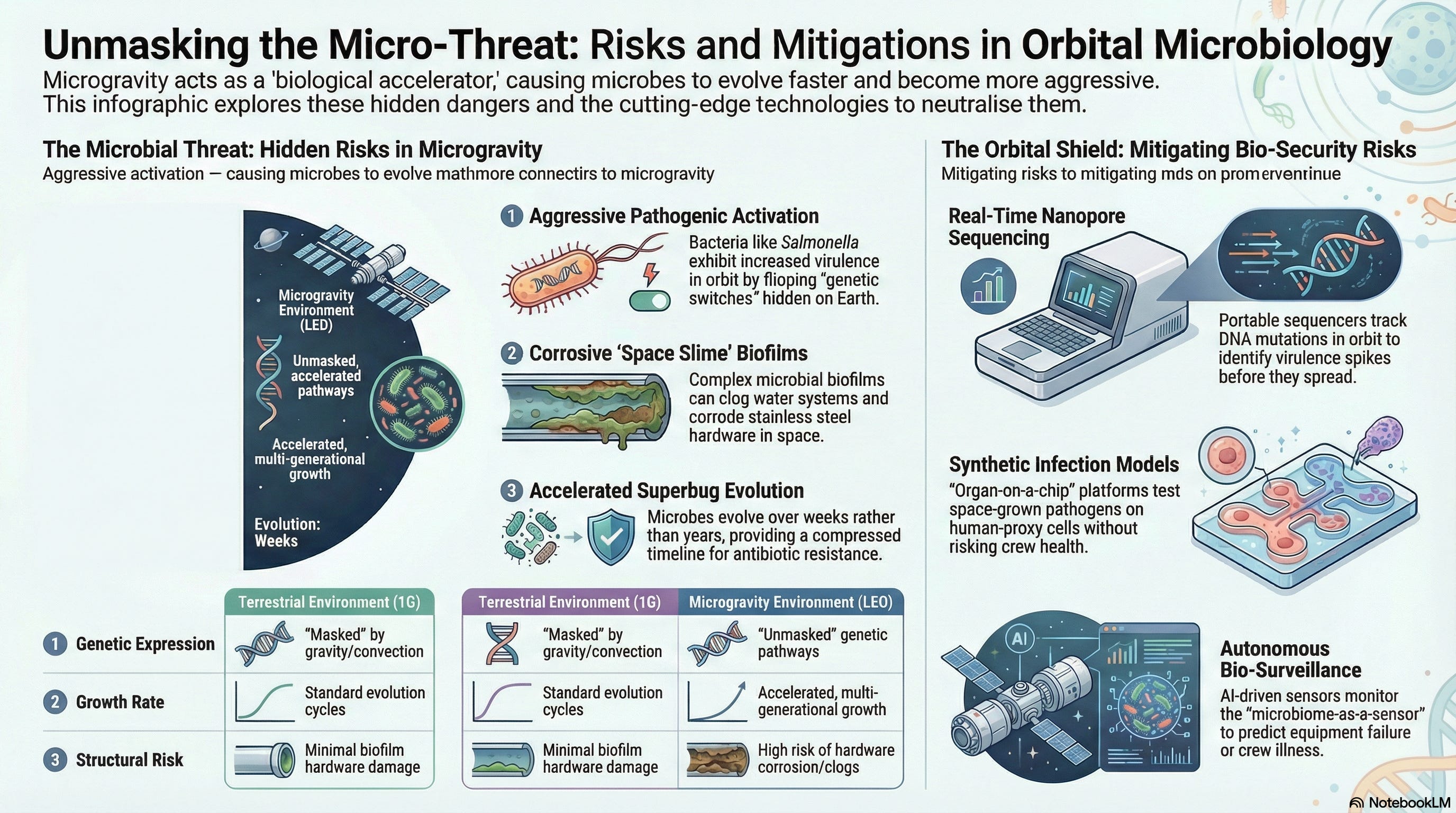
Microbial Research in Microgravity utilizes the unique, near-weightless environment of Low Earth Orbit (LEO) to study how bacteria, fungi, and viruses evolve and function without the downward pull of 1G.
While terrestrial labs use centrifuges to simulate gravity, researchers in orbit use the Microgravity Environment to “unmask” genetic pathways that are hidden on Earth.
Because microbes grow faster, become more virulent, and develop unique physical structures in space, they provide a compressed timeline for drug discovery and biomanufacturing.
I. Why is Microbial Research being conducted in Space?
While Earth-bound biology is limited by the “masking” effects of sedimentation and convection, space-based research acts as a “Biological Accelerator.” The demand for orbital microbiology is driven by the need to protect astronaut health on long-duration missions and the commercial desire to engineer superior vaccines and “living” materials.
1. The Strategic Level: Virulence Unmasking & Vaccine Development
This tier focuses on the foundational discovery that common pathogens become more aggressive in space, revealing their “Achilles’ heels” for medical breakthroughs.
Pathogenic Activation: Identifying the “Genetic Switches” that trigger infection. In microgravity, bacteria like Salmonella exhibit increased virulence; by mapping the specific genes that flip during spaceflight, researchers can develop targeted “master-key” vaccines that are more effective back on Earth.
Accelerated Evolution: Observing multiple generations of microbial life in weeks rather than years. This allows scientists to predict how superbugs might evolve on Earth, providing a “proactive defense” against future antibiotic resistance.
2. The Tactical Level: Astronaut Health & Life Support Systems
At this level, research focuses on the “Bio-Security” of the spacecraft, ensuring that the closed-loop environment remains habitable for humans during deep-space transit.
Biofilm Mitigation: Preventing the growth of “Space Slime” on critical hardware. In microgravity, microbes form thick, complex biofilms that can corrode stainless steel and clog water recycling systems. Researching these structures leads to the development of new antimicrobial coatings for both spacecraft and terrestrial hospitals.
The Microbiome Shift: Monitoring how the human “gut-brain axis” changes in orbit. By studying how an astronaut’s internal bacteria react to radiation and weightlessness, scientists could create “Precision Probiotics” to prevent immune system degradation during Mars missions.
3. The Industrial Level: Bio-Manufacturing & Protein Crystallization
This tier focuses on the commercial potential of using microbes as “Orbital Factories” to produce high-value chemicals and pharmaceuticals.
Perfect Protein Crystals: Utilizing the lack of convection to grow large, high-quality protein crystals. These “Space Crystals” allow for the mapping of complex disease structures (like those in cancer or Alzheimer’s) with a clarity impossible on Earth, drastically shortening the R&D cycle for new drugs.
Living Foundries: Engineering microbes to “mine” lunar or Martian soil. Through “Bio-mining,” specific bacteria could be used to extract precious metals or oxygen from regolith, reducing the logistical cost of hauling raw materials from Earth.
4. The Logistical Level: Waste Upcycling & Synthetic Biology
This tier addresses the “Circular Economy” of space travel, where every gram of waste must be converted back into a resource.
The “Zero-Waste” Bioreactor: Converting CO2 and human waste into edible nutrients or bioplastics. Using specialized yeast and bacteria strains, orbital labs are developing closed-loop systems that turn exhaled breath into vitamins, ensuring “Nutritional Sovereignty” for crews far from Earth.
Microbial “Hardening”: Testing the limits of extremophiles to develop “Synthetic Shields.” By studying how certain microbes survive high-radiation environments, researchers can engineer bio-synthetic materials that protect both humans and electronics from cosmic rays.
II. Microbe Types & Applications
By accounting for decades of ISS and Shuttle-era data, researchers target specific kingdoms of life that exhibit the most drastic phenotypic shifts in microgravity.
1. Gram-Negative Pathogens (The “Virulence Models”)
These serve as the primary subjects for infectious disease research, as they consistently show increased antibiotic resistance and aggressiveness in space.
Innovation Example: Salmonella typhimurium and Pseudomonas aeruginosa studies on the ISS, which revealed that microgravity “tricks” these bacteria into behaving as if they are deep inside a human host’s fluid-filled tissues.
Mechanism: Low-Shear Modeled Microgravity (LSMM). In the absence of gravity-driven convection, the fluid environment around the cell becomes stagnant. This lack of mechanical “scrubbing” triggers the Hfq protein (a global master regulator) to upregulate genes associated with biofilm formation and toxin production.
Application: Next-Generation Vaccine Discovery. By identifying the exact “Genetic Switch” (like the hfq gene) that flips under space-stress, scientists could develop “locked” versions of these bacteria that are permanently weakened, serving as safer, more effective live-attenuated vaccines for Earth-based diseases.
2. Extremophilic “Rock-Eaters” (The “Orbital Miners”)
These are the “Biological Refineries,” capable of surviving the vacuum of space and metabolizing inorganic minerals into usable industrial materials.
Innovation Example: The BioRock and BioAsteroid experiments (University of Edinburgh), which utilized Sphingomonas desiccabilis to demonstrate that microbes can extract rare earth elements from basaltic rock as efficiently in 0G as they do on Earth.
Mechanism: Bio-Leaching. These microbes secrete organic acids that dissolve silicate and oxide minerals, releasing metals (like Vanadium, Neodymium, or Iron) into a solution. In microgravity, the lack of sedimentation allows the microbes to stay in constant, 360-degree contact with the rock surface, potentially increasing extraction rates.
Application: In-Situ Resource Utilization (ISRU). Essential for permanent lunar or Martian colonies to “grow” their own building materials or extract oxygen and fuel from local regolith without hauling heavy chemical processing plants from Earth.
3. Filamentous Fungi & Yeasts (The “Living Foundries”)
These act as the “Bio-Factories,” utilizing their complex cellular machinery to synthesize high-value pharmaceuticals and nutritional supplements.
Innovation Example: Saccharomyces cerevisiae (Brewer’s Yeast) and Aspergillus niger studies, which showed that fungi often grow in larger, more complex 3D structures in space, leading to a higher yield of secondary metabolites.
Mechanism: Enhanced Secondary Metabolism. Because fungi are not limited by the physical “crush” of gravity, they can grow into denser “pellets” or mats. This stress response often triggers the production of defensive chemicals; many of which are potent antibiotics, antioxidants, or vitamins (like Vitamin A/Provitamin A) that are difficult to synthesize chemically.
Application: Long-Haul Nutritional Sovereignty. Providing “on-demand” nutrients for astronauts on Mars missions. Using a simple yeast-based bioreactor, a crew could “brew” fresh vitamins and proteins to counteract the degradation of pre-packaged food over a three-year journey.
4. Photosynthetic Algae & Cyanobacteria (The “Sustenance Loops”)
These serve as the “Orbital Oxygenators,” forming the backbone of Bioregenerative Life Support Systems (BLSS) by closing the loop between waste and breath.
Innovation Example: The Photobioreactor (PBR) experiment (DLR/University of Stuttgart), which used Chlorella vulgaris on the ISS to demonstrate simultaneous CO2 scrubbing and oxygen production in a modular, liquid-based system.
Mechanism: Continuous Gas Exchange. Microgravity allows for the creation of ultra-thin, high-surface-area liquid layers that maximize light exposure for photosynthesis. Because bubbles don’t rise in 0G, researchers use centrifugal membranes or sonic agitation to ensure CO2 is delivered to the algae and O2 is removed without “gas-choking” the colony.
Application: Closed-Loop Ecosystems. Creating “Living Walls” for spacecraft that convert exhaled carbon dioxide into oxygen and harvestable biomass (protein-rich food), significantly reducing the mass of life-support consumables needed for deep-space transit.
III. Example Business Models
These models focus on commercializing the unique biological advantages of weightlessness, turning microgravity into a high-throughput laboratory for the global pharmaceutical and industrial sectors.
1. The “Pathogen-to-Platform” (P2P) Model
Primary Tier: The Strategic Level (Virulence Unmasking) and Vaccine Development.
Model: Operating an orbital “Accelerated Pathology Lab” that identifies the genetic triggers of infectious diseases. By flying terrestrial pathogens and forcing them into a high-virulence state, the provider identifies “vulnerability windows” that are invisible on Earth. Revenue is generated by selling these proprietary genetic blueprints to Big Pharma for vaccine and antibiotic synthesis.
Innovator Opportunity: The “Bio-Digital Twin.” Creating a library of microbial genetic responses to microgravity. This allows AI-driven drug discovery platforms to simulate how a virus might mutate or respond to a drug candidate, using space-verified data as the ground truth.
SWOT Analysis:
Strengths: Creates a massive “IP Moat” by owning unique genetic data; bypasses the slow pace of terrestrial evolution.
Weaknesses: High biosafety risks (BSL-3/4 requirements in orbit); complex downmass logistics for physical samples.
Opportunities: Partnering with national health agencies to develop “Universal Flu” or “Pan-Coronavirus” vaccines.
Threats: Advancements in terrestrial “Organ-on-a-Chip” tech simulating microgravity effects without the launch cost.
2. The “Orbital Crystal Foundry” (OCF) Model
Primary Tier: The Industrial Level (Protein Crystallization) and Bio-Manufacturing.
Model: Providing a “Crystallization-as-a-Service” (CaaS) platform for structural biology. While Earth-bound crystals are often small and disordered due to gravity-driven convection, the OCF produces “Perfect Crystals” of complex proteins. The business sells the resulting high-resolution diffraction data, which is useful for “Structure-Based Drug Design” (SBDD).
Innovator Opportunity: Pure-Batch Monoclonal Antibodies. Using microgravity to manufacture highly concentrated, stable formulations of biological drugs that are too unstable to be produced in large batches on Earth, potentially turning “IV-only” treatments into simple under-the-skin injections.
SWOT Analysis:
Strengths: Extremely high value-to-weight ratio; clear “Space-to-Earth” commercial pipeline.
Weaknesses: Sensitivity to “G-jitter” (vibrations from spacecraft thrusters) which can ruin crystal growth.
Opportunities: Becoming the exclusive manufacturer for “orphan drugs” that require ultra-pure chemical environments.
Threats: AI-based protein folding (e.g., AlphaFold) reducing the absolute necessity for physical crystallization.
3. The “Cislunar Bio-Utility” (CBU) Model
Primary Tier: The Tactical Level (Life Support) and Logistical Level.
Model: Acting as the “Microbial Utility Provider” for the burgeoning lunar economy. This model focuses on the “In-Situ Resource Utilization” (ISRU) of biological agents. The company leases specialized bioreactors to lunar bases that use engineered microbes to recycle water, scrub CO2, and produce lab-grown meat or bioplastics.
Innovator Opportunity: Regolith-to-Resource Microbes. Developing and licensing “Rock-Eating” bacteria that can metabolize lunar soil to extract oxygen or rare earth elements, reducing the need for heavy chemical processing equipment.
SWOT Analysis:
Strengths: Essential infrastructure for permanent human presence; “sticky” long-term service contracts.
Weaknesses: High CAPEX for lunar deployment; biological systems are “fickle” and prone to contamination.
Opportunities: Standardizing the “Biological Interface” for all lunar habitats, becoming the “Windows OS” of life support.
Threats: Government-led missions (NASA/Artemis) developing open-source biological life support standards.
4. The “Microbiome-as-a-Sensor” (MaaS) Model
Primary Tier: The Tactical Level (Astronaut Health) and Environmental Monitoring.
Model: Utilizing the human and spacecraft microbiome as a “Canary in the Coal Mine.” By monitoring how microbial communities shift in response to radiation and recycled air, the provider sells “Bio-Analytics” to space station operators. This data is used to predict equipment failure (via biofilm corrosion) or crew illness before symptoms appear.
Innovator Opportunity: The “Hardened Probiotic” Suite. Selling customized microbial “armor” for astronauts; probiotics specifically engineered to survive cosmic radiation and maintain gut health, preventing the “Space-Immune-Symptom” during long-haul flights.
SWOT Analysis:
Strengths: Low-cost data play; utilizes existing crew samples (saliva/skin swabs) rather than requiring dedicated hardware.
Weaknesses: Ethical and privacy hurdles regarding astronaut genetic data.
Opportunities: Expanding to “Extreme Environment” workers on Earth (submariners, Arctic researchers).
Threats: Rapid improvements in wearable electronic sensors that might detect health shifts faster than microbial ones.
IV. Enabling Technologies
Microbial research in microgravity relies on Microfluidic Bioreactors and On-Board Genetic Sequencing. These technologies allow for the autonomous cultivation and analysis of living systems while protecting the spacecraft from biological contamination.
1. Automated Microfluidic Bioreactors (Lab-on-a-Chip)
Traditional biology requires large incubators and manual pipetting, which are impractical and hazardous in a weightless, closed-loop environment.
The Innovation: Microfluidics shinks a full-scale laboratory onto a clear plastic slide. Tiny channels, valves, and pumps move nanoliters of nutrients and samples with extreme precision.
Autonomous Cultivation: These “Chips” allow for “Multi-Generational Studies” where microbes are grown, sampled, and preserved entirely by pre-programmed logic. This eliminates the need for astronaut intervention and prevents “cross-contamination” between the experiment and the station’s air supply.
2. In-Situ Nanopore Sequencing
Previously, space biology required “Downmass”; freezing samples and sending them back to Earth for analysis. This created a months-long delay in getting results.
The Innovation: Nanopore Sequencers (like the MinION) allow for real-time DNA and RNA sequencing in orbit. They work by passing a single strand of DNA through a microscopic pore and measuring the electrical change.
Real-Time Evolutionary Tracking: By sequencing microbes while they are in microgravity, researchers can see exactly when a “Virulence Gene” flips on. This allows for “Adaptive Experimentation,” where the conditions of the bioreactor are changed in response to the data being generated in real-time.
3. Acoustic Levitation & Containerless Processing
On Earth, gravity keeps liquids in a flask; in space, surface tension makes liquids “crawl” up walls, making it difficult to control microbial exposure to drugs.
The Innovation: Acoustic Tweezers use high-frequency sound waves to create “pressure pockets” that hold droplets of liquid—and the microbes inside them—perfectly still in mid-air.
Pure Interaction: This allows for “Containerless Processing,” where a microbial colony can be studied without touching any solid surface. This removes the “wall effect” (biofilm formation on the container) and ensures that the data collected represents the microbe’s pure reaction to the microgravity environment alone.
4. High-Throughput “Organ-on-a-Chip” (OOC) Platforms
To understand how microbes affect humans (the microbiome), you cannot always use human subjects for high-risk pathogen testing.
The Innovation: Organ-Chips are micro-engineered environments that mimic the mechanical and biological functions of human organs (like the lung, gut, or blood-brain barrier).
Synthetic Infection Models: By introducing space-grown pathogens into a “Gut-on-a-Chip,” researchers can observe how the “leaky gut” syndrome (common in astronauts) actually happens at a cellular level. This provides a “Human-Proxy” for testing new antibiotics or probiotics without risking the health of the crew.
V. Example Innovators
This segment highlights the core researchers and organizations leading the field of orbital microbiology, from academic pioneers to venture-backed synthetic biology startups.
1. Primary Research Groups & Academic Pioneers (The “Brains”)
The Space Microbiology Group (Cornell University / University of Edinburgh): Led by Dr. Rosa Santomartino, this group focuses on “Biomining” and waste upcycling. Their research into how fungi and bacteria extract minerals from regolith is foundational for lunar In-Situ Resource Utilization (ISRU).
UK Centre for Astrobiology (University of Edinburgh): Directed by Professor Charles Cockell, a key figure in the BioRock and BioAsteroid experiments, which first demonstrated the use of microbes to mine rocks in microgravity.
The Roesch Lab (University of Florida): Specializes in “Space Omics” and the astronaut microbiome. They investigate how the gut-bone axis shifts in orbit and are developing microbial countermeasures to prevent bone loss during deep-space travel.
GeneLab Microbes Analysis Working Group (NASA/Open Science): A global collaborative led by figures like Dr. Katherine J. Baxter (University of Glasgow) and Prof. Nicholas J. B. Brereton (UCD). They provide the open-source “Roadmap” for multi-omics research into biofilm formation in space.
KAUST Space Biology Team (Saudi Arabia): Under Professor Alexandre Rosado, this group recently identified 26 new bacterial species in NASA cleanrooms, studying “extremotolerance” to ensure planetary protection and astronaut safety.
Macau University of Science and Technology (MUST): Led by Dr. André Antunes, they focus on halophiles and microbes from “terrestrial analogues” (like deep-sea brines) to predict life on icy moons like Europa.
University of Colorado Boulder (BioServe Space Technologies): Directed by Dr. Louis Zea, BioServe is a premier hardware and research partner, having conducted hundreds of microbial experiments on the ISS ranging from antibiotic effectiveness to yeast fermentation.
2. Commercial Biotech & Synthetic Biology (The “Scale-Up”)
BioOrbit (UK): Led by Dr. Katie King, they are a primary innovator in “Space-made Pharmaceuticals,” specifically scaling the production of perfectly crystallized monoclonal antibodies for cancer therapy.
Bioscreen: Developers of the BIOSCREEN C° Pro, an automated growth-curve analysis device that allows for high-throughput, autonomous microbial monitoring in remote orbital environments.
Varda Space Industries (USA): While a hardware provider, their core team includes specialists in microbial crystallization, focusing on returning high-purity biological batches from their autonomous “Orbital Drug Factories.”
Ginkgo Bioworks (USA): The “Cell Programming Company” works with DARPA to engineer synthetic microbes capable of recycling waste and producing nutrients in high-radiation environments.
Mammoth Biosciences (USA): Utilizing CRISPR technology for in-situ diagnostics; their systems are designed to detect shifting bacterial virulence or spacecraft contamination in real-time.
SpacePharma (Switzerland): Operating miniaturized MOZ labs, which allow researchers to perform remote-controlled biochemistry on microbes, essentially providing a “SaaS” model for space microbiology.
Isomerase (UK): A synthetic biology innovation partner that helps companies engineer microbial strains.
Kiverdi (USA): Using NASA-inspired technology to capture CO2 with microbes to create protein (”Air Protein”), a model they are now adapting for closed-loop life support in cislunar space.
3. Niche Innovators & Mission Support (The “Enablers”)
Oxford Nanopore Technologies (UK): Their portable MinION sequencer is the essential tool for every microbial researcher in orbit, enabling real-time genomic tracking without waiting for sample return.
Space Park Leicester (University of Leicester): Home to the Petri-Pod project led by Professor Mark Sims and Professor Tim Etheridge, which creates miniature “smart” labs for deep-space biological testing.
Yuri Gravity (Germany): They act as the logistical bridge, providing “Science-Taxi” services and modular incubators to help terrestrial labs move their microbial experiments to LEO.
SURFACtoBioTech (Germany): Developing specialized surfactants for droplet-based microfluidics, ensuring that microbial reactions remain stable and controlled in the absence of gravity.
Blue Marble Space Institute of Science (USA): A non-profit research institute that supports a global network of “Rising Stars” in space microbiology through fellowship and data-sharing platforms.
Ecolysium (Argentina): Creating “Programmable Probiotics” that use selenium-based nanotechnology to enhance microbial resilience in harsh environments, applicable to both space agriculture and human health.
SteriTrend (Germany): Provides the digital “Nervous System” for microbiological monitoring, ensuring that orbital manufacturing facilities maintain GMP (Good Manufacturing Practice) compliance via automated data logging.
Aramis Biotech (Canada): Focusing on the computational design of antigens.
Nanolive (Switzerland): Their CX-A microscopes are used by space researchers to perform “label-free” live-cell imaging, allowing them to see how microbes move and interact in 3D without chemical interference.
VI. Potential Opportunities for New Innovators
1. Autonomous “Bio-Foundry” Orchestration
Current orbital labs require heavy ground-based monitoring. The next generation of space biotech needs a “Universal Operating System” for biology that can manage complex microbial cultures with zero-latency intervention.
The Opportunity: Developing AI-Driven Bioreactor Management software that can predict microbial “drift” and adjust nutrient feeds or thermal profiles in real-time, ensuring GMP (Good Manufacturing Practice) compliance in LEO.
Innovation Focus:
Edge-Bioinformatics: Creating on-orbit algorithms that process genomic data from nanopore sequencers instantly, identifying beneficial mutations without sending terabytes of raw data to Earth.
Digital Twin Synchronization: Building high-fidelity digital twins of microbial colonies that allow terrestrial scientists to run “what-if” simulations before executing physical commands in the orbital lab.
Cross-Platform API: Standardizing the interface between different commercial stations (e.g., Axiom, Orbital Reef, Starlab) so a single microbial “blueprint” can be manufactured anywhere in orbit.
Example Innovators: Sonder Bio (Incubation platforms), Benchling (R&D software), Salutes Space (Space-ready AI).
2. High-Throughput “Omics” Hardware for SmallSats
As private space stations proliferate, the demand for compact, “plug-and-play” analytical tools will skyrocket. The goal is to shrink an entire pathology lab into a standard 1U CubeSat module.
The Opportunity: Engineering Single-Cell Analysis Chips that can survive the vibration of launch and the radiation of space while providing the same resolution as a multi-million dollar terrestrial lab.
Innovation Focus:
Radiation-Hardened Microfluidics: Developing “self-healing” polymers for microfluidic chips that do not become brittle or “foggy” under intense cosmic ray exposure.
Nanoliter Purification Modules: Creating automated systems to extract and purify proteins or DNA from raw microbial broth, a critical step for on-demand pharmaceutical production.
In-Situ Cryo-Preservation: Designing ultra-low-power “flash-freezing” modules that can preserve biological discoveries for return to Earth without requiring massive liquid nitrogen payloads.
Example Innovators: SpacePharma (Lab-on-a-chip), Oxford Nanopore (DNA sequencing), Arraytech (Microarray diagnostics).
3. “Microbiome-as-a-Service” (MaaS) for Planetary Protection
The expansion to the Moon and Mars creates a legal and technical market for monitoring the “Bio-Footprint” of human explorers, ensuring we don’t contaminate other worlds or bring “Space Superbugs” back to Earth.
The Opportunity: Providing Continuous Bio-Surveillance for commercial lunar landers, using engineered microbial sensors that “glow” or change color when they detect specific contaminants or hazardous mutations.
Innovation Focus:
Forensic Bio-Traceability: Developing “DNA Watermarks” for engineered microbes used in ISRU (In-Situ Resource Utilization), allowing companies to prove their biological agents haven’t leaked into the lunar environment.
Pathogen-Agnostic Detection: Building sensors that look for “Patterns of Life” (metabolic signatures) rather than specific known sequences, identifying novel mutations before they become a risk to the crew.
Automated Decontamination Robotics: Creating specialized UV-C or chemical-mist robots that use microbial “heat maps” to target and eliminate harmful biofilms in spacecraft vents and water lines.
Example Innovators: Mammoth Biosciences (CRISPR diagnostics), SteriTrend (GMP compliance), Byome Labs (Microbiome testing).
4. Relativistic Biomanufacturing & “Time-Accelerated” R&D
Microgravity and radiation effectively “speed up” the clock on cellular aging and microbial evolution. Innovators can sell this “Compressed Time” to terrestrial industries.
The Opportunity: Marketing “Accelerated Aging-as-a-Service” to cosmetics and longevity companies, using orbital microbes and skin-tissue chips to test the 10-year efficacy of anti-aging compounds in just 6 months.
Innovation Focus:
Evolutionary Selection Engines: Utilizing the high-mutation rates in orbit to “force-evolve” microbes that can eat plastic or capture carbon 10x more efficiently than their Earth-bound ancestors.
Space-to-Earth CDMO: Establishing a “Contract Development and Manufacturing” bridge that specializes in taking an orbital discovery (like a new crystal structure) and scaling it for mass production on Earth.
Sovereign Bio-Banks: Creating “Orbital Seed Vaults” for critical microbial strains, utilizing the natural cold and isolation of space as a failsafe against terrestrial ecological collapse.
Example Innovators: Varda Space (Orbital manufacturing), Oxford SIL (Ageing research), Ecolysium (Resilient probiotics).