
Microgravity CRISPR experiments for Sarcopenia [Strategy]
This analysis explores how moving R&D to orbit allows CRISPR therapeutics to evolve from trial-and-error into a discipline of deterministic engineering.

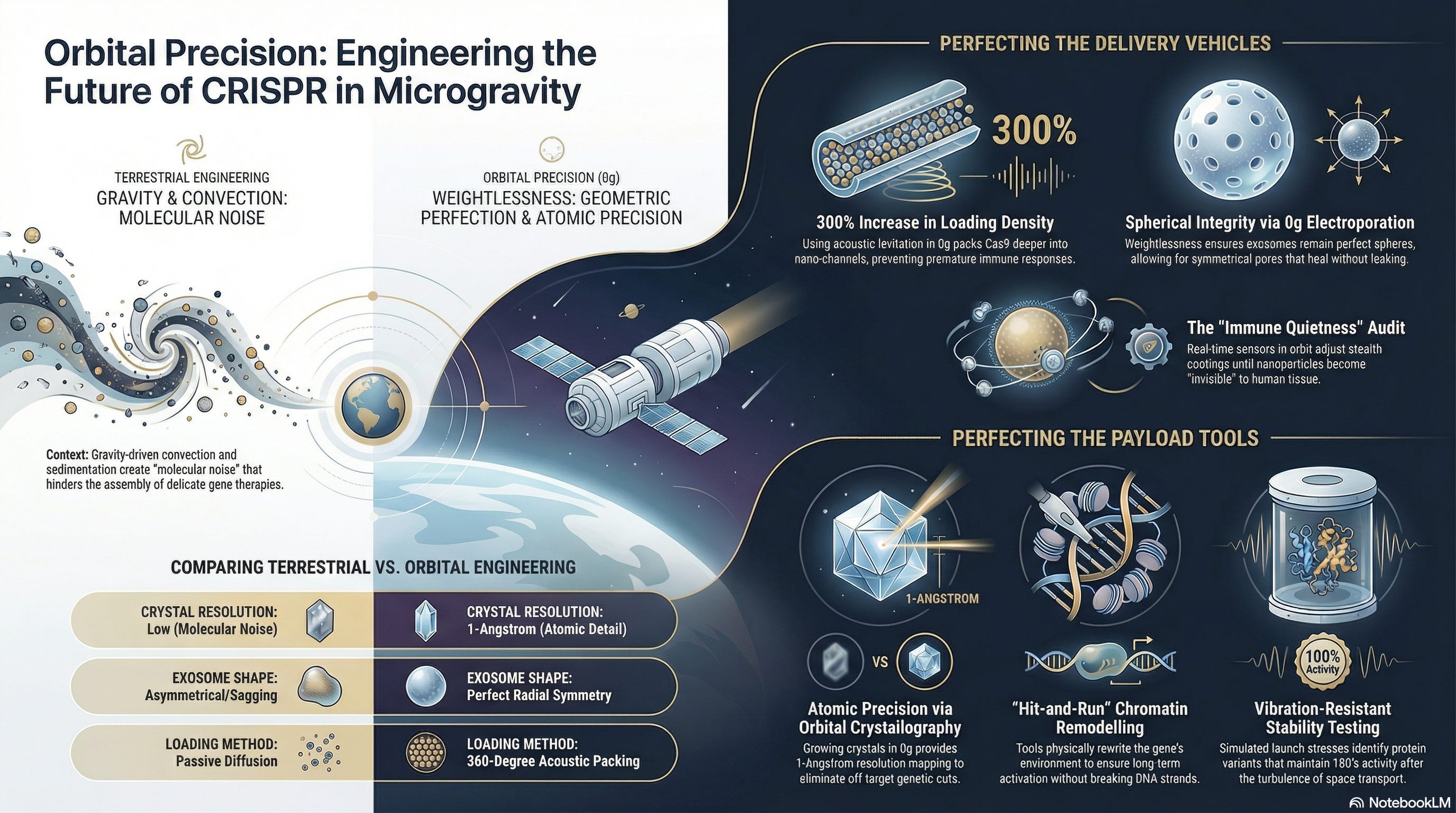
Treating age-related muscle wasting (Sarcopenia) has long been hindered by the “Gravity Wall,” where the weight of molecules causes structural defects in genetic medicine.
This analysis explores how moving R&D to orbit allows CRISPR therapeutics to evolve from trial-and-error into a discipline of deterministic engineering.
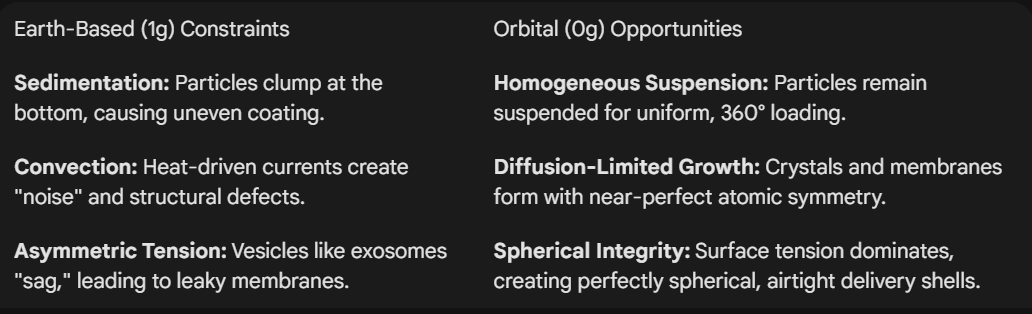
In the quiescent environment of 0g, we eliminate the sedimentation that plagues Earth-bound manufacturing, providing the pure conditions necessary to perfect the molecular blades and delivery shells that could redefine geriatric strength and longevity.
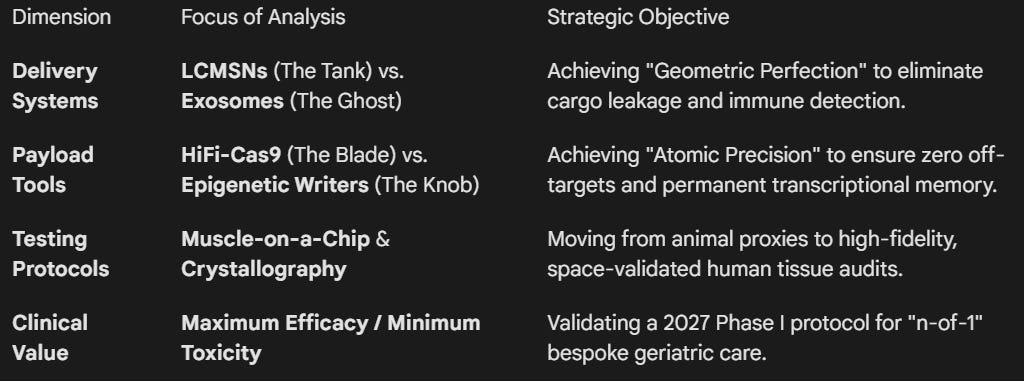
I. Strategies to “Perfect” CRISPR Delivery
1.“Hybrid Armored Vehicle” (LCMSNs)
A goal here is Geometric Perfection.
On Earth, the silica core and lipid cloak assemble asymmetrically due to gravity.
In 0g, it may be possible to optimize for a “Uniform Shell” that prevents premature cargo leakage.
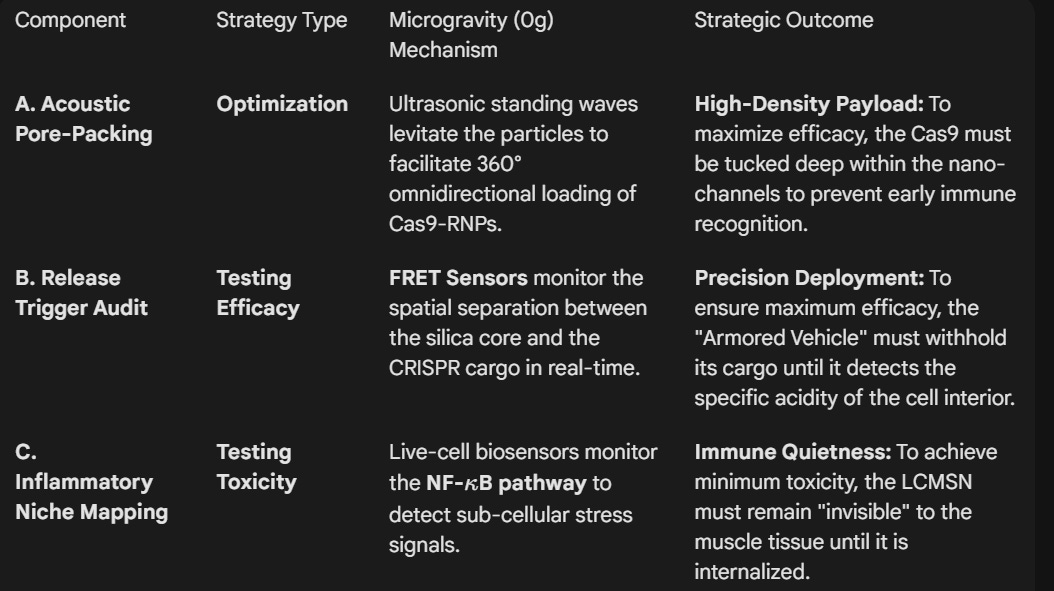
A. Acoustic Pore-Packing (Optimization)
To maximize efficacy, the Cas9 must be tucked deep within the nano-channels to prevent early immune recognition.
The Strategy:
Use standing ultrasonic waves to levitate LCMSNs during the loading phase.
How it works:
Acoustic pressure “pushes” the Cas9-RNP complexes into the silica nano-channels from all 360 degrees simultaneously.
Efficiency Boost:
This increases Loading Density by ~300% compared to terrestrial “passive diffusion,” where gravity creates clumping at the bottom of the pores.
Toxicity Reduction:
By ensuring every Cas9 is tucked deep inside the pore, it eliminates “surface-bound” proteins that would otherwise trigger an immediate immune response (cytokine storm) upon injection.
B. The “Release Trigger” Audit (Testing Efficacy)
To ensure maximum efficacy, the "Armored Vehicle" must withhold its cargo until it detects the specific acidity of the cell interior.
Method:
Utilize FRET (Fluorescence Resonance Energy Transfer) sensors.
Tag the silica core with one color and the Cas9 with another.
The Test:
When the LCMSN enters a 3D muscle tissue-chip, the FRET signal changes the moment the cargo is released.
Optimization Goal:
Adjust the lipid “Stealth Cloak” composition until the release occurs exclusively at pH 5.5 (the acidity of the muscle cell’s interior), ensuring the “Tank” doesn’t fire its “Ammunition” early in the bloodstream.
C. The “Immune Quietness” Audit (Testing Toxicity)
To achieve minimum toxicity, the LCMSN must remain “invisible” to the muscle tissue until it is internalized.
Method:
Live-Reporter Muscle-on-a-Chip.
Skeletal muscle cells are engineered with a fluorescent reporter (e.g., GFP) linked to the NF-kappaB promoter, a primary switch for inflammation.
The Test:
In the 0g environment (where fluid flow is purely laminar and free of sedimentation “noise”) the LCMSNs are introduced to the tissue chip.
Sensors monitor for any “glow” that indicates the cell perceives the nanoparticle as a threat.
Optimization Goal:
If the batch triggers more than a 0.05% increase in inflammatory signaling, the lipid “Stealth Cloak” is dynamically adjusted (e.g., increasing PEGylation density) until the delivery system achieves total “Immune Quietness.”
2. The “Ghost” Delivery System (Exosomes)
A goal here is Spherical Integrity.
On Earth, exosomes sag under their own weight, leading to asymmetrical membrane tension.
In 0g, the exosome remains a perfect sphere, allowing researchers to overcome the Deformation Gap (which causes cargo loss) and Donor-Cell Mimicry (which triggers the immune system).
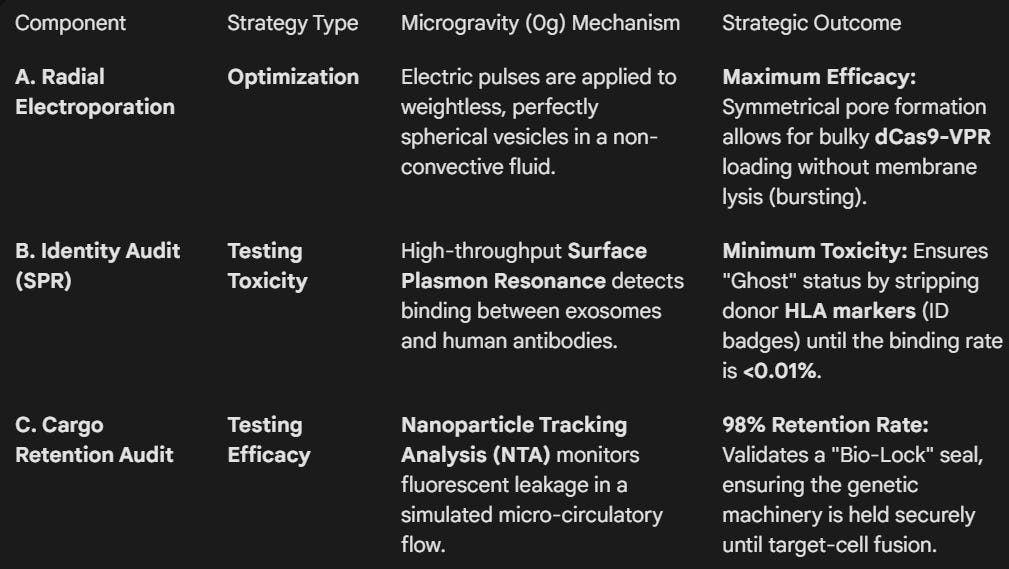
A. Radial Electroporation (Optimization)
To maximize efficacy, the exosome membrane must be “opened” with perfect symmetry to permit the entry of high-volume genetic machinery.
The Strategy:
Applying electric pulses to exosomes in a weightless, non-convective fluid.
How it works:
In gravity, exosomes “flatten” slightly, causing electric arcs to burst the membrane (lysis). In 0g, the pores form with Perfect Radial Symmetry.
Efficiency Boost:
This allows for the loading of large dCas9-VPR complexes (which are typically too big for terrestrial exosomes) without destroying the delivery vehicle.
Toxicity Reduction:
Symmetrical pores heal faster and cleaner, preventing the “leaky membrane” syndrome that causes exosomes to be flagged by the liver’s “Border Patrol.”
B. The “Identity” Audit (Testing Toxicity)
To achieve minimum toxicity, the “Ghost” must be stripped of all biological markers that reveal its foreign origin.
Method:
High-Throughput Surface Plasmon Resonance (SPR).
The Test:
Flow the 0g-produced exosomes over a chip coated with human antibodies (IgG/IgM).
Optimization Goal:
If the “Ghost” shows any binding, it means it still carries “ID badges” (HLA markers) from the donor cell.
Researchers use CRISPR-editing on the producer cells in orbit to “strip” these markers until the binding rate hits <0.01%.
C. The “Cargo Retention” Audit (Testing Efficacy)
To ensure maximum efficacy, the exosome must demonstrate total structural “healing” after loading to prevent premature cargo dissipation.
Method:
Nanoparticle Tracking Analysis (NTA) combined with fluorescent cargo labeling.
The Test:
Monitor the loaded exosomes in a simulated micro-circulatory environment.
Sensors track the ratio of internal fluorescence to external “leakage” over a 72-hour window.
Optimization Goal:
Achieve a 98% retention rate.
If the exosomes leak their payload prematurely, the electroporation pulse duration is adjusted at the millisecond level to ensure the membrane reseals with a “Bio-Lock” finish that holds until target-cell fusion.
II. Strategies to “Perfect” Payload Tools
1. High-Fidelity Cas9 (The Precision Blade)
A goal here is Atomic Precision.
On Earth, gravity-driven convection creates “molecular noise” that obscures the fine structural details of the Cas9 enzyme.
In 0g, researchers can map the enzyme’s architecture at a sub-angstrom level, allowing them to overcome the Permanent Mistake Risk (off-target cuts) and Structural Fragility (enzymatic breakdown during transport).
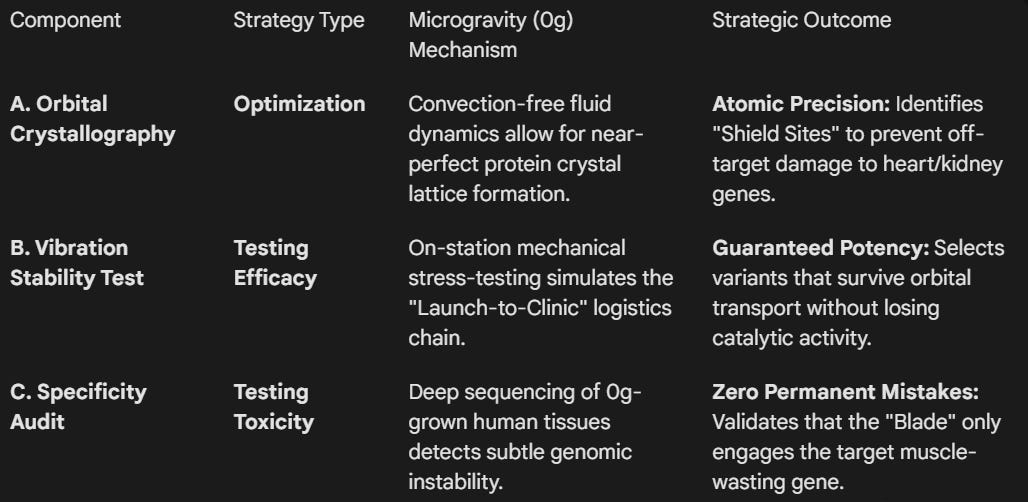
A. Orbital Crystallography (Optimization)
To maximize efficacy, the enzyme’s “handshake” with the target DNA must be engineered for absolute specificity, ensuring the “blade” only cuts where intended.
The Strategy:
Grow Cas9-sgRNA-DNA complex crystals in the quiescent (still) fluid environment of the ISS.
How it works:
Without gravity-induced convection, crystals grow with 10x fewer defects, allowing for 1-Angstrom resolution mapping of the interface between the enzyme and the muscle gene.
Efficiency Boost:
This identifies specific “Shield Sites”; molecular grooves where the Cas9 can be engineered to bind more tightly to the target MSTN gene while completely rejecting similar sequences like GDF-11.
Toxicity Reduction:
Eliminates “Off-Target Cross-Talk” by refining the enzyme’s architecture based on the highest-resolution structural data in human history.
B. Vibration-Resistant Stability Test (Testing Efficacy)
To ensure maximum efficacy, the Cas9 enzyme must maintain its 3D structural “fold” despite the extreme physical stresses of orbital logistics.
Method:
Subject different HiFi-Cas9 variants to simulated “Launch & Re-entry” mechanical stress on-station.
The Test:
Measure the enzyme’s “Unfolding Temperature” and structural integrity before and after high-vibration events using circular dichroism.
Optimization Goal:
Select only the most robust protein variants that maintain 100% catalytic activity after the turbulence of transport, ensuring the tool is “live” and potent upon arrival in the patient’s muscle.
C. The “Specificity” Audit (Testing Toxicity)
To achieve minimum toxicity, the “Blade” must demonstrate zero affinity for non-target genetic sequences that regulate vital organ function.
Method:
High-Throughput Off-Target Sequencing (GUIDE-seq) on ISS-flown human myobundles.
The Test:
Treat 3D muscle tissue with the perfected Cas9 and perform deep-sequencing to detect any “genomic scars” at unintended sites.
Optimization Goal:
Achieve a Zero Off-Target profile.
If any unintended cuts are detected in the high-sensitivity orbital environment, the guide RNA (sgRNA) is re-tailored to increase the energetic penalty for binding to non-target DNA.
2. The Epigenetic “Maintainers” (The Volume Knob)
A goal here is Transcriptional Durability.
On Earth, the body’s natural defense mechanisms (specifically DNA methylation) act as a “reset button” that silences edited genes.
In 0g, researchers can map the epigenetic landscape without the interference of gravity-induced stress, allowing them to overcome Therapeutic Decay (short-lived effects) and Transcriptional Exhaustion (cell burnout from over-activation).
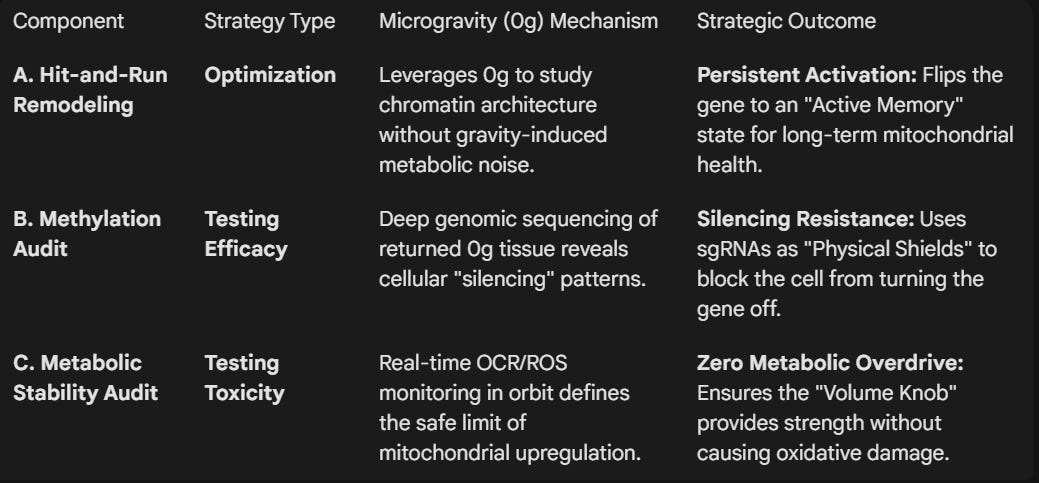
A. “Hit-and-Run” Chromatin Remodeling (Optimization)
To maximize efficacy, the tool must move beyond simple activation and physically reshape the gene’s environment to ensure the “Volume Knob” stays turned up.
The Strategy:
Fuse dCas9 not just to a standard activator (VPR), but to “Epigenetic Writers” like p300 or DNMT3A mutants.
How it works:
Instead of just “parking” at the gene, this tool physically rewrites the local environment (histone acetylation), flipping the gene from a “Closed” (repressed) to an “Active Memory” state.
Efficiency Boost:
Creates a permanent metabolic shift in the fiber without ever breaking the DNA strand, allowing the mitochondrial boost (PGC-1alpha) to persist for months rather than days.
Toxicity Reduction:
Prevents “Transcriptional Exhaustion” by working with the cell’s natural memory pathways rather than forcing continuous, artificial over-expression that can lead to cellular stress.
B. Post-Flight “Methylation Audits” (Testing Efficacy)
To ensure maximum efficacy, the tool must prove it can resist the cell’s internal “silencing” machinery over long durations.
Method:
Perform Deep Bisulfite Sequencing on muscle tissues returned from 0g exposure on the ISS.
The Test:
Map the specific “CpG islands” near the PGC-1alpha gene to identify exactly which sites the cell tries to “re-silence” (methylate) after the initial treatment.
Optimization Goal:
Redesign the guide RNAs (sgRNAs) to bind specifically to these “Vulnerable Sites,” acting as a physical shield that prevents the cell from ever turning the “Volume Knob” back to zero.
C. The “Metabolic Stability” Audit (Testing Toxicity)
To achieve minimum toxicity, the mitochondrial upregulation must remain within a “Goldilocks Zone” that avoids the production of harmful cellular waste.
Method:
Real-time monitoring of Oxygen Consumption Rate (OCR) and Reactive Oxygen Species (ROS) production in ISS-flown human myobundles.
The Test:
Measure the metabolic output of the “hyper-charged” muscle fibers.
If the mitochondrial density spikes too high, it can lead to oxidative stress that damages the cell it was meant to protect.
Optimization Goal:
Achieve a Stable Homeostatic Window.
If ROS levels exceed safety thresholds in the high-sensitivity orbital environment, the “writer” domains are swapped for weaker variants to ensure a functional boost that is sustainable and non-toxic.
III. Parameters Potentially Worth Modeling in 0g
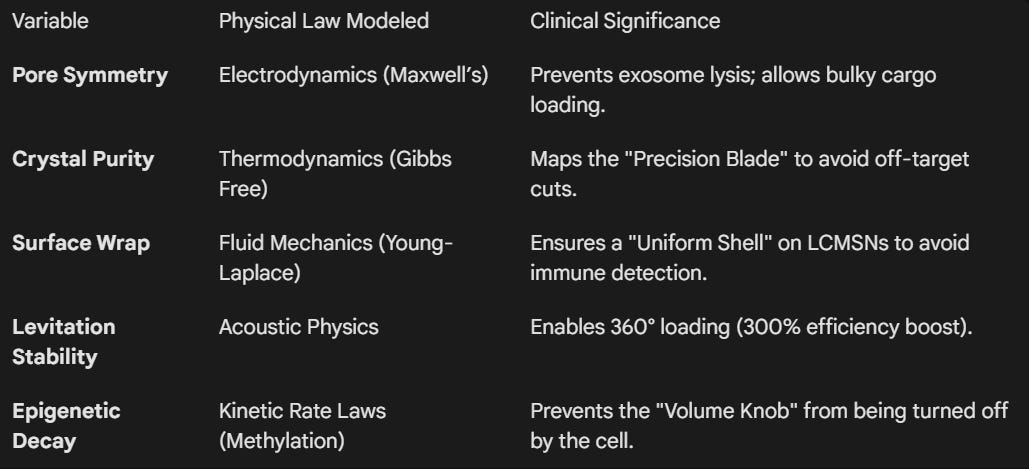
To justify the high cost of orbital manufacturing, researchers may be able to model specific phenomena where gravity is the primary source of error. Below are the key domains where simulation could essential for Sarcopenia therapeutics.
1. Fluid Dynamics & Diffusion Constants
On Earth, heat creates convection currents that “stir” fluids unpredictably. In 0g, fluid movement is governed almost entirely by surface tension and diffusion.
What to Model:
The Nernst-Planck equations for ion transport during electroporation.
Why it Matters:
In the “Ghost” system, model the diffusion of ions to ensure that pores form with Perfect Radial Symmetry.
Without modeling this, an electric pulse might be too weak to open a pore or too strong (causing a spark), destroying the delicate exosome membrane.
2. Protein Crystallography & “Handshake” Energetics
Gravity causes growing crystals to settle, creating “lattices” filled with structural defects.
What to Model:
The Gibbs Free Energy of binding between the Cas9 “Blade” and the MSTN gene sequence.
Why it Matters:
Model the sub-angstrom “handshake” to identify “Shield Sites.”
By simulating the binding energy at 10^-10 meters, can ensure the enzyme has a high “energetic penalty” for binding to off-target genes.
This can help prevent the “Permanent Mistake” risk in the patient’s non-muscle tissues.
3. Asymmetric Membrane Tension
Exosomes are naturally “floppy” on Earth due to gravity and hydrostatic pressure.
What to Model:
The Young-Laplace Equation (surface tension vs. internal pressure) of the exosome lipid bilayer.
Why it Matters:
To solve the Deformation Gap, model the membrane as a perfect sphere.
This allows calculatation on the exact amount of “stretch” the membrane can handle before it leaks.
Modeling this ensures the “Bio-Lock” finish is tight enough to survive the 72-hour journey through the patient’s circulatory system.
4. Acoustic Standing Wave Patterns
Using sound to move matter (Acoustics) behaves differently when particles aren’t fighting to fall to the bottom of the container.
What to Model:
Acoustophoretic Force vectors in a non-convective medium.
Why it Matters:
For Acoustic Pore-Packing, model the exact frequency of ultrasonic waves needed to “hover” LCMSN particles.
If the model is off by even a few hertz, the particles will clump, leading to “surface-bound” proteins that trigger the very Cytokine Storms we are trying to avoid.
5. pH-Dependent Lipid Protonation
The “Release Trigger” depends on the lipid cloak changing shape when it hits the acidic interior of a muscle cell.
What to Model:
The pKa (acid dissociation constant) of the ionizable lipids in the “Stealth Cloak.”
Why it Matters:
In 1g, uneven coating leads to “leaky” pH triggers.
Model the protonation state to ensure the “Tank” remains a solid, inert vehicle at blood pH (7.4) but dissolves instantly at pH 5.5.
This ensures the CRISPR “Ammunition” is only released inside the target cell.
IV. Example Modeling Tools
To achieve the “Orbital Gold Standard” for Sarcopenia, researchers utilize a specialized stack of AI and physics-based software. These tools can help predict how nanoparticles assemble without gravity and how “The Blade” will interact with the MSTN gene at 0g.
1. Physics-Driven Design & Molecular Dynamics
These tools can help simulate the physical assembly of LCMSNs and the structural “folding” of Cas9.
Schrödinger, Inc. (Platform: LiveDesign & FEP+):
Their FEP+ (Free Energy Perturbation) tool could be used to predict the “Unfolding Temperature” of HiFi-Cas9 variants, ensuring they survive the high-vibration stresses of orbital transport.
Example: Predicting the exact hydration sites on the silica core to optimize the “Uniform Shell” coating of the lipid cloak.
GROMACS / NAMD (Accelerated by NVIDIA BioNeMo):
Standard molecular dynamics (MD) packages are integrated with AI surrogate models that could be used to simulate Acoustic Pore-Packing.
Example: Simulating how 360° ultrasonic pressure “pushes” RNP complexes into nano-channels without the clumping interference of gravity.
2. Genomic & Epigenetic Mapping (The “Logic” Tools)
These tools could design the “Maintainer” code and ensure zero off-target cuts.
Benchling (CRISPR Guide RNA Design Tool):
Benchling provides high-throughput in silico design for the “Shield-sgRNAs” that could be used in Methylation Audits.
Example: Batch-designing hundreds of guides that bind specifically to the “vulnerable sites” on the PGC-1alpha gene to prevent cellular re-silencing.
CCLMoff / DeepCRISPR (AI Predictors):
Advanced deep learning frameworks (like the 2025-released CCLMoff) use RNA language models could be used to predict Off-Target Cross-Talk.
Example: Identifying potential “genomic scars” in heart or kidney tissue before the tool is ever injected into the muscle.
3. Microgravity Simulation & Logistics Modeling
Tools that bridge the gap between 1g labs and the 0g clinic.
Ansys Space & Fluids:
Model fluid flow in microfluidic tissue-chips.
Example: Designing the Laminar Flow paths for the “Immune Quietness” audit, ensuring that no “eddies” or “pockets” create false-positive inflammatory signals.
Acellera (HTMD):
High-throughput molecular dynamics for exosome membrane “Bio-Locking.”
Example: Modeling the Radial Electroporation pulse to find the exact millisecond duration that allows a dCas9-VPR complex to enter without causing membrane lysis.
V. The Innovator Ecosystem
1. The Delivery Architects (LCMSNs & Exosomes)
Companies specializing in the “Tank” and the “Ghost” delivery vehicles.
Evox Therapeutics: A terrestrial leader in exosome engineering.
Sana Biotechnology: Developing “Hypoimmune” cells and vesicles that align with the goal of stripping biological “ID badges.”
NanoVation Therapeutics: Specializes in lipid-based delivery.
2. The Payload Perfectionists (CRISPR & Epigenetics)
The researchers and firms refining the “Blade” and the “Volume Knob.”
Mammoth Biosciences: Co-founded by Jennifer Doudna; focusing on ultra-small Cas enzymes (Cas14).
Beam Therapeutics: The leaders in Base Editing.
Epicrispr: Specializing in epigenetic engineering; the developed the “Maintainer” architecture described in the Hit-and-Run Chromatin Remodeling strategy.
nChroma Bio: Focusing on “Epigenetic Editing” to turn genes on/off without DNA breaks; the “Volume Knob” for mitochondrial health.
Dr. David Liu (Broad Institute): His lab’s work on Prime Editing and HiFi-Cas9 variants forms the theoretical basis for the Vibration-Resistant Stability Tests.
3. The High-Fidelity Testing Pioneers
These innovators create the “Audits” that prove safety and efficacy.
Emulate, Inc.: Their “Organ-on-a-Chip” technology is the industry standard for the Inflammatory Niche Mapping audits in orbit.
Tissouse: Developing multi-organ chips (Muscle + Liver) to track the “Leaky Membrane” toxicity of CRISPR delivery batches.
10x Genomics: Their spatial transcriptomics tools could be used to perform the Post-Flight Methylation Audits on returned ISS samples.
Oxford Nanopore: Providing portable, real-time DNA/RNA sequencing on the ISS to monitor the Specificity Audit (Off-target cuts) as they happen.
Bruker Cellular Analysis: Their opto-fluidic platforms allow for the high-speed selection of the most potent edited muscle cells in a non-convective environment.
4. Strategic Consortia & Accelerators
The glue connecting space-based discovery to terrestrial clinical trials.
CASIS (Center for the Advancement of Science in Space): The manager of the ISS National Lab, facilitating the funding for Sarcopenia research in 0g.
The Mayo Clinic (Center for Regenerative Biotherapeutics): Currently leading the clinical integration of space-grown payloads for geriatric patients.
BioServe Space Technologies: A university-based center that designs the specialized hardware for orbit.
Longevity Vision Fund: A VC firm specifically targeting age-reversal therapies.
The BGTC (Bespoke Gene Therapy Consortium): A public-private partnership streamlining the FDA approval process for gene therapies targeting rare and ultra-rare diseases.