
Modular Nuclear Micro-Reactors [Concept]
By utilizing high-energy-density radioisotopes (like Americium-241) and modular fission architectures, there is an opportunity for “plug-and-play” power that survives where traditional grids cannot.

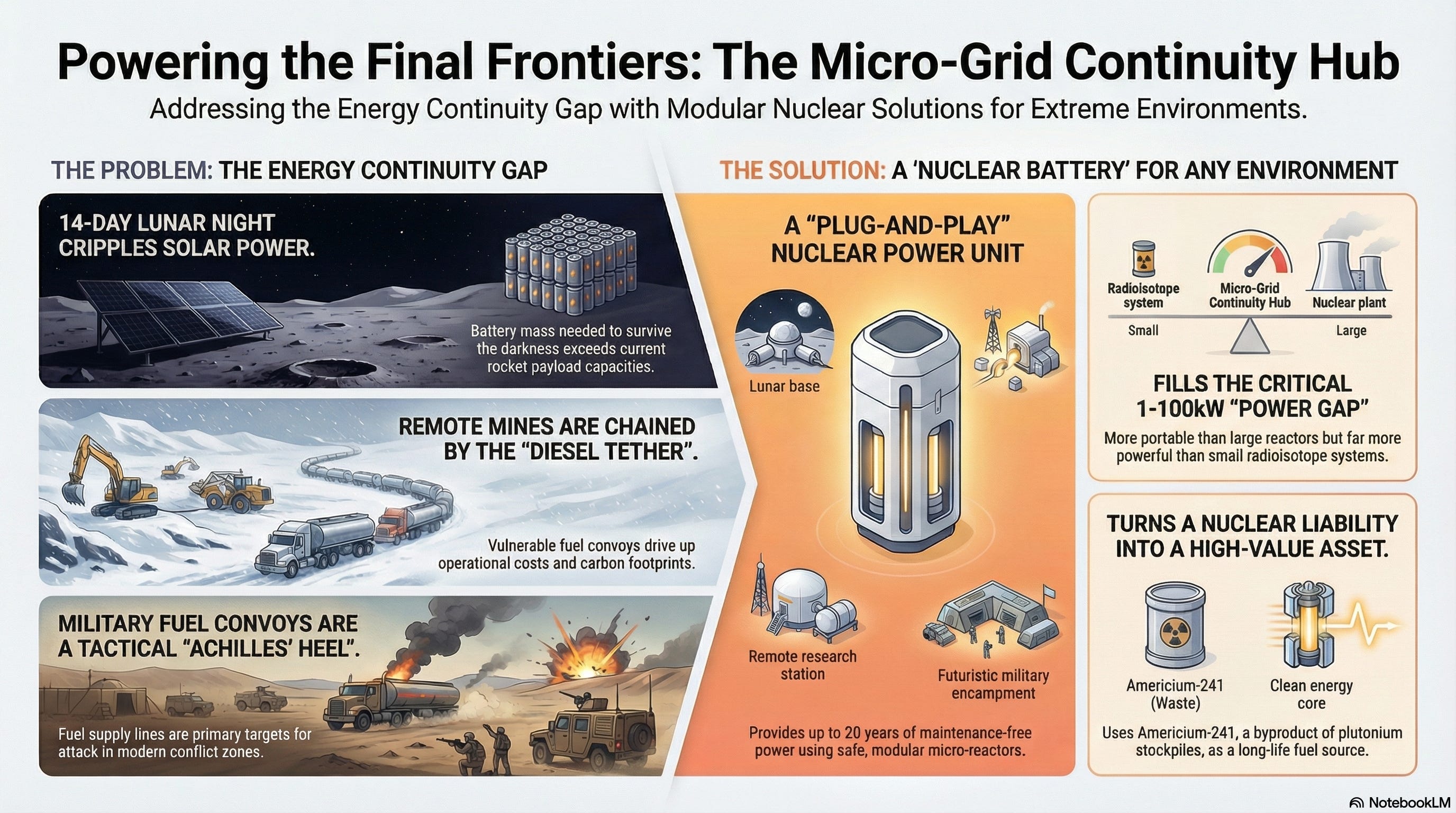
The primary bottleneck for high-frontier operations, whether in the lunar night, the Arctic Circle, or a forward-deployed military zone, is the Energy Continuity Gap.
Renewable sources are intermittent, and chemical fuels (diesel) are logistically “heavy” and carbon-intensive.
The Micro-Grid Continuity Hub (MGCH) is a proposed strategic consortium designed to commercialize Modular Fission Micro-Reactors (1-100kW).
By utilizing high-energy-density radioisotopes (like Americium-241) and modular fission architectures, the MGCH could provide “plug-and-play” power that survives where traditional grids cannot.
This could move us from a world of “energy-rationing” and “diesel-dependency” to a new era of Autonomous Basaload Resilience.
The MGCH could aim to address the challenge of continuous power across three key domains:
Lunar Exploration: Providing the critical “always-on” heartbeat for the Artemis era, powering In-Situ Resource Utilization (ISRU) processing plants and life support systems through the 14-day lunar night.
Terrestrial Mining: Decarbonizing the “blind” remote mines of the High Arctic and deep deserts, replacing expensive, carbon-heavy diesel convoys with 20-year maintenance-free power units.
National Defense: Eradicating the “logistical tail” by powering Forward Operating Bases (FOBs) and mobile directed-energy weapon systems with self-contained units that require no vulnerable fuel supply lines.
I. The “Energy Continuity” Barrier
The MGCH could address the physical and logistical limits of current power generation in extreme environments.
The Lunar Night Survival Gap: A lunar night lasts 354 hours (14 Earth days). Solar power is non-functional, and battery densities are insufficient to sustain life support and Industrial In-Situ Resource Utilization (ISRU) at scale.
The “Diesel Tether” in Mining: Remote terrestrial mines rely on “ice roads” or convoys for diesel. Fuel can account for a significant amount of the operational costs and a site’s carbon footprint.
The Vulnerable Supply Line (Defense): Forward Operating Bases (FOBs) are often powered by fuel convoys that are primary targets for asymmetric threats. A mobile, self-contained power unit could eliminate this tactical “Achilles’ heel.”
The Heat Bottleneck: Many remote processes (mineral leaching, lunar habitation) require thermal energy as much as electricity. Traditional renewables provide only power; the MGCH could provide simultaneous Co-Generation (Heat + Power).
II. The Potential Technical Stack
A modular power framework combining nuclear physics with advanced solid-state conversion to create a “Nuclear Battery.”
Americium-241 Radioisotope Power Systems (RPS): Utilizing Am-241 (a byproduct of plutonium decay) which offers a longer half-life than Plutonium-238. This allows for decades of maintenance-free heat generation, ideal for long-duration lunar “baseload” power.
Modular Fission Micro-Cores: Low-enriched uranium (HALEU) cores designed with “inherent safety”.
Stirling & Thermoelectric Conversion: High-efficiency Stirling engines or solid-state thermoelectric generators that convert the heat from the core into 1-100kW of “always-on” electricity.
Shielded “Plug-and-Play” Casing: Multi-layered tungsten and lead-composite shielding integrated into a standard ISO-container format (terrestrial) or a hexagonal “Lunar Cell” format for easy deployment via robotic landers.
III. Intellectual Property (IP) Generation
“Isotope-Sync” Power Electronics: An inverter system that manages the steady, unceasing output of a nuclear core and integrates it with local “surge” storage (supercapacitors) for high-load events.
Thermal-Vault Architecture: IP surrounding a closed-loop heat exchange system that can divert excess reactor heat to melt subsurface ice or warm a pressurized habitat without contaminating the environment.
“Black-Start” Autonomous Control: AI-driven software that allows the micro-grid to self-synchronize and restart without human presence, critical for “unattended” terrestrial mining sensors or lunar depots.
Radiation-Hardened Digital Twin: A real-time monitoring protocol that uses fiber-optic sensing to track core health and fuel depletion over a 20-year lifespan.
IV. Alternative Approaches & Competitors
1. Solar-Battery & Fuel Cell Arrays
The Model: Deployment of massive photovoltaic (PV) fields coupled with Lithium-ion or Hydrogen storage.
The NASA/Industry Landscape: Companies like Intuitive Machines utilize solar for short-duration (14-day) missions.
The Problem: In the Lunar South Pole or the Arctic, “Solar-only” systems require a 100:1 storage-to-generation ratio to survive the 14-day lunar night or 3-month polar winter. For a 100kW load, the battery mass exceeds the payload capacity of current heavy-lift rockets (Starship/SLS).
MGCH Value: “Dark-Start” Autonomy. By removing the sun from the equation, MGCH reduces total system mass by 80% for long-duration missions and ensures baseload continuity.
2. NASA’s Fission Surface Power (FSP) Project
The Model: NASA, in partnership with the Department of Energy (DOE), is developing a 100kWe class reactor for the Artemis missions.
The Competitors: In 2022, NASA awarded Phase 1 contracts to Lockheed Martin, Westinghouse, and IX (a joint venture between Intuitive Machines and X-energy).
The Bottleneck: NASA’s FSP is potentially a “bespoke” space asset and may lack a terrestrial “dual-use” path for commercial mining or defense.
MGCH Value: Modular Ubiquity. MGCH focus could be on 1-10kW modular units (using Americium-241 and HALEU) that are mass-produced for both Arctic mines and lunar habitats offering a “Commercial-Off-The-Shelf” (COTS) approach to nuclear power.
3. Mobile Micro-Reactors (Defense & Commercial)
The Model: Project Pele (US Department of Defense) and Westinghouse’s eVinci micro-reactor.
The Competitors:
BWXT & X-energy: Currently building prototypes for Project Pele, targeting a mobile 1-5MW reactor for military bases.
Westinghouse eVinci: A “nuclear battery” design using heat pipes to deliver 5MWe. It is targeting remote mining and data centers.
Ultra Safe Nuclear (USNC): Developing the Micro Modular Reactor (MMR) for industrial heat and remote power.
The Problem: Most “micro” reactors are still sized in the Megawatt (MW) range. They require semi-truck transport and are too heavy (30+ tonnes) for lunar landers or rapid-deployment drone delivery.
MGCH Value: The 1-100kW Sweet Spot. MGCH could fill the “Power Gap” between low-output RTGs (200W) and heavy micro-reactors (5MW). Units could be “man-portable” or “rover-mountable,” providing the precise scale needed for ISRU plants and Forward Operating Bases.
V. Potential Consortium Deliverables
The MGCH consortium could provide a comprehensive ecosystem spanning specialized hardware, autonomous control software, and international regulatory frameworks to ensure nuclear continuity is as accessible as a diesel generator but with zero-emission endurance.
1. The “Continuity-Cell” Modular Power Unit (Hardware)
The primary physical deliverable could be a self-contained, 10kW nuclear power module designed for rapid deployment via heavy-lift drones (terrestrial) or Commercial Lunar Payload Services (CLPS) landers.
Technical Specification: A hermetically sealed “Nuclear Battery” utilizing an Am-241 isotope core (or HALEU fission fuel) coupled with high-reliability Stirling convertors and redundant heat-pipes. The unit could feature an integrated Graphene-based Deployable Radiator for thermal rejection and a tungsten-boron composite radiation shield optimized for “safe-to-touch” handling within 2 meters. It could be designed to be “cold-start” capable, generating power immediately upon activation without external heaters.
Commercial Utility: This unit could seek to eliminate the “infrastructure lag” in remote operations by allowing a mining company or a defense unit to drop a power source into a mountain pass or lunar crater and have immediate, high-density energy without laying kilometers of cable or establishing a fuel supply line.
2. The “Grid-Master” OS & Autonomous Dispatch (Software)
A resilient, AI-driven power management system (PMS) designed to operate without human intervention for years at a time in communications-denied environments.
Technical Specification: A decentralized Load-Balancing Algorithm that performs real-time sensor fusion of reactor health, battery state-of-charge, and environmental demand. The OS could utilize Predictive Thermal Management to divert excess heat from the core into secondary “Heat-Sinks” (e.g., habitat heating or water-ice melters) to prevent reactor “poisoning” or thermal shutdown. It could include an Air-Gapped Cybersecurity Layer with a hardware-root-of-trust to prevent remote hijacking of the micro-grid.
Commercial Utility: For lunar ISRU, the “Grid-Master” could ensure that life-support never loses power during a peak processing cycle. For terrestrial mining, it could allow for a “Lights-Out” operation where the power grid self-heals and adjusts to seasonal temperature shifts in the Arctic without requiring a resident technician team.
3. The “Arctic-Shield” & Lunar Cryo-Housings (Deployment Kits)
Specialized environmental integration packages that adapt the core “Continuity-Cell” to the world’s most punishing thermal gradients.
Technical Specification: For terrestrial use, a Vacuum-Insulated Permafrost Sleeve that prevents the reactor’s waste heat from melting the surrounding ground (avoiding “ground-heave”). For lunar use, a Gold-Coated Multi-Layer Insulation (MLI) shroud and a piezo-electric self-leveling base that ensures the unit remains stable on uneven regolith. Both kits could include Inductive Power Transfer (IPT) pads, allowing rovers or UGVs to “recharge by proximity” without physical plugs that could fail due to dust or ice.
Commercial Utility: This “ruggedization” allows a single reactor design to be sold into two vastly different markets. It could enable Rio Tinto to power sensors in -60°C tundra and the MOD to power directed-energy sensors in dusty, high-vibration forward environments using the same core hardware.
4. The “Isotope-Cradle” Lifecycle Protocol (Compliance & Audit)
Developed with the National Nuclear Laboratory (NNL) and the IAEA, this could be a formal “Cradle-to-Grave” certification and logistics framework for the non-proliferation and recovery of nuclear materials.
The Deliverable: A blockchain-backed Chain-of-Custody Ledger known as the “Sovereign-Fuel Standard.” This protocol could define the requirements for the “Nuclear-as-a-Service” (NaaS) model, where the consortium retains ownership of the fuel. It could include a Terminal Recovery Blueprint in the form of a pre-funded, robotic-ready decommissioning plan that ensures spent units are retrieved and returned to a centralized recycling facility for Am-241 re-purposing.
Commercial Utility: This framework de-risks the project for private investors and host nations. It provides banks and insurers with a “Zero-Liability” guarantee for the end-user, ensuring that the mining company or military branch is never left with a “radiological legacy.” It could turn a complex nuclear regulatory hurdle into a standardized, “tick-box” commercial agreement.
VI. Example Consortium Partners
1. Rolls-Royce (UK)
The “Nuclear Prime”: Modular Fission & Space Power Systems
Business Case: Rolls-Royce is pivoting its storied history in naval nuclear propulsion toward the burgeoning “Micro-Grid” market. By miniaturizing reactor technology originally designed for submarines, they can capture the “off-grid” energy market, which is projected to grow exponentially as terrestrial mining decarbonizes and the lunar economy matures.
Value Contributed: Decades of experience in high-integrity nuclear engineering, shielding physics, and recent UK Space Agency-backed R&D into the Space Micro-Reactor. They could provide the core IP for the heat-pipe cooling and the Stirling engine power conversion units.
Value Received: A rapid commercialization pathway for their Micro-Reactor IP into non-maritime sectors. This diversifies their revenue streams into terrestrial mining and mobile defense, while amortizing the high cost of space-grade nuclear R&D across terrestrial high-volume markets.
2. National Nuclear Laboratory (NNL)
The “Isotope Engine”: Domestic Fuel Supply & Radiochemistry
Business Case: The NNL is the custodian of the UK’s nuclear knowledge. By spearheading the extraction of Americium-241 from civil plutonium stockpiles, the NNL could transform an expensive national storage liability into a high-value export commodity that provides decades of maintenance-free heat.
Value Contributed: World-leading expertise in actinide chemistry and the only UK facilities capable of handling and processing radioisotopes into fuel pellets for Radioisotope Power Systems (RPS). They bridge the gap between “waste” and “fuel.”
Value Received: Direct application for their “Plutonium Management” mandate, proving the “Circular Nuclear” model. It elevates the NNL from a research body to a critical upstream supplier for the global deep-space and remote-power supply chains.
3. Rio Tinto (The Mining Anchor)
The “Commercial Infrastructure”: Terrestrial Scaling & Field Validation
Business Case: Rio Tinto has the desire to reach “Net Zero” and is seeking to address the exhaustion of surface-level mineral deposits. To mine deeper and in more remote regions (like the High Arctic), they will likely need to break their reliance on massive, carbon-heavy diesel convoys that are vulnerable to both climate change (melting ice roads) and price volatility.
Value Contributed: A multi-billion dollar operational footprint, access to extreme-environment test beds (e.g., the Diavik Diamond Mine), and the technical requirements for integrating micro-grids into heavy industrial machinery and autonomous hauling fleets.
Value Received: Early-access to “Continuity-Cells,” providing a massive competitive advantage in operational cost reduction. This could enable them to bid on remote mineral concessions that are currently “uneconomic” due to energy logistics, while meeting aggressive ESG targets.
4. Ministry of Defence (MOD) / DSTL
The “Strategic Guardian”: Tactical Energy Independence
Business Case: Modern military doctrine requires “Energy Resilience.” The MOD needs to power Forward Operating Bases (FOBs) and high-drain assets (like Directed Energy Weapons and Signal Intelligence arrays) without the “Targetable Trail” of fuel trucks. The MGCH could provide a power source that is invisible to thermal tracking.
Value Contributed: Formal “Statement of Requirements” for mobile nuclear safety, access to secure testing ranges (e.g., Otterburn or Salisbury Plain), and the regulatory weight to establish “Sovereign Energy” corridors for the movement of modular nuclear assets.
Value Received: A decisive tactical edge. The ability to deploy a 10kW-100kW “silent” power anywhere on Earth, or the Moon, provides a strategic deterrent and logistical freedom that current fossil-fuel-dependent forces lack.
VII. Sample Work Packages (WPs)
WP 1: The Isotopic Core (Miniaturization & Heat Flux)
Objective: To optimize the geometry of the Americium-241 fuel pellets and the primary heat-pipe interface to maximize thermal-to-electric conversion while minimizing the shield-to-fuel mass ratio.
Example Partners: Rolls-Royce (Lead), National Nuclear Laboratory (NNL), University of Manchester (Nuclear Materials).
Example Deliverables:
The “High-Flux” Fuel Matrix: A proprietary cermet (ceramic-metallic) fuel pellet design that enhances thermal conductivity, preventing localized “hot-spots” and extending the operational life of the Stirling convertors.
Tungsten-Lithium Gradient Shielding: A multi-layered, topologically optimized radiation shield that utilizes 3D-printed tungsten gradients to attenuate gamma and neutron flux with less mass than traditional lead shielding.
The Capillary-Driven Heat Interface: A redundant array of alkali-metal heat pipes that passively transfer thermal energy from the core to the power block, eliminating the need for mechanical pumps or moving parts within the primary containment.
WP 2: The Vacuum-Radiator Array (Lunar Survivability)
Objective: To engineer a thermal rejection system capable of shedding waste heat in a vacuum while surviving the 300K temperature swings of the lunar surface.
Example Partners: Rolls-Royce (Space Lead), STFC RAL Space (Thermal Testing), Lockheed Martin UK.
Example Deliverables:
Deployable Graphene Radiator Fins: Ultra-lightweight, high-emissivity carbon-composite fins that unfurl post-landing, providing a high surface-area-to-weight ratio for radiative cooling in the lunar PSRs.
The “Night-Cycle” Thermal Switch: A passive thermal valve that prevents the core from over-cooling during the 14-day lunar night, maintaining the electronics at a steady +10°C while the external environment drops to 40K.
Dust-Repellent Electrodynamic Shields: An integrated coating for the radiators that uses high-voltage, low-current pulses to “flick” abrasive lunar regolith off the cooling surfaces, maintaining thermal efficiency over decades.
WP 3: The “Digital Safeguard” (Autonomous Compliance)
Objective: To develop a tamper-proof, remote-monitoring sensor suite that provides the IAEA and national regulators with real-time assurance of fuel integrity without requiring physical inspections.
Example Partners: NNL (Safeguards Lead), CGI UK (Cyber Security), IAEA (Advisory).
Example Deliverables:
Quantum-Key Encrypted Telemetry: A secure S-band and satellite uplink that beams “state-of-health” data (neutronic flux, temperature, GPS) to a sovereign control center using post-quantum encryption.
The “Active-Seal” Fiber Optic Loop: A fiber-optic mesh wrapped around the reactor pressure vessel that triggers an immediate “dead-man” data wipe and alert if the casing is mechanically breached or tampered with.
WP 4: The “Cradle-to-Grave” Standard (Stewardship & Recovery)
Objective: To establish the legal and logistical framework for “Nuclear-as-a-Service” (NaaS), ensuring the consortium retains responsibility for the fuel from fabrication to final recycling.
Example Partners: Nuclear Decommissioning Authority (NDA), Rio Tinto (Field Logistics), Department for Energy Security and Net Zero (DESNZ).
Example Deliverables:
The MGCH “Passport” & Ledger: A blockchain-based digital twin for every unit, recording every flight, deployment site, and exposure hour to ensure a transparent audit trail for the 20-year lifecycle.
Robotic Recovery “Hot-Dock”: A standardized mechanical interface that allows autonomous UGVs or lunar rovers to “grab-and-go” with a spent unit, simplifying the retrieval process for terminal decommissioning.
The Isotope Recovery Facility (IRF) Blueprint: A design for a centralized UK-based facility that receives spent Am-241 units, refurbishes the hardware, and recycles the isotope into new “Continuity-Cells.”
VIII. Strengths, Limitations, & Risks
A. Core Strategic Strengths
The “Always-On” Advantage: Unlike solar or hydrogen, the MGCH is capable of providing baseload (24/7/365) power in “denied” environments (lunar night/Arctic winter) without a supply chain.
Waste-to-Asset Conversion: By using Am-241, the consortium could turn the UK’s civil plutonium stockpile from a multi-billion pound liability into the “gold standard” of deep-space fuel.
Dual-Use Amortization: The R&D costs for a lunar reactor are directly subsidized by high-volume terrestrial sales to the mining and defense sectors, creating a “virtuous cycle” of TRL advancement.
B. Structural Limitations
Mass-to-Power Floor: Nuclear shielding has a minimum physics-based mass. While highly efficient at 10kW+, it is difficult to scale down to “backpack” size (<100W) compared to traditional primary batteries.
Public Perception & “NIMBY” (Not In My Back Yard): Despite inherent safety, the word “nuclear” creates local resistance. Terrestrial mining deployments may require significant “Social License to Operate” (SLO) investment.
Thermal Rejection Bottleneck: In a vacuum (Moon) or stagnant air (deep mine), shedding waste heat is harder than generating it. The system’s size is often dictated by its radiators, not its reactor core.
C. Critical Risks & Mitigation Strategies
Regulatory Gridlock (Geopolitical Risk): Transporting nuclear material across borders for a private mine could take years of permitting.
Mitigation: Use a “Leasing/NaaS” model where the consortium (sovereign-backed) retains ownership, treating the reactor as a “Service” rather than a “Sale.”
Launch/Transport Accident: A crash during transport or launch could scatter material.
Mitigation: The fuel is encapsulated in “Aero-shell” impact-resistant ceramic layers designed to survive a 100mph impact or a launch-vehicle explosion without breaching.
Cyber-Sabotage: Remote micro-grids could be targeted by state actors.
Mitigation: The “Grid-Master” OS could utilize an air-gapped, hardware-only “Logic Controller” for safety-critical functions that cannot be overridden by external software commands.
IX. The ROI & Strategic Interest
1. The “Lunar Ice-Rush” Catalyst
The MGCH could be the “Golden Spike” enabler for the Artemis era.
Economic Unlock: Every kg of water-ice mined on the Moon via MGCH power saves $100,000 in launch costs from Earth. A single 10kW unit could facilitate the extraction of many tonnes of ice over its life.
2. Decarbonizing the “Hard-to-Abate” Arctic
For miners like Rio Tinto, the MGCH could be a tool for Operational Resilience.
Direct Cost Savings: Replacing a single 100kW diesel generator in the Arctic could save 250,000 liters of fuel/year.
Carbon Credits: Elimination of CO2 emissions from remote sites could allow mining firms to capture premium pricing for “Green Minerals” (Lithium/Nickel) required by the EV industry.
3. Sovereign Energy Sovereignty (UK Defence)
The MOD could gain a “Mobile National Grid.”
Tactical Freedom: FOBs no longer require “fuel-convoys,” which are a key cause of casualties in recent asymmetric conflicts. The ROI here could be measured in lives saved and mission endurance.
Strategic Reserve: In the event of a domestic grid failure or cyber-attack, a fleet of MGCH units could provide a mobile, resilient emergency power backbone for hospitals, command centers, and critical infrastructure.