
Open Lunar Foundation [Case Study]
Non-profit focused on creating open-source tools and legal frameworks designed to ensure humanity’s return to the Moon is peaceful, cooperative, and sustainable.

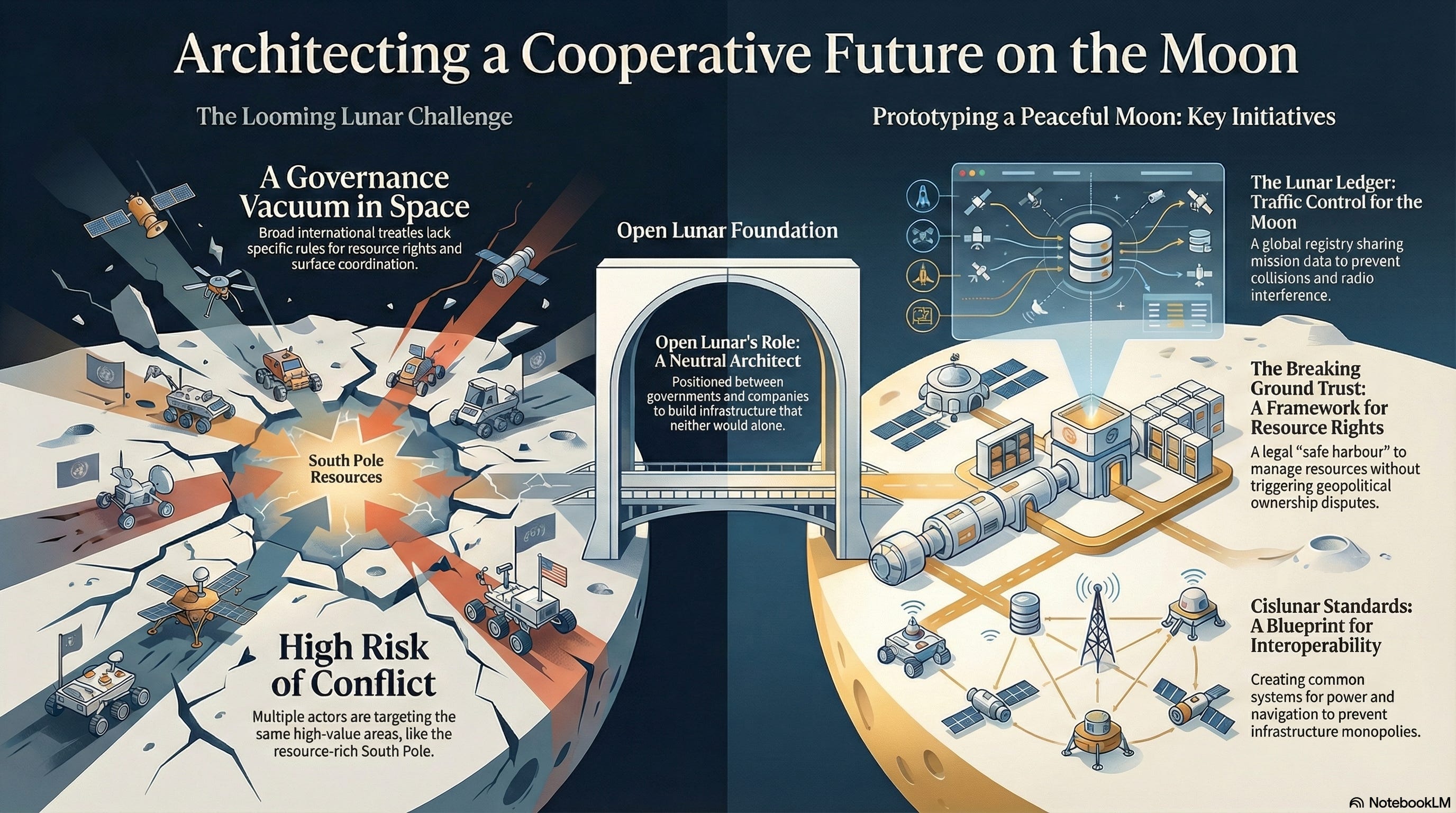
The Open Lunar Foundation, headquartered in San Francisco, is a non-profit focuses on creating intentional precedents such as practical, open-source tools and legal frameworks designed to ensure humanity’s return to the Moon is peaceful, cooperative, and sustainable.
I. Value Proposition
Open Lunar positions itself between government space agencies and private commercial actors, pursuing research and infrastructure that neither group would traditionally undertake alone.
Current international space law (like the Outer Space Treaty) is broad, leaving a vacuum regarding specific issues like resource rights, surface coordination, and “safety zones.”
This ambiguity risks conflict as multiple nations and companies head for similar high-value lunar areas (e.g., the South Pole).
Policy Prototyping: Instead of waiting for top-down international treaties, Open Lunar “prototypes” governance through active projects like the Breaking Ground Trust, which models how to manage lunar resources multi-laterally.
Open Infrastructure: By building digital and legal “standards” before the Moon becomes crowded, Open Lunar aims to bake transparency and cooperation into the foundation of the lunar economy.
II. Example Initiatives & Frameworks
Open Lunar’s work is organized into “Hunches,” “Concepts,” and “Initiatives,” moving from early-stage ideas to operational systems.
1. The Lunar Ledger (Registry of Objects and Activities):
A neutral, voluntary, and globally accessible database for sharing real-time information on lunar missions. This could prevent accidental collisions or radio interference that could derail multi-billion dollar missions.
Function: It aggregates data from government (NASA, ISRO, KARI) and commercial (ispace, Firefly) partners to track trajectories and landing sites, effectively acting as an “Orbital Traffic Control” prototype for the Moon.
Validation: In October 2025, Open Lunar officially launched the Lunar Ledger with founding commercial partners Firefly Aerospace, ispace, and Astrolab signing MoUs to share operational data.
Possible Success Metrics (KPIs):
Participation: Successfully onboarding the “Big Five” commercial lunar operators (e.g., ispace, Firefly, Astrolab, Intuitive Machines) and at least three major national space agencies (NASA, ESA, ISRO) into the Ledger by 2027.
Real-Time Data Fidelity: Moving from “static” mission registrations (declaring a launch) to “active” telemetry sharing (updating live coordinates) for at least 50% of active surface assets.
Incident Reduction: A target of zero “near-miss” radio frequency interference (RFI) events or physical landing conflicts between actors who are active Ledger participants.
2. The Breaking Ground Trust (Lunar Resource Property Rights)
An independent legal entity established in 2021 to hold and manage lunar resource rights on behalf of the global community creating a potential legal “safe harbor” for companies to use lunar ice and minerals without triggering geopolitical conflict over ownership.
Property Rights without Sovereignty: Resources that can be bought, sold, and used in a way that respects the Outer Space Treaty.
Significance: It serves as a “living laboratory” for Resource Stewardship, testing how to fairly exchange or collect lunar volatiles (like water ice) without violating the non-appropriation clauses of space law.
Possible Success Metrics (KPIs):
Proof-of-Concept “Transactions”: Facilitating at least three “simulated” or “physical” regolith transfers where the title is held by the Breaking Ground Trust. This proves the legal plumbing works.
Standardized Resource Contracts: The adoption of Open Lunar’s “Resource Stewardship” clauses in at least 25% of commercial lunar mining MoUs by 2028.
Geopolitical Plurality: Measuring the diversity of the Breaking Ground advisory board; success is having representation from both Artemis Accord signatories and non-signatory nations (e.g., BRICS nations).
3. Cislunar Standards & PNT (Infrastructre Interoperability)
Standardization: Open Lunar is working on Lunar Power Standards and Positioning, Navigation, and Timing (PNT) concepts that could ensure future lunar habitats use interoperable systems, preventing “infrastructure monopolies” and increasing Lunar accessibility to a wider number of responsible actors.
Possible Success Metrics (KPIs):
Hardware Compatibility: The number of third-party hardware manufacturers (e.g., rover or habitat builders) that design their systems to meet OLF-advocated power interface standards.
“Lunanet” Policy Integration: Success could be defined by NASA or the European Space Agency (ESA) officially adopting OLF’s “Neutral Interoperability” recommendations into their procurement requirements for lunar communications.
Fellowship Output Utilization: Tracking the “citation rate” of research produced by OLF Fellows in official government white papers or International Standards Organization (ISO) space-tech standards.
4. Designated Lunar Areas (Safety Zones)
This could involve categorizing the lunar surface into:
Scientific Quiet Zones: Areas where radio noise and dust must be strictly limited (e.g., the Far Side).
Infrastructure Hubs: Areas optimized for high-traffic landing and power sharing.
Heritage Sites: Protective “Safety Zones” around historic landing sites like Apollo or Luna.
Possible Success Metrics (KPIs):
Consensus Adoption: Securing a multi-stakeholder agreement (at least 15 nations) on the definition of a “Safety Zone”.
Digital Twin Integration: Successfully integrating these “Safety Zones” as digital overlays within the Lunar Ledger, so operators see “Keep-Out” or “Caution” alerts when planning landing trajectories.