Quantum Clocks in Space [Strategy]
This article explores Quantum Clock applications and commercial strategies for Lunar Navigation, Subsurface Mapping (Mining), and Defense Resilience.

To be commercially viable, a quantum clock mission could benefit from solving problems that are either currently physically impossible or prohibitively expensive using classical methods.
This article explores Lunar Navigation, Subsurface Mapping (Mining), and Defense Resilience, and possible system architecture.
I. Potentially High-Value Applications
1. Autonomous Lunar PNT (The “Moonlight” Economy)
A. Commercial Driver
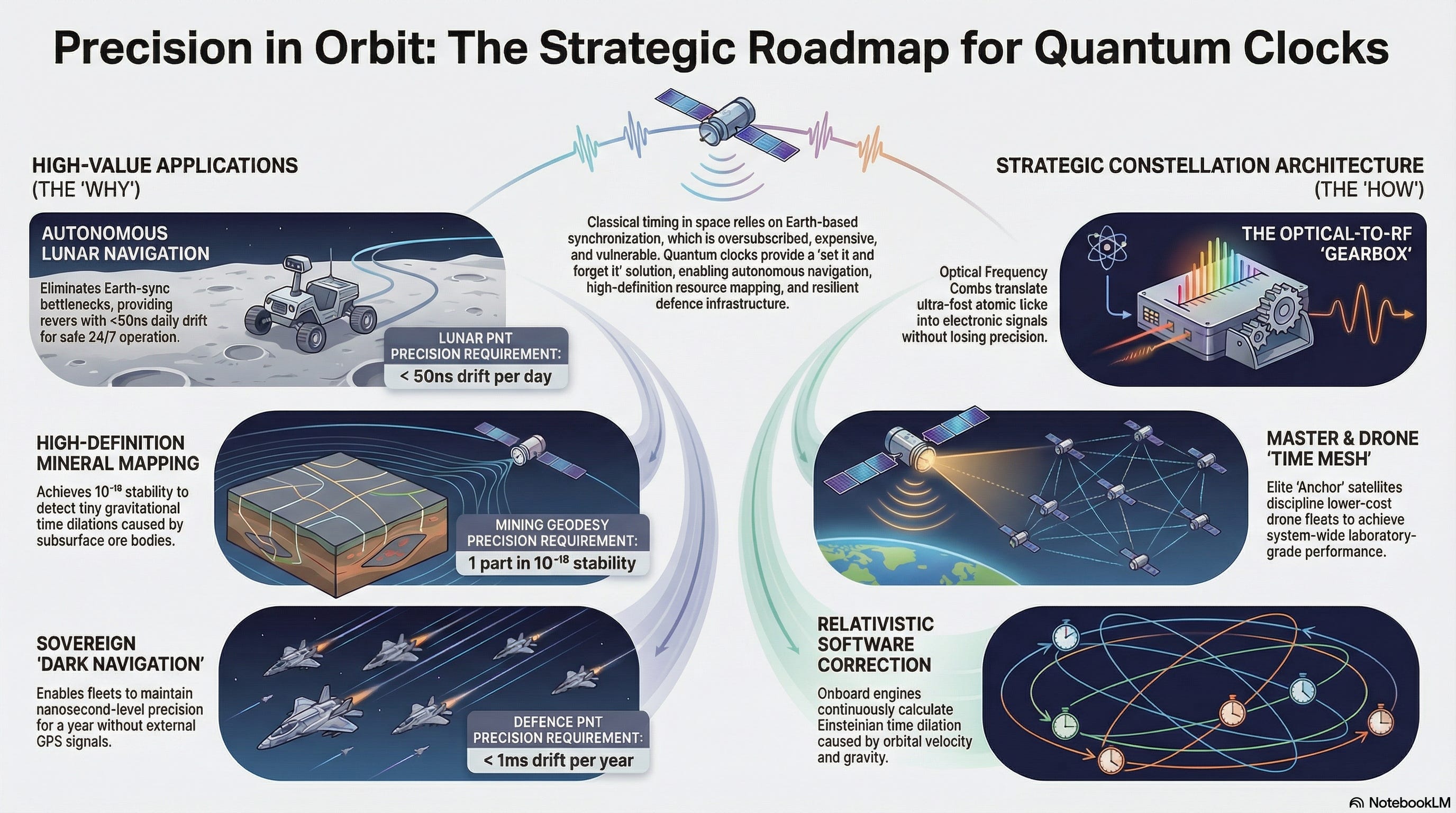
As the Moon transforms from a research outpost to a commercial hub (Artemis, private mining), the current reliance on “bent-pipe” timing (requesting a time-sync from Earth via the Deep Space Network (DSN)) is becoming a bottleneck.
DSN time is expensive, oversubscribed, and subject to communication delays.
For a lunar rover or an automated mining drill to operate safely 24/7, it needs a local “GPS” constellation that works without constant check-ins with Earth.
B. Possible Minimal Success Metrics
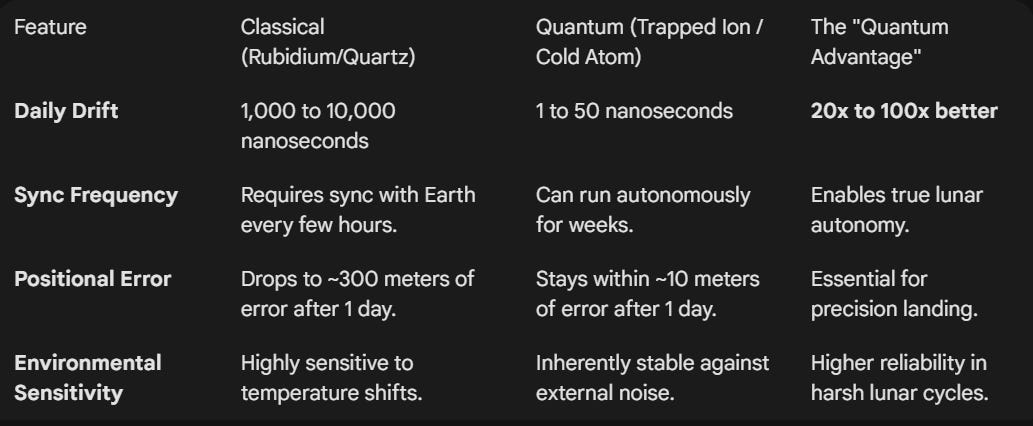
Precision (Autonomous Holdover): Less than 50 nanoseconds of drift per day.
The “Why”:
In navigation, time is distance.
To keep a rover within a 10-meter accuracy window over a 24-hour period without an Earth update, the onboard clock cannot drift by more than 33 nanoseconds.
A 50-nanosecond threshold could represent the “minimum viable product” for basic safe navigation.
Commercial Viability (SWaP-C): Under 5 kg and under 15 Watts.
The “Why”:
Every gram on a lunar launch manifest costs thousands of dollars.
Traditional high-stability clocks (like Hydrogen Masers) weigh over 20 kg and occupy significant volume.
For a commercial constellation to potentially be profitable, the clock benefits from having the footprint of a small laptop but the stability of a laboratory instrument.
C. Classical v. Quantum
Using Classical methods, a lunar constellation would require a massive ground-segment investment on Earth to constantly “correct” the drifting satellite clocks.
This makes the operational cost (OPEX) of the mission sky-high.
By switching to Quantum clocks, you move the intelligence to the Moon itself.
The “Quantum” version is the only one that allows for a “set it and forget it” constellation, which allows for a model that scales for a commercial lunar economy.
2. Relativistic Geodesy (Subsurface Resource Mapping)
A. Commercial Driver
To find high-density ore bodies (like gold, copper, or rare earth elements) from orbit, you have to measure Earth’s gravity with extreme precision.
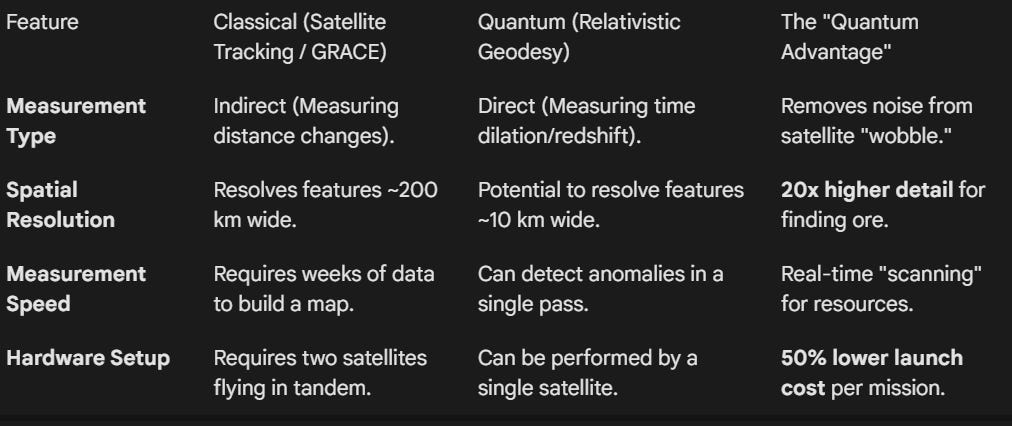
Traditionally, missions like GRACE-FO do this by measuring the distance between two satellites as they get “tugged” by gravity.
Quantum clocks offer a more direct method: Relativistic Geodesy.
According to Einstein, time actually slows down as you get closer to a massive object.
By using a quantum clock to measure these tiny “time dilations,” a satellite could map mass density on the ground with much higher resolution than classical satellite-tracking methods.
B. Possible Minimal Success Metrics
Stability (Precision): 1 part in 10^-18 over 3 hours.
The “Why”:
This is the level of precision required to notice that time is ticking differently because of a 1 cm change in height (or a corresponding change in the density of the earth beneath the satellite).
If your clock isn’t this stable, it cannot “see” the gravitational signature of a mineral deposit.
Commercial Viability (Measurement Time): Less than 2 hours to reach full precision.
The “Why”:
A satellite travels at roughly 27,000 km/h.
If the clock takes several days to “settle” and give an accurate reading, the satellite will have orbited the Earth dozens of times, blurring the gravity data into a low-resolution smear.
To be commercially useful for mining, the clock must reach its target precision within a single orbital pass over the exploration site.
C. Classical v. Quantum
Using Classical methods, we can see that a region has “more mass,” but we can’t pinpoint exactly where the mine should be; it’s like trying to find a needle in a haystack with a blurry magnifying glass.
Quantum clocks provide the “high-definition” version of gravity mapping.
For a mining company, this is the difference between a speculative $500M exploration budget and a targeted, data-driven drilling plan.
This “single-satellite” architecture could allow commercial startups to deploy mapping constellations at a fraction of the cost of government-scale gravity missions.
3. Defense PNT: “Dark” Navigation & Resilient Infrastructure
A. Commercial Driver
Modern military operations and critical national infrastructure (power grids, financial markets) are dangerously dependent on GPS/GNSS.
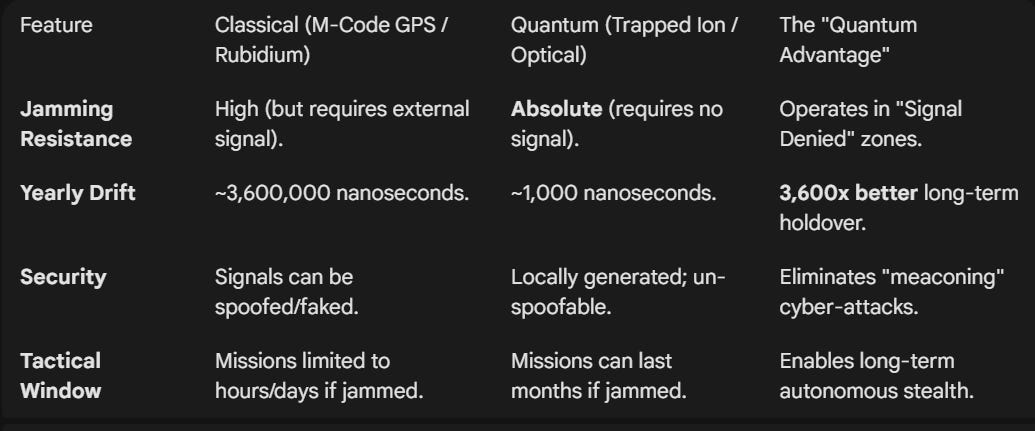
In a “Grey Zone” conflict, adversaries could jam or “spoof” satellite signals, rendering standard navigation useless.
Quantum clocks enable Dark Navigation; the ability for a satellite or a carrier group to maintain nanosecond-level timing and pinpoint positioning for months at a time without ever receiving an external signal.
This creates a “sovereign time” standard that is immune to electronic warfare and solar interference.
B. Possible Minimal Success Metrics
Resilience (Holdover): Less than 1 millisecond of drift per year.
The “Why”:
Critical infrastructure and military encrypted comms require tight synchronization.
If GPS is disabled during a prolonged conflict, a quantum clock must keep the “beat” of the network independently.
A 1-millisecond drift over an entire year ensures that even after 12 months of total signal isolation, the system remains accurate enough to maintain global communication handshakes.
Commercial Viability (Interoperability): End-to-end signal latency under 1 picosecond.
The “Why”:
To be useful for High-Frequency Trading (HFT) or tactical missile defense, the “ticks” of the quantum clock must be converted into electronic signals (RF) perfectly.
If the conversion hardware (the Optical Frequency Comb) adds “jitter” or delay, the precision of the quantum atoms is wasted.
A sub-picosecond latency ensures the user gets the pure, unadulterated accuracy of the quantum physics package.
C. Classical v. Quantum
Using Classical methods, the moment a satellite loses its link to a ground station or GPS, the “clock starts ticking” on its eventual failure; it becomes a drifting, expensive piece of space junk within days.
Quantum clocks turn the satellite into a self-contained “Master Clock.”
For defense contractors and national governments, this provides a strategic “Time Fortress.”
It ensures that even if the entire GPS constellation is compromised, your specific fleet or financial network stays perfectly synchronized, providing a massive tactical advantage in contested environments.
II. End-to-End System Stack Considerations
The “stack” could follow a tiered architecture, moving from the physics of the atom to the end-user’s receiver.
1. The Physics Layer (Frequency Generation)
This layer generates the “tick” and responsible for frequency generation. It consists of the Quantum Core (the reference) and the Local Oscillator (the flywheel).
A. The Components
The Quantum Core:
A high-vacuum chamber where atoms are isolated from the universe.
Lasers or microwaves “interrogate” these atoms, measuring the exact frequency of their internal energy transitions.
The Local Oscillator (LO):
Usually a high-quality Quartz crystal or a Hydrogen Maser.
The LO provides the high-power, “noisy” signal used by the satellite’s electronics.
The “Supervisor” Loop:
The Quantum Core acts as a relentless auditor.
It compares the LO’s output to the “perfect” atomic transition and sends a correction signal every few milliseconds to steer the LO back to the correct frequency.
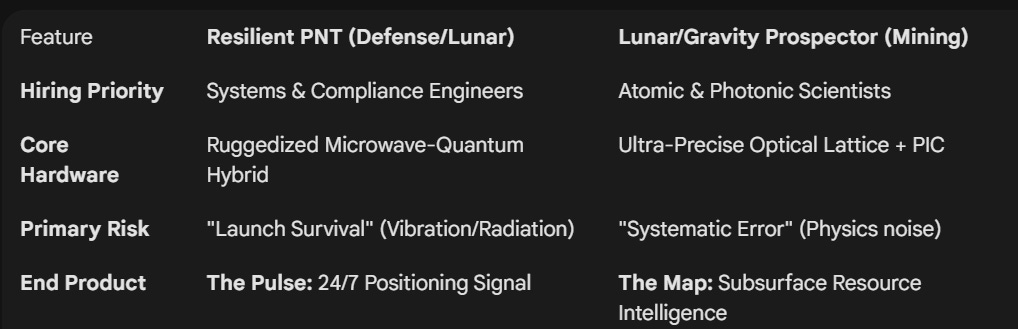
B. The Three-Way Divergence
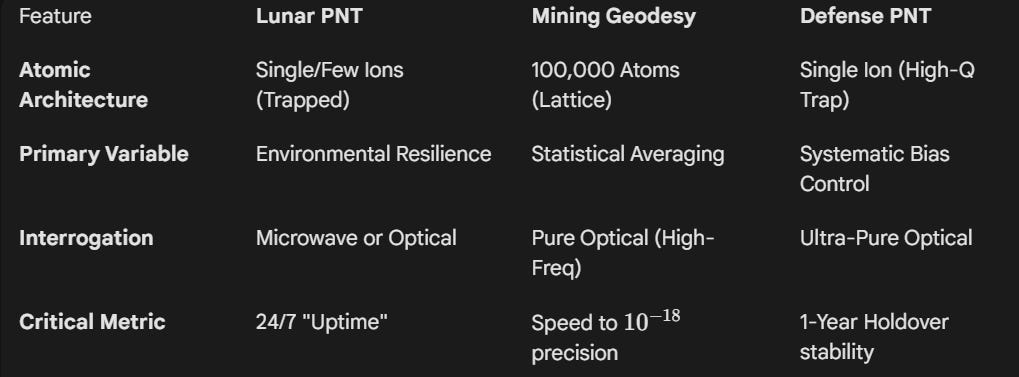
The divergence here is based on whether the mission prioritizes long-term autonomous stability or instantaneous mass sensitivity.
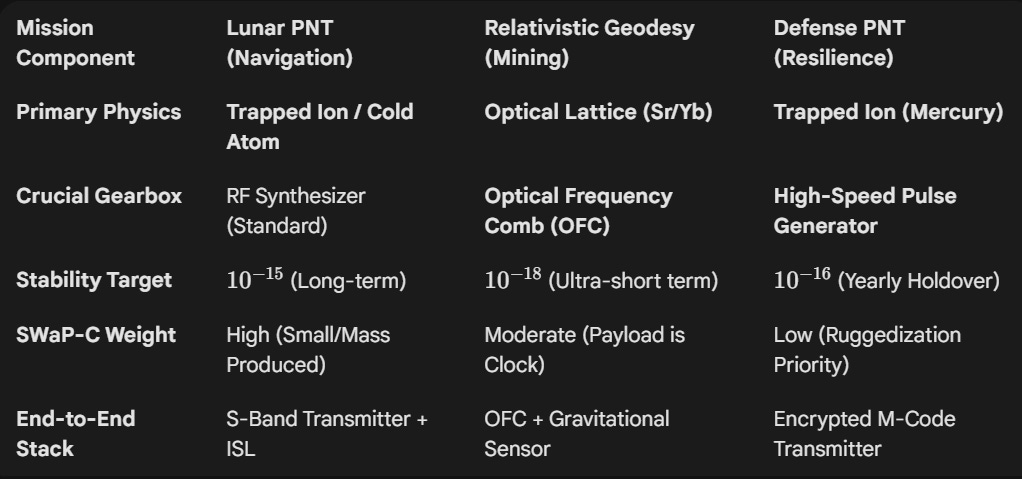
Lunar PNT (Mercury/Rubidium):
Diverges toward Trapped Ion or Vapor Cell clocks.
These systems are “ruggedized” to ignore magnetic fields and temperature swings.
The focus is on a high “duty cycle”; the clock must run 24/7 with zero downtime to ensure rovers never lose their position.
Mining Geodesy (Strontium/Ytterbium):
Diverges toward Optical Lattice clocks.
These use thousands of atoms trapped in “cages” of light.
This allows for massive statistical averaging to reach the 10^-18 stability threshold quickly (within 2 hours), which is necessary to “see” the density of a gold deposit before the satellite passes over it.
Defense PNT (Mercury Ion):
Diverges toward Trapped Ion tech because it is more immune to “drift.”
In a “Dark Navigation” scenario where GPS is jammed for a year, this layer must ensure the clock remains within 1 millisecond of its original time without any external help.
2. The Conversion Layer (The Gearbox)
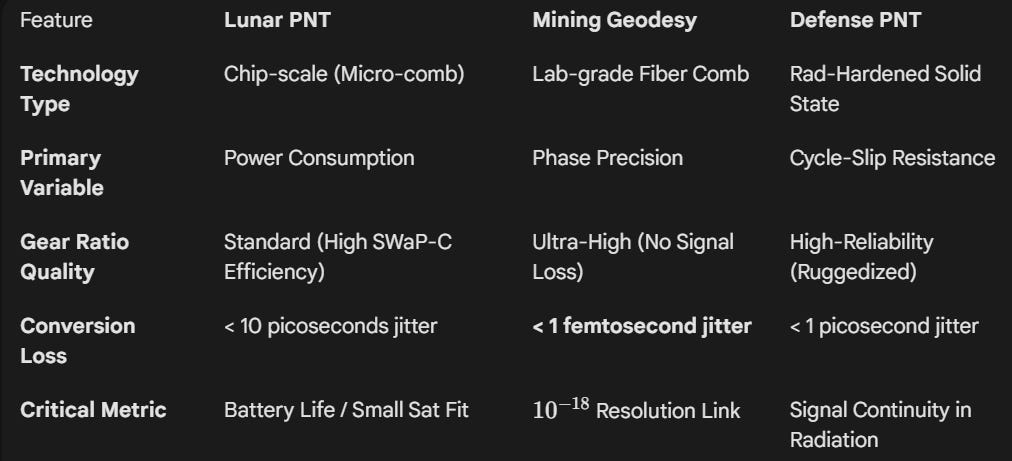
This layer translates the ultra-fast atomic “ticks” from the Physics Layer into usable data. It acts as the bridge between the world of light and the world of electronics.
A. The Components
The Optical Frequency Comb (OFC):
Quantum atoms “tick” at optical frequencies; roughly 500 trillion times per second (500 THz).
However, satellite electronics and digital radios can only “count” at microwave frequencies; roughly 1 to 10 billion times per second (GHz).
The “Optical-to-RF” Bridge:
The OFC acts as a geared transmission. It creates a “comb” of perfectly spaced laser lines that lock onto the atomic frequency and divide it down.
It produces an electronic pulse for every few million optical pulses, ensuring that not a single “tick” of precision is lost in translation.
The Phase-Locked Loop (PLL):
This is the synchronization mechanism that ensures the electronic output stays perfectly “in step” with the optical laser.
If this loop slips, the nanosecond precision required for navigation vanishes instantly.
B. The Three-Way Divergence
The divergence here is based on whether the gearbox needs to be “ultra-light,” “ultra-precise,” or “ultra-hardened.”
Lunar PNT (Micro-combs / Kerr Combs):
Diverges toward Photonic Integrated Circuits (PICs). On a lunar mission, every watt of power is precious.
The Strategy: “Micro-combs”; frequency combs shrunk down onto a silicon chip. They provide “good enough” gear ratios to maintain 10-meter positioning while keeping the hardware small enough to fit in a shoebox.
The Focus: Size, Weight, and Power (SWaP). It prioritizes high-volume deployment for a constellation over absolute laboratory perfection.
Mining Geodesy (Bulk-Fiber / High-Finesse Combs):
Diverges toward Full-Scale Fiber Combs. To detect the tiny time dilations caused by gold or copper deposits, the “gears” cannot have any play or vibration.
The Strategy: These systems use high-performance fiber optics and vacuum-stabilized cavities to ensure the conversion is transparent down to the 10^-18.
The Focus: Phase Fidelity. The gearbox must be so perfect that it adds zero “noise” to the atomic signal, allowing the satellite to resolve 1 cm changes in gravitational height.
Defense PNT (Radiation-Hardened Combs):
Diverges toward Rad-Hardened Solid State Combs. In a contested environment, the gearbox is the most vulnerable point for electronic interference or cosmic ray damage.
The Strategy: These combs use specialized glass and redundant laser paths to prevent “cycle slips” (where the gear skips a tooth).
The Focus: Reliability and Jitter Control. Even if a cosmic ray hits the satellite in MEO orbit, the OFC must maintain a “fixed lock” to ensure the 1-year holdover remains valid for secure military communications.
3. The Dissemination Layer (The Messenger)
This layer is responsible for the “last mile” of the mission; delivering the ultra-precise timing signal from the satellite’s internal clock to the user on the ground, in the air, or on the Lunar surface.
A. The Components
The RF Front-End:
This unit takes the electronic signal from the Gearbox and up-converts it to radio frequencies.
It includes high-stability amplifiers and antennas that broadcast the signal as a wave (like a “Lunar GPS” signal).
The Optical Terminal (Lasercom):
Instead of radio waves, this uses a laser beam to transmit data.
Because light waves are much shorter than radio waves, they can carry timing information with significantly higher “temporal resolution,” meaning the “edges” of the time pulses are sharper and easier to define.
The Time-Transfer Protocol:
This is the software handshake. It ensures that the time the user receives is corrected for the “travel time” it took for the signal to fly from the satellite to the receiver, accounting for atmospheric delays or the vacuum of space.
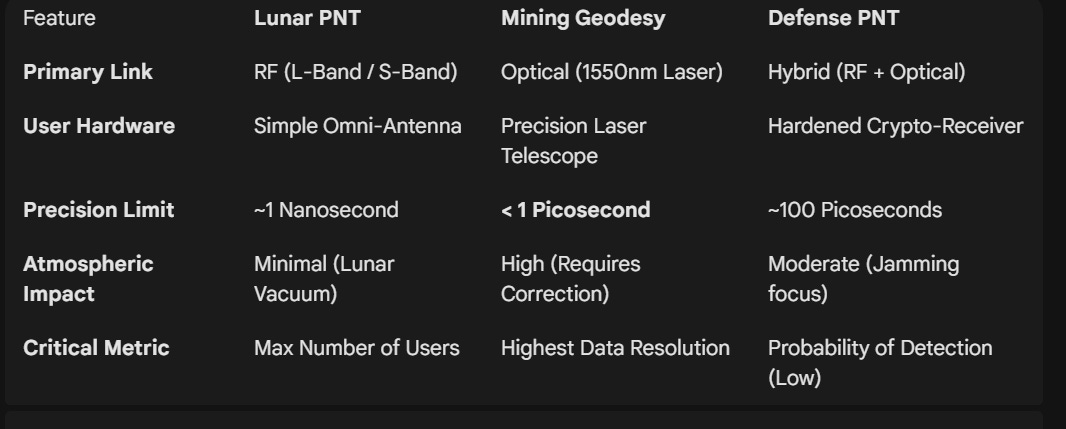
B. The Three-Way Divergence
The divergence here is based on whether the user needs “universal accessibility,” “absolute resolution,” or “stealth and security.”
Lunar PNT (Broad-Spectrum RF):
Diverges toward Multi-User Radio Broadcasts. Lunar rovers and habitats are designed for simplicity; they cannot always point a precise laser at a satellite.
The Strategy: S-band and L-band frequencies to provide a wide “floodlight” of timing data. This allows any device with a simple antenna to pick up its position, similar to how a smartphone uses GPS on Earth.
The Focus: Accessibility and Field of View. It prioritizes keeping multiple low-power assets connected across the rugged Lunar terrain.
Mining Geodesy (Coherent Optical Links):
Diverges toward Point-to-Point Lasercom. Radio waves “blur” at the 10^-18 precision level. To measure the 1 cm height difference caused by mass density, the signal must be pure.
The Strategy: The satellite fires a dedicated laser beam directly at a ground station or a second “reflector” satellite. This coherent link allows for “Phase-Exchange,” where the two clocks compare their “ticks” with zero interference from the ionosphere.
The Focus: Resolution and Sensitivity. It ensures the atomic precision generated in the Physics Layer actually reaches the mapping software.
Defense PNT (Jam-Resistant Hybrid):
Diverges toward M-Code RF + Secure Optical Crosslinks. In a conflict, the broadcast must be both invisible to enemies and impossible to drown out with noise.
The Strategy: Uses a hybrid approach. The satellite broadcasts a “spread-spectrum” M-Code radio signal that is very hard to jam, while simultaneously using stealthy, narrow-beam lasers to sync with other satellites in the “Dark Navigation” mesh.
The Focus: Resilience and Anti-Spoofing. The dissemination is designed to be “verified”; if a ground receiver detects a signal that doesn’t match the secure satellite crosslink data, it knows it is being spoofed and ignores the fake signal.
4. The Software Integration Layer (The Sync Protocol)
This final layer is the “brain” of the system. It manages the mathematical logic required to transform raw atomic pulses into actionable mission intelligence, ensuring the clock remains synchronized with the rest of the universe.
A. The Components
The Relativistic Correction Engine:
At quantum precision, time is fluid.
This software continuously calculates “Time Dilation” based on the satellite’s specific altitude and velocity.
Without these real-time Einsteinian corrections, the clock would appear to “break” within minutes.
The Network Integrity Manager:
This protocol handles “Clock Voting.”
In a constellation, the software compares signals from multiple satellites to identify and “vote out” any clock that is malfunctioning or being tampered with.
The Kalman Filter (Time-State Estimator):
A sophisticated algorithm that predicts the clock’s future behavior based on past performance.
It “smooths out” tiny vibrations or thermal shocks, ensuring the output signal remains a perfect, steady beat.
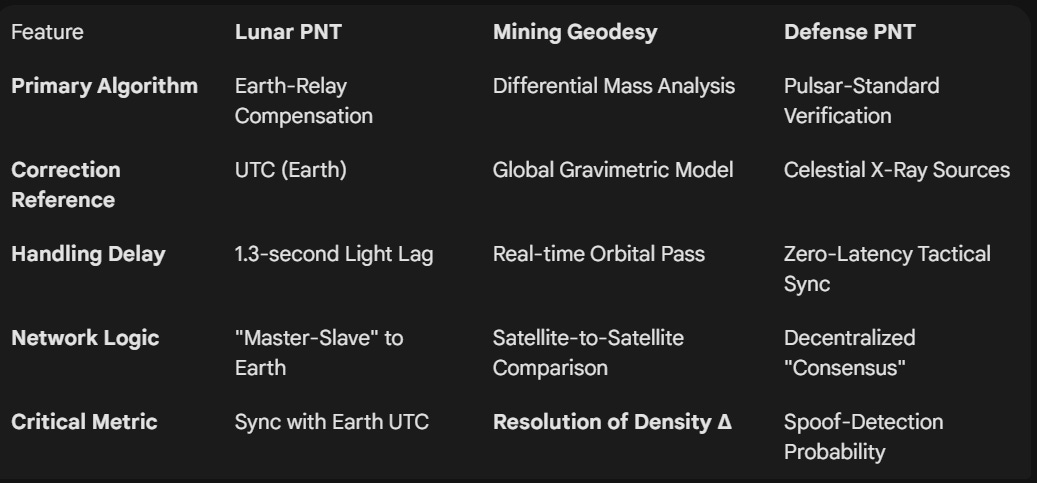
B. The Three-Way Divergence
The divergence here is based on whether the software is solving for “distance,” “density,” or “truth.”
Lunar PNT (Earth-Lunar Sync):
Diverges toward Lag-Compensated Networking. The primary challenge is the distance between the Earth and the Moon.
The Strategy: The software must manage the 1.3-second light-delay to Earth. It creates a “Lunar Prime Time” that is locally autonomous but periodically “nudged” to stay aligned with Universal Coordinated Time (UTC) on Earth.
The Focus: Universal Interoperability. It ensures that a rover using a Lunar satellite and a base station using an Earth link are both looking at the exact same “map” of time.
Mining Geodesy (Gravity Model Comparison):
Diverges toward Differential Relativistic Mapping. This software doesn’t just look at time; it looks at “Time Anomalies.”
The Strategy: The protocol compares the onboard clock’s frequency against a digital Reference Gravity Model. If the clock slows down slightly compared to the model, the software flags a “Mass Anomaly” (a potential ore body).
The Focus: Anomaly Detection. The software is optimized to filter out “noise” (like ocean tides or atmospheric pressure) to isolate the signal of subsurface minerals.
Defense PNT (Pulsar & Sovereign Verification):
Diverges toward External Truth Cross-Referencing. In a war zone, the software assumes the “local” environment is compromised.
The Strategy: The software compares the Quantum Clock against “Pulsar Signatures” (X-ray pulses from deep-space stars). Since an adversary cannot “jam” a star, the software uses these celestial beacons to verify that the onboard clock hasn’t been spoofed or tampered with.
The Focus: Absolute Trust (Anti-Tamper). It provides a “zero-trust” architecture for timing, ensuring the military commander always has a verified, un-hackable time standard.
III. Constellation Considerations
Quantum clocks reach their full commercial and tactical potential when integrated into a networked constellation. This architecture moves away from “standalone” clocks toward a unified Network Time Standard, utilizing a tiered synchronization strategy to balance extreme performance with cost-efficiency.
1. The Tiered Constellation (“Master & Drone” Architecture)
To optimize the fleet, could utilize Hybrid Synchronization, which avoids the prohibitive cost of placing a flagship optical lattice clock on every satellite.
This architecture creates a hierarchical “Time Mesh” where the highest precision is distributed from a few high-end units to the rest of the constellation.
A. The Components
Master Nodes:
A select few “Anchor” satellites carry the primary Optical Lattice Clocks.
These serve as the system’s ultimate “Truth Sources,” maintaining absolute frequency accuracy.
Secondary Nodes (Drones):
The majority of the fleet carries compact, lower-cost Trapped Ion or Cold Atom clocks.
While these are slightly less precise than the Master Nodes, they are far superior to classical quartz/rubidium standards.
The “Discipline” Link:
Using Inter-Satellite Links (ISL), the Master Nodes constantly broadcast a “correction pulse” to the Secondary Nodes.
This forces the entire constellation to “march to the beat” of the optical lattice clock, effectively providing a $1B performance profile for a $100M constellation budget.
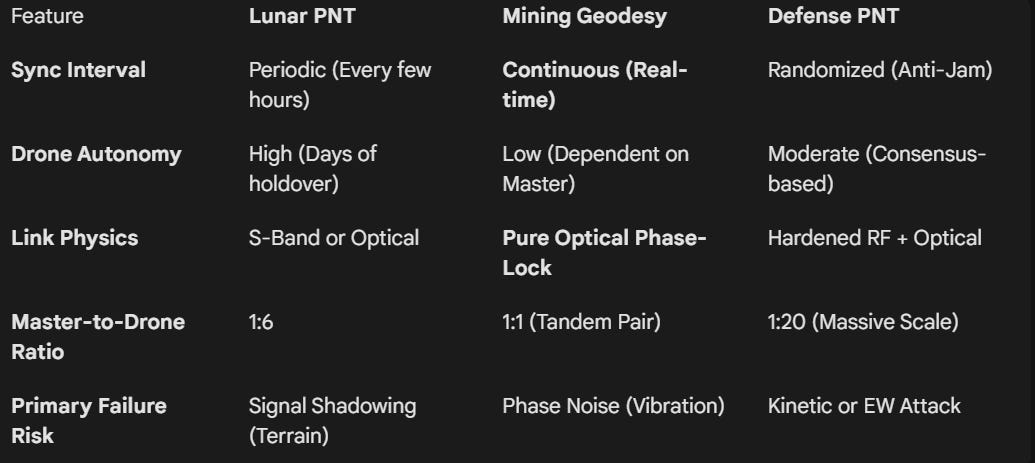
B. The Three-Way Divergence
The logic of the Master/Drone relationship varies based on the mission’s coverage area and the required “refresh rate” of the timing signal.
Lunar PNT (Sparse Network Sync):
The Setup:
2 Master Nodes in high “frozen” orbits and 6–12 Drones in lower lunar orbits.
The Divergence:
Because lunar terrain creates frequent line-of-sight blockages, the “Discipline Link” focuses on long-period stability.
The Drones are designed with higher “autonomy”; they only need a correction from the Master Node once every few orbits to stay within the 50-nanosecond error budget.
The Focus:
Ensuring the “Drone” clocks have enough independent stability to survive long “dark periods” where the Master Node is behind the Moon.
Mining Geodesy (High-Speed Continuous Sync):
The Setup:
A “Leader-Follower” pair or a tight cluster of satellites in Low Earth Orbit (LEO).
The Divergence:
The Master and Drone must stay in constant phase-lock.
To detect 1 cm height changes, the Master Node disciplines the Drone via an optical carrier wave (Lasercom).
Any delay or “slip” in the sync link would be indistinguishable from a gravity anomaly.
The Focus: Zero-latency synchronization.
The Master and Drone act almost as a single physical instrument stretched across kilometers of space.
Defense PNT (Resilient Mesh Sync):
The Setup:
A “MEO-to-LEO” tiered architecture where Master Nodes in high orbits discipline hundreds of Drones in low orbits.
The Divergence:
The system prioritizes redundancy over hierarchy.
If a Master Node is “taken offline,” the Drones immediately shift to a “consensus” model, where they average their own internal Trapped Ion clocks to maintain a degraded but still highly accurate “Sovereign Time” until a new Master Node can be verified.
The Focus: Dynamic Reconfiguration. The Master-Drone link is encrypted and frequently hops frequencies to prevent an adversary from jamming the “Discipline Link” that keeps the fleet in sync.
2. Synchronization Considerations
The logic of how these satellites talk to one another diverges based on the mission’s “Center of Gravity.”
Lunar PNT: “The Earth-Lunar Bridge”
Unique Consideration: The system must sync across the Cislunar Gap. Because the Moon is roughly 1.3 light-seconds away, the network architecture cannot use a “real-time” Earth sync.
The Integration: The constellation must be locally autonomous. It uses a “Peer-to-Peer” consensus model where the satellites agree on a “Lunar System Time” amongst themselves and only “check in” with Earth UTC once every few days to prevent long-term drift between planetary bodies.
Mining Geodesy: “Differential Baseline Sync”
Unique Consideration: Gravity mapping doesn’t care about “what time it is” as much as it cares about the difference in time between two points.
The Integration: The architecture uses a “Twin-Link” configuration. Two satellites fly in tandem; one serves as a “Reference” (over a known mass) and the other as the “Sensor” (over the exploration target). The software synchronizes them so perfectly that any detected “jitter” is identified as a subsurface mass anomaly rather than a network error.
Defense PNT: “Zero-Trust Mesh”
Unique Consideration: In a conflict, nodes will be lost or jammed. The network cannot rely on a single “Master” satellite that acts as a single point of failure.
The Integration: This utilizes a Decentralized Byzantine Fault Tolerant (BFT) sync protocol. Every satellite in the mesh compares its time with its neighbors. If one satellite’s clock is spoofed by an enemy or damaged by radiation, the rest of the network detects the “outlier” and automatically severs its sync-link to preserve the integrity of the “Dark Navigation” signal.
3. The Relativistic Correction Engine
At quantum precision, Einstein’s laws are significant operational errors that must be coded into the system architecture. The onboard computer must run a continuous Relativistic Compensation Module to account for:
Velocity (Special Relativity):
Satellites moving at orbital speeds see time slow down relative to the user on the ground.
Gravity (General Relativity):
As satellites move higher up in the “gravity well” (further from Earth/Moon), their clocks actually speed up.
Frame Dragging & Sagnac Effect:
The software must compensate for the rotation of the Earth/Moon itself, which “drags” space-time and creates a timing offset for signals sent in the direction of rotation versus against it.
IV. Vendors and Strategic Sourcing Options
A. Commercial-Off-The-Shelf (COTS) – TRL 7-9
These vendors provide “Ready-to-Launch” units. They are potentially the primary choice for the Secondary Nodes (Drones) in a constellation and the foundational Physics Layer for Lunar PNT.
Microchip (USA): Known for the CSAC (Chip Scale Atomic Clock).
Mission Fit:
Ideal for the “Drone” layer of a Lunar PNT constellation where weight and power are the ultimate constraints.
However, their stability is insufficient for the 10−18 requirements of Geodesy.
Infleqtion (USA): A leader in Cold-Atom technology.
Mission Fit:
Their “Tiqker” series bridges the gap between classical atomic clocks and high-end quantum sensors.
They are a prime candidate for the Defense PNT core, offering high stability in a package small enough for tactical satellites.
Safran / Orolia (Europe):
The gold standard for space-qualified Rubidium and passive Hydrogen Masers.
Mission Fit:
They provide the “Classical” Local Oscillator (LO) or backup frequency standards required for all three mission profiles to ensure system redundancy.
B. Bespoke & High-Performance Engineering
These vendors are the architects of the Master Nodes. They build the specialized Physics Layers and Conversion Layers (OFC) that allow for relativistic measurements.
Honeywell / Northrop Grumman (USA):
Tier-1 defense contractors with deep expertise in Trapped Ion systems.
Mission Fit:
The go-to partners for the Defense PNT “Dark Navigation” profile.
They focus on long-term holdover and “Radiation-Hardened” clock architectures that can survive contested MEO/GEO orbits.
AOSense / M-Squared (USA/UK):
Specialists in Optical Lattice and Atom Interferometry.
Mission Fit:
Essential for the Mining Geodesy mission.
They provide the ultra-stable laser traps and strontium/ytterbium physics packages needed to reach the 10−18 stability threshold.
Exail / Muquans (Europe):
Leaders in quantum gravimetry and cold-atom clocks.
Mission Fit:
They specialize in the integration of the Software Sync Protocol and the hardware for Differential Mapping, making them a strategic choice for subsurface resource exploration.
V. Aggressive Roadmap & Execution Paths
1. The Architecture Lock (Months 1–6)
Budget: $500k – $1.5M
Core Decision: Which “Atom” is our anchor?
The team decides if they are building a Drift-Resistant clock (Lunar/Defense) or a Sensitivity clock (Mining).
Low-Risk Strategy: “The Resilient Responder”
Focus: Trapped Ion (Mercury/Rubidium). Prioritize ruggedness over peak precision.
Target: Defense PNT & Lunar Comms.
Potential Goals:
Secure a Letter of Intent (LOI) from an EU Space Prime (e.g., Airbus or Thales Alenia Space).
Target EIC Pathfinder (TRL 1-4). This supports high-risk/high-gain research with grants up to €3M.
Secure a $500k Phase I SBIR or DIU prototype contract.
Deliver:
3U CubeSat PDR (Trapped Ion): A complete blueprint of the Physics Layer. It must show how a Mercury or Rubidium ion trap can be miniaturized into a 10cm x 10cm x 30cm volume while maintaining a vacuum of 10^-10.
High-Risk Strategy: “The Quantum Prospector”
Focus: Neutral Atom Lattice (Strontium). Pushing for 10^-18 stability from Day 1.
Target: Relativistic Geodesy (Mining).
Potential Goals:
Join a Quantum Technologies Flagship consortium under Horizon Europe Cluster 4 (Digital, Industry, and Space).
Position the clock as the "Reference Standard" for the upcoming European Quantum Space Gravimetry mission (2027 call).
Secure an exclusive R&D partnership with a Tier-1 Mining major (e.g., Rio Tinto).
Deliver:
10^-18 Stability Link Budget: A mathematical proof that the clock can reach the required precision within the short "pass-over" window of a satellite orbit. This is the document that convinces mining giants that you can actually "see" density changes from space.
2. The “Gearbox” Prototype (Months 6–18)
Budget: $3M – $7M
Low-Risk Strategy: “The COTS Integrator”
European Signal:
Watch the ESA NAVISP (Navigation Innovation and Support Programme) Element 2. They fund competitive hardware development for European companies.
Potential Goals:
Purchase a space-qualified OFC from Menlo Systems or Vescent.
Focus burn on the Sync Software rather than hardware R&D.
Partner with a European SME (e.g., Menlo Systems in Germany) for a Eurostars grant. Focus on integrating their OFC with physics package.
Lunar Focus:
Ensure the “Gearbox” handles Relativistic Sagnac Corrections for lunar orbits, which differ significantly from Earth-LEO.
Deliver:
“White Rabbit” Integration Test: White Rabbit is the industry standard for sub-nanosecond synchronization over Ethernet. This deliverable proves your clock can synchronize a terrestrial or lunar ground station mesh with zero “jitter.”
High-Risk Strategy: “The Chip-Scale Pioneer”
Market Signal:
Watch for Infleqtion’s Tiqker performance on the ISS (2026). If their SWaP-C is too high, double down on your miniaturization.
Potential Goals:
Invest heavily in internal Micro-comb (PIC) development. Aim to reduce the Gearbox size by 90% to dominate the “SmallSat” market.
Apply for EIC Accelerator 2026 (blended finance). You can receive a €2.5M grant plus up to €10M in equity from the EIC Fund.
Demonstrate a "European-only" supply chain for the laser-lock systems, avoiding US/ITAR-restricted components.
Deliver:
Prototype Micro-comb (European-only): A hardware prototype that avoids US-made components. This is a crucial deliverable for European Strategic Autonomy funding (EIC/ESA) and ensures the tech can be sold globally without US State Department veto power.
Market Signal & Pivot Check:
Watch Safran’s 2026 rollout of the “White Rabbit” quantum bundle. If it gains mass adoption, stay compatible with their interfaces.
Pivot to Software if:
SpaceX or Amazon (Project Kuiper) announces an “Onboard Timing Service” using cheap, mass-produced clocks.
Action: Stop building the “Gearbox.” Pivot to the Relativistic Correction Engine to manage their massive, drifting fleets.
Double Down on Hardware if:
The Infleqtion/NASA Quantum Gravity Sensor flight proves sub-nanosecond stability in LEO.
This validates the “High-Burn” market for 1cm-resolution gravity mapping.
3. The Path to Orbit (Months 18–36)
Budget: $10M – $25M
Low-Risk Strategy: “Payload-as-a-Service”
Potential Goals:
Deliver clock as a “black box” hosted payload on the ESA Moonlight / LCNS constellation or an Intuitive Machines lunar relay.
Bid for a sub-contract under the ESA Moonlight / LCNS (Lunar Communications and Navigation Services) program.
Partner with Apex or York Space Systems. Don’t build the bus; just deliver the clock as a “black box” payload.
First revenue through “Leased Timing” to government constellations.
Deliver:
TVAC Certification for Lunar Orbit: Thermal Vacuum (TVAC) testing proves the clock works in the -180°C to +120°C swings of the lunar environment. This is the final “Go” signal for integration into an ESA Moonlight or NASA Artemis relay.
High-Risk Strategy: “Vertical Sovereign Constellation”
Potential Goals:
Monopolize “Gravity-Mapping-as-a-Service,” selling high-value density maps to the global resource sector.
Build a proprietary satellite bus optimized for thermal stability. Control the end-to-end data stream.
Integrate into IRIS² (Europe’s answer to Starlink).
Become the "Timing Anchor" for Europe's secure satellite connectivity constellation. This is a multi-billion euro infrastructure play.
Deliver:
Subsurface Density Mapping API: The final product. A software interface where a mining company inputs a satellite’s location and receives a high-resolution map of mass anomalies (gold, copper, or water ice).
Market Signal & Pivot Check:
Exit (Acquisition) if:
Defense Primes (e.g., Honeywell, Northrop) move “Dark Navigation” to a Program of Record (2027-2032 budget cycle).
Action: Sell the company to a prime as their “Standard Timing Interface.”
Double Down if:
Secure a multi-year data-buy from a mining conglomerate (e.g., Rio Tinto).
Action: Ignore PNT entirely. Pivot 100% of R&D to the Relativistic Geodesy stack.
VI. Key Market Signals & When to Pivot
A team should watch for specific Technical Inflection Points and Competitor Milestones to decide when to burn more capital or shift the product roadmap.
A. Signal to Double Down (“The Optical Gold Rush”)
The Signal:
A successful pilot of Relativistic Geodesy by a competitor (e.g., Exail or AOSense) that secures a multi-year data-buy from a Tier-1 mining group like Rio Tinto or BHP.
Specific Milestone:
NASA’s VERITAS mission or ESA Moonlight trials (2026) demonstrating sub-10 nanosecond stability over a lunar month.
Action:
Pivot 100% of R&D to Strontium/Ytterbium Lattice clocks.
Ignore the “Drones” and focus on building the “Grandmaster” node for the highest-margin customers (Mining & Sovereign Wealth).
Team Focus:
Aggressive hiring in PIC Fabrication and Atomic Theory.
Success Metric:
Securing “Reference Standard” status in an EU-wide quantum flagship.
B. Signal to Pivot (“The Constellation Commodity”)
The Signal:
SpaceX or Amazon (Project Kuiper) announces an “Onboard Timing Service” using upgraded Rubidium or basic Cold Atom clocks (e.g., from Infleqtion) integrated directly into their massive LEO buses.
Specific Competitor Watch:
Microchip or Safran releasing a “Space-Plug” CSAC (Chip Scale Atomic Clock) that reaches 10^-14 stability at a sub-50k price point.
Action:
Stop building hardware.
Pivot to the Software Integration Layer.
Focus on the Relativistic Correction Engine and Master/Drone Sync Protocols that these mega-constellations will need to manage their massive, drifting fleets.
Team Focus:
Lay off/attrition in vacuum/hardware; aggressive hiring in Cloud Architecture and Distributed Systems.
Deliverable:
A Relativistic Sync API that can be sold as a subscription (SaaS) to SpaceX or Amazon.
Success Metric:
Integration of your software into an existing LEO constellation’s ground-control segment.
C. Signal to Exit (“The Infrastructure Roll-Up”)
The Signal:
Defense Primes (e.g., Honeywell, Northrop Grumman, or Bharat Electronics Limited) begin “Acquire-to-Hire” sprees of quantum sensing startups to secure their domestic supply chains (Hardware Sovereignty).
Specific Milestone:
The US Department of Defense or the UK Dstl moves “Dark Navigation” from “Experimental” to “Program of Record” for the 2027–2032 budget cycle.
Action:
Shift from a “Product” company to a “Subsystem” company.
Standardize Conversion Layer (OFC) and Dissemination Layer to be compatible with their prime satellite buses.
Aim for a 10x acquisition based on being the “Standard Interface” for Sovereign Time.
Team Focus:
Freeze R&D; hire 1 M&A Advisor and 1 Quality Assurance Lead to ensure all IP is “Prime-Ready.”
Deliverable:
A Standardized Subsystem Interface (SSI) document that allows clock to be “plug-and-play” with a Northrop or Thales satellite bus.
Success Metric:
Passing a TRL-7 Ground Demo observed by a Defense Prime’s corporate development team.
VII. The “North Star” Checklist
A team should look beyond pure physics and treat Supply Chain, Power Efficiency, and Relativistic Logic as the three pillars of their technical moat.
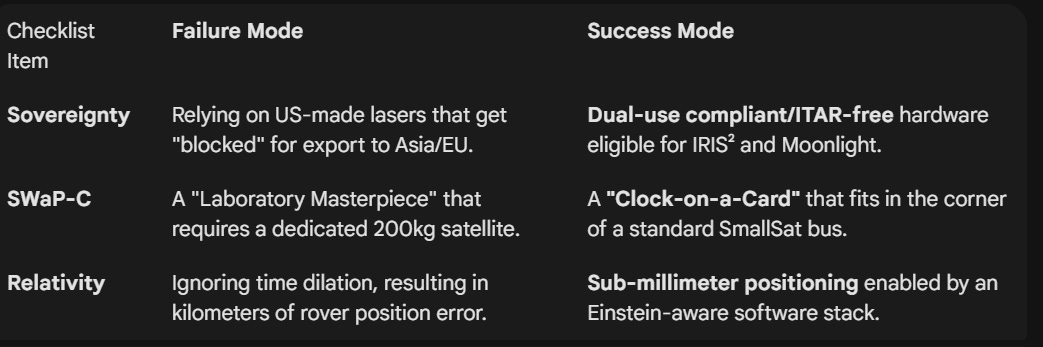
1. Supply Chain Sovereignty
“Can you build your ‘Gearbox’ without components from China or the US?”
In the 2026 geopolitical landscape, Sovereign Time is a matter of national security. For a European-based startup, the ability to bypass ITAR (US) and dual-use restrictions from China is the single greatest factor in securing high-value government contracts.
The EIC Funding Link:
To qualify for the EIC Accelerator’s “Strategic Technologies” calls, you must prove that your Intellectual Property and critical components (lasers, vacuum pumps, and specialized FPGAs) are manufactured within the EU or associated “trusted” nations.
The Deliverable:
A “Clean Bill of Materials (BOM).” The team should identify European alternatives for every critical path componentl specifically the high-finesse laser diodes and the frequency comb’s nonlinear fibers.
The Risk:
If a core component is ITAR-restricted (US), you cannot sell your PNT solution to non-US lunar missions or sovereign EU constellations like IRIS² without a veto from the US State Department.
2. SWaP-C Defensibility
“Is your power consumption dropping by 20% year-over-year?”
The “SmallSat Revolution” is a battle for the Power Budget. A quantum clock is useless if it consumes the entire satellite’s battery.
SmallSat Adoption:
To fit into a 6U or 12U CubeSat for Lunar PNT or Defense mesh networks, the entire clock stack (including the lasers and the vacuum system) must ideally pull less than 15–20 Watts.
Year-over-Year (YoY) Targets:
In 2026, the industry standard for a cold-atom clock is roughly 40W. A competitive startup must show a clear engineering roadmap to shrink this via:
PIC Integration: Moving from bulk optics to chip-scale photonics.
Low-Power Electronics: Replacing power-hungry lab-grade FPGAs with custom ASICs or low-power SoC (System on Chip) architectures.
The Metric:
Investors will track your Stability-per-Watt. If you improve precision but double the power draw, you are moving away from the market, not toward it.
3. Relativistic Awareness
“Does your software account for the Sagnac Effect and Gravitational Redshift?”
At the 10^-16 precision level and above, Einstein’s relativity is a primary source of error. Your software is what makes your hardware “Quantum-Grade.”
The Sagnac Effect:
As your satellite moves in a lunar or terrestrial orbit, the rotation of the body below “drags” space-time. Your software must perform real-time corrections for this phase shift to ensure the user on the ground gets a nanosecond-accurate coordinate.
Gravitational Redshift:
A clock at the Lunar South Pole (high gravity) ticks differently than a clock in a high lunar orbit (lower gravity).
The Competitive Moat:
This is where you outpace classical manufacturers. Classical Rubidium clocks have “drift” that masks these effects. Because your quantum clock is stable enough to see these relativistic shifts, your Relativistic Correction Engine becomes a high-value piece of proprietary IP.
The Deliverable:
A “Relativistic Simulator” validated by 3rd-party geophysicists, proving that your system can maintain “Universal Time” across the Earth-Moon gap.