
Quantum in Space [Innovation]
Possibilities for unhackable communications, hyper-precise navigation, and sensing capabilities that can peer beneath the surface.

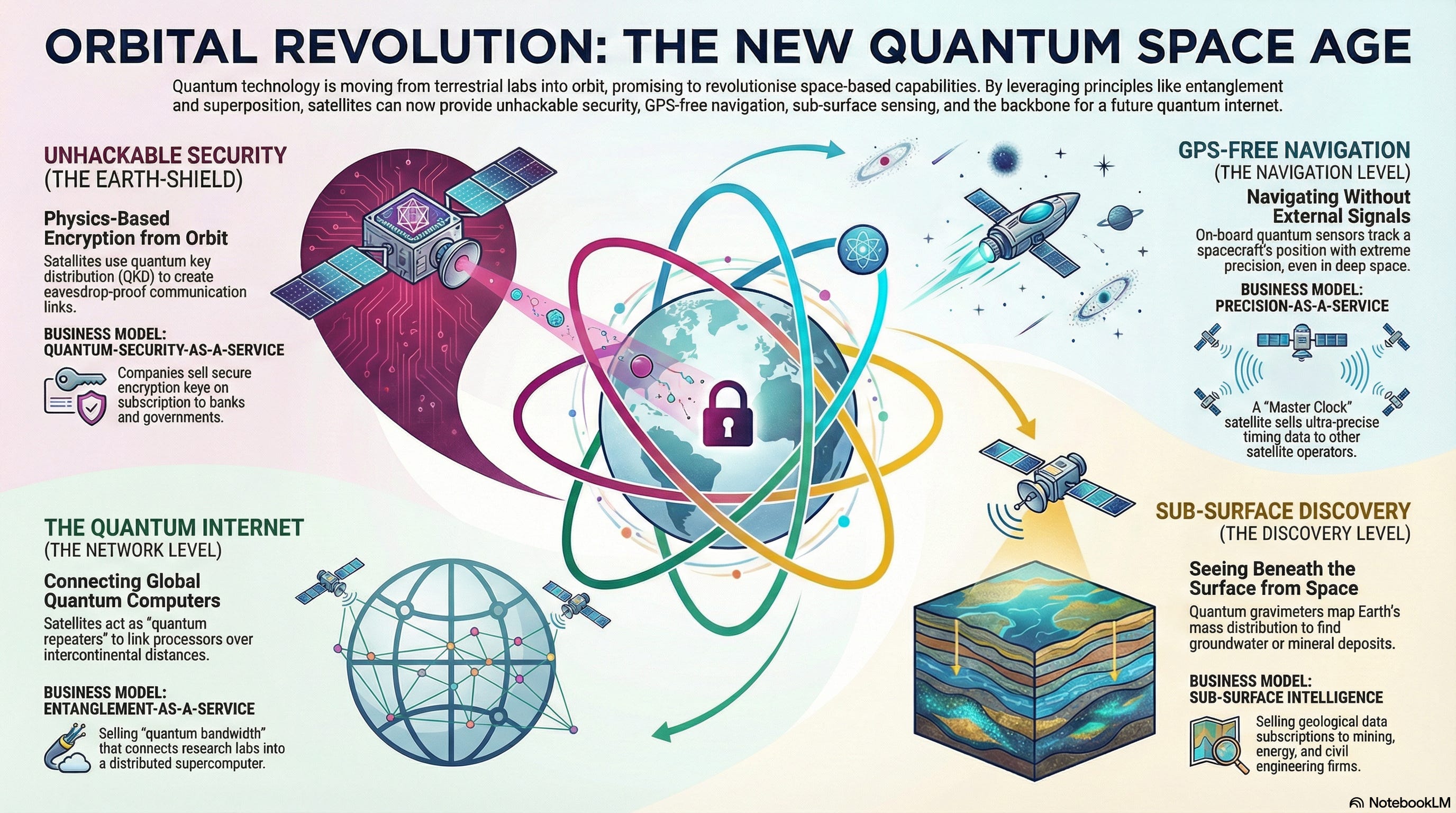
By leveraging entanglement and superposition, quantum innovation in space could provide possibilities for unhackable communications, hyper-precise navigation, and sensing capabilities that can peer beneath the surface.
I. Where is Space Quantum Technology most needed?
1. The Earth-Shield Level: Post-Quantum Cryptography (PQC) & QKD
This tier focuses on securing current and future orbital assets against the impending “Quantum Threat”; the ability of future quantum computers to break standard RSA/ECC encryption.
Quantum Key Distribution (QKD): Utilizing entangled photons to create encryption keys that are physics-guaranteed against eavesdropping. Space is an ideal medium for this, as vacuum allows for much longer transmission distances than fiber optics.
Satellite-to-Ground Secure Links: Establishing “Quantum Enclaves” where sensitive military and financial data are beamed via laser terminals, ensuring that even if a signal is intercepted, the act of observation collapses the quantum state and alerts the user.
2. The Navigation Level: Quantum PNT (Positioning, Navigation, & Timing)
At this level, quantum sensors replace traditional GPS-dependency, which is prone to jamming and is unavailable in deep space or on the lunar far side.
Cold Atom Interferometry: Using clouds of atoms cooled to near absolute zero to detect infinitesimal changes in acceleration and rotation. This could allow for “Dead Reckoning” with drift rates so low that a spacecraft could navigate to Mars without a single external reference.
Optical Lattice Clocks: Space-based quantum clocks that are orders of magnitude more precise than current atomic clocks. These are useful for synchronizing high-speed satellite handovers and deep-space network timing.
3. The Discovery Level: Quantum Sensing & Imaging
This tier utilizes quantum states to measure physical properties, such as gravity, magnetic fields, and temperature, with sub-atomic resolution.
Quantum Gravimetry: Using atom interferometers to map mass distribution. In orbit, this could allow for tracking groundwater depletion on Earth or identifying hollow lava tubes (potential habitats) on the Moon.
Magnetometry for Mineral Mapping: Detecting ultra-weak magnetic anomalies on planetary bodies to find rare-earth elements or water-bearing minerals without physical drilling.
4. The Network Level: The Quantum Internet & Distributed Computing
The tier involves connecting disparate quantum computers and sensors into a single, unified “Quantum Mesh.”
Entanglement Distribution: Satellites acting as “Quantum Repeaters” that store and relay entangled qubits, overcoming the distance limitations of terrestrial quantum networks.
Distributed Quantum Computing: Linking small quantum processors on different satellites to create a massive, virtual “Super-Quantum Computer” in orbit for complex orbital mechanics and climate modeling.
II. Example Business Models
1. The “Quantum-Security-as-a-Service” (QSaaS) Model
Primary Tier: The Earth-Shield Level (PQC/QKD)
Model: A company deploys a constellation of QKD-enabled satellites. Instead of selling the hardware, they sell “Secure Keys” to banks, governments, and NGOs. Clients pay a subscription for a guaranteed delivery of fresh, quantum-random entropy keys.
Innovator Opportunity: Hybrid Terminals. Developing small-form-factor ground stations that can receive both classical laser comms and quantum keys simultaneously.
SWOT Analysis:
Strengths: Physics-based security is a “future-proof” product; high demand from defense sectors.
Weaknesses: High cost of satellite deployment; atmospheric interference (clouds) can block photon transmission.
Opportunities: Becoming a “Gold Standard” for the world’s financial backbone.
Threats: Rapid advances in terrestrial PQC (mathematical encryption) might temporarily decrease the urgency for hardware-based QKD.
2. “Precision-as-a-Service” (PNT Outsourcing)
Primary Tier: The Navigation Level (PNT)
Model: Providing ultra-precise timing and positioning data to other satellite operators. Small-sat startups that cannot afford a quantum clock on every unit pay a “Timing Fee” to sync with a Quantum Master Clock satellite in a higher orbit.
Innovator Opportunity: Quantum Micro-PNT units. Ruggedized, “chip-scale” cold atom clocks that can be integrated into 12U CubeSats.
SWOT Analysis:
Strengths: Eliminates the “GPS-Denied” risk for deep space missions.
Weaknesses: Extremely complex calibration; high sensitivity to satellite vibrations.
Opportunities: Useful infrastructure for the “Lunar Economy” where no GPS currently exists.
Threats: Sovereignty issues; nations may not want to rely on a private company for timing.
3. “Quantum-Sensing-as-a-Service” (QSaaS) & Earth Observation
Primary Tier: The Discovery Level (Sensing & Imaging)
Model: Companies deploy satellites equipped with quantum gravimeters and magnetometers to map Earth’s sub-surface density and magnetic fields with unprecedented resolution. Rather than selling raw data, they provide a “Sub-Surface Intelligence” subscription to mining, energy, and civil engineering firms to monitor groundwater depletion, locate mineral deposits, or track magma movement in volcanoes.
Innovator Opportunity: Quantum-Assisted Digital Twins. Creating high-fidelity 4D models of the Earth’s crust that integrate quantum gravity data to predict geological shifts or resource availability.
SWOT Analysis:
Strengths: Can “see” where optical and radar sensors cannot; high value for climate change monitoring (e.g., glacier mass balance).
Weaknesses: Quantum sensors are highly sensitive to satellite platform noise/vibration; requires complex data de-convolution.
Opportunities: Enabling the “Green Mining” era by pinpointing lithium or rare-earth deposits without invasive exploratory drilling.
Threats: National security restrictions on high-resolution gravity maps; competition from low-altitude drone-based quantum sensors.
4. “Entanglement-as-a-Service” (EaaS) & The Quantum Backbone
Primary Tier: The Network Level (Quantum Internet & Comms)
Model: This model serves as the “ISP of the Quantum Era.” The provider operates a constellation of “Quantum Repeaters” and “Entanglement Routers.” They sell “Entangled Pair Seconds” (EPS) to quantum computing centers and research labs, allowing them to link disparate quantum processors via teleportation to solve problems that exceed the capacity of a single machine.
Innovator Opportunity: Orbital Quantum Memory Nodes. Developing vacuum-stable “storage” units (e.g., rare-earth-doped crystals) that can hold a qubit’s state for minutes, allowing for asynchronous entanglement distribution.
SWOT Analysis:
Strengths: Creates a “Network Moat” where the more nodes connected, the more potentially valuable the service; essential for the true Quantum Internet.
Weaknesses: Extreme technical difficulty in maintaining entanglement fidelity across long orbital distances.
Opportunities: Providing the “Blind Quantum Computing” infrastructure where clients can run sensitive algorithms on a cloud quantum computer without the provider ever seeing the data.
Threats: Interoperability; if a dominant player establishes a proprietary “quantum protocol,” the market may fragment into incompatible silos.
III. Enabling Technologies
To achieve the operational longevity and sub-atomic precision required for the Quantum Space Age, satellite architectures are shifting toward Photonic and Cold-Atom Intelligence. These technologies transform the spacecraft from a mere relay station into a quantum-native node capable of preserving delicate states of matter against the intense radiation and thermal turbulence of the orbital environment.
1. Atom-on-a-Chip & Cold Atom Laboratories (CAL)
On Earth, the “Observation Time” of quantum states is limited by gravity pulling atoms out of the sensor’s laser-cooled trap.
The Innovation: By miniaturizing bulky vacuum chambers into Silicon-Photonic chips, innovators are creating “Cold Atom Factories” that could operate in microgravity. This allows atoms to remain in a “free-fall” quantum state for several seconds, rather than milliseconds.
Hyper-Precise Inertial Sensing: These chips could act as the ultimate accelerometer. By measuring the interference patterns of matter-waves, the satellite could detect infinitesimal changes in velocity, enabling Quantum Dead Reckoning; navigation that remains accurate to within meters over months without a single GPS update.
2. Space-Qualified Entangled Photon Sources (EPS)
Generating “spooky action at a distance” typically requires heavy, vibration-sensitive laboratory tables and high-power crystals.
The Innovation: Modern EPS modules utilize Non-Linear Optical Waveguides integrated into ruggedized, shoebox-sized payloads. These units use Gallium Nitride (GaN) laser diodes to maintain a stable “Quantum Heartbeat” despite the 100°C thermal swings experienced as a satellite moves from sunlight into Earth’s shadow.
Radiation-Hardened Entanglement: By utilizing Self-Healing Optoelectronic materials, these sources can withstand the high-energy proton bombardment of the Van Allen belts, potentially ensuring that the rate of entangled pair generation does not degrade over a satellite’s five-year lifespan.
3. SNSPDs & Closed-Cycle Cryogenic Bus
To detect a single photon (the “qubit”) beamed from 36,000 km away in geostationary orbit, standard sensors are too noisy.
The Innovation: Superconducting Nanowire Single-Photon Detectors (SNSPDs) utilize a mesh of niobium-nitride wires cooled to near absolute zero.
Active Cooling Firewall: Unlike previous “open-loop” systems that relied on limited liquid helium, new architectures use Vibration-Isolated Pulse Tube Cryocoolers. This creates a permanent “thermal vacuum” that allows the satellite to catch a single “whisper” of light from Earth while the exterior of the spacecraft is being cooked by solar radiation, maintaining a signal-to-noise ratio previously only possible in underground labs.
4. Adaptive Optics & Laser Guide Star (LGS) Terminals
The Earth’s atmosphere acts as a turbulent, “shimmering” lens that scatters quantum signals, decohering the delicate phase of the photons.
The Innovation: Satellites now deploy Deformable Mirror (DM) Terminals paired with a secondary “Laser Guide Star.” The LGS measures atmospheric turbulence 1,000 times per second.
Phase-Corrected Quantum Links: Using a Real-Time Controller (RTC), the satellite’s mirror physically deforms its shape to “pre-distort” the quantum signal. This ensures that by the time the photon reaches the ground station, the atmospheric distortion has been perfectly cancelled out, allowing for Daytime QKD; a feat previously impossible due to solar background noise.
5. Quantum Frequency Combs (QFC)
Global positioning and deep-space comms rely on the stability of an atomic clock. Standard microwave clocks drift by nanoseconds, which equals decimeters of error.
The Innovation: The “Optical Frequency Comb” acts as a gear-wheel that translates the ultra-fast oscillations of an optical clock (millions of billions of times per second) into a measurable electronic signal.
Universal Time Synchronization: By embedding these combs into Photonic Integrated Circuits (PICs), satellites can synchronize their timing to within a few femtoseconds (10^-15 seconds). This enables Sub-Centimeter Positioning and allows a fleet of satellites to act as a single, distributed “Quantum Telescope” with an effective aperture the size of the Earth’s orbit.
IV. Example Innovators
1. The Earth-Shield Level: QKD & PQC
These innovators focus on “Quantum-Native” security to protect global data backbones from the “Q-Day” threat.
QUARTZ (SES/ESA): A European consortium building a sovereign, satellite-based QKD system to provide unhackable encryption for EU governmental and financial sectors.
SpeQtral (Singapore): A leader in miniaturized QKD payloads; they are pioneering the “Quantum Gate” terminal that allows small satellites to beam keys to portable ground stations.
Quantinuum (Honeywell): They are developing “In-Orbit PQC” software in the form of mathematical encryption designed to run on satellite CPUs that is resilient to quantum decryption.
Arqit Quantum: A UK-based innovator delivering a software-defined “Symmetric Key Agreement” platform that utilizes satellite entropy to secure global networks without requiring massive quantum hardware on every node.
ID Quantique (Switzerland): Pioneers of Quantum Random Number Generators (QRNG) and photon counters used in almost major space-based quantum communication experiments.
Thales Alenia Space: A joint venture leading the QKD-GEO mission, which aims to provide a quantum key distribution service from Geostationary Orbit, covering entire continents with a single asset.
Hispasat: The Spanish satellite operator partnering with Thales to bridge the gap between quantum science and the commercial satellite telecommunications market.
2. The Navigation & Sensing Level: PNT
Focusing on GPS-denied navigation and high-resolution gravity mapping to find resources and guide spacecraft.
ColdQuanta (Infleqtion): A primary provider of “Cold Atom” hardware for the ISS; they are developing the “Tiqker” atomic clock, designed to provide ultra-precise timing in a 3U CubeSat form factor.
AOSense (USA): Specialists in atom-interferometer-based sensors, currently building high-performance quantum gyroscopes for the next generation of deep-space inertial navigation systems.
Exail (France): Developers of commercially available quantum gravimeter, now being adapted for orbital platforms to map groundwater and mineral deposits from space.
Q-CTRL (Australia): Partnered with Lockheed Martin, they provide the “Quantum Infrastructure Software” that ruggedizes atomic sensors against the vibrations and radiation of rocket launches.
SBQuantum (Canada): Innovators in Diamond-NV Magnetometry, developing sensors the size of a milk carton that can map the Earth’s magnetic field with high enough resolution for “Magnetic Navigation” (MagNav).
3. The Discovery Level: Resource Mapping & Earth Observation
These companies utilize quantum effects to “peer” into the subsurface for mining and climate science.
Fleet Space Technologies (Australia): Leading the Seven Sisters mission to the Moon, they integrate quantum sensors into satellite swarms to locate water ice and mineral wealth in the lunar regolith.
Nomad Atomics: Focused on “drift-free” quantum accelerometers and gravimeters that enable real-time, high-resolution geophysical mapping without the need for base-station recalibration.
DeteQt: Specializing in diamond-on-chip magnetometers that provide vector magnetic measurements, potentially useful for identifying the rare-earth mineral “signatures” required for the green energy transition.
4. The Network Level: The Quantum Internet
Innovators building the “infrastructure nodes” (repeaters and routers) that connect distant quantum processors.
Micius (CAS): A Chinese Academy of Sciences project that proved the viability of long-distance entanglement and intercontinental QKD.
Qunnect (USA): Developers of room-temperature “Quantum Memories” and repeaters that can store and relay qubits, effectively acting as the “Cisco of the Quantum Internet.”
Aliro Quantum: They provide the network emulation and control software (AliroNet) required to manage the complex entanglement handovers between ground stations and satellite constellations.
AUREA Technology (France): Engineering the “photonic building blocks”, such as GHz single-photon counters and entangled photon sources, required for future European quantum networks.
Nu Quantum (UK): Focusing on high-efficiency “Quantum Networking Units” that link quantum computers together into scalable, distributed clusters.
VI. Potential Opportunities for New Innovators
1. High-Fidelity Quantum Buffers (The Coherence Gap)
While it’s possible to currently transmit entangled photons across thousands of kilometers, the lack of “Quantum Memory” prevents satellites from storing qubits. This creates a reliance on “Direct-Link” line-of-sight, which is fragile and intermittent.
The Opportunity: Developing vacuum-stable, radiation-hardened Quantum Buffers that can store a qubit’s state for seconds or minutes without decoherence.
Innovation Focus:
Rare-Earth-Doped Crystals: Utilizing crystals like Yttrium Orthosilicate (YSO) that can “freeze” light as a stationary excitation, providing a stable storage medium for entangled states in orbit.
Warm Vapor Memories: Developing alkali-gas cells (e.g., Rubidium or Cesium) that do not require cryogenic cooling, enabling “Quantum Store-and-Forward” capabilities in small-satellite form factors.
Entanglement Swap Controllers: On-board processors that can execute Bell State Measurements (BSM) between stored qubits, effectively acting as the “Quantum Router” for a global mesh network.
Example Innovators: Qunnect (US), ORCA Computing (UK), Fraunhofer Institute (Germany).
2. Cryogenic Photonic Packaging (The Thermal Gap)
Quantum detectors (SNSPDs) require temperatures near absolute zero, but the side of a satellite facing the sun can reach 120C. The current “Utility Ceiling” is the high power consumption of active cryocoolers.
The Opportunity: Moving toward Passive-First Cryogenic Architectures that leverage material intelligence and the deep-space heat sink to reach near-absolute zero without heavy machinery.
Innovation Focus:
Multi-Stage Radiative Parasols: Deploying origami-inspired, multi-layered “Sunshields” made of aluminized Kapton that create a permanent thermal shadow, allowing the sensor bay to cool passively.
Micro-Scale Pulse Tube Refrigerator (PTR): Developing vibration-free, closed-loop coolers that utilize Gallium Nitride (GaN) electronics to manage high-frequency gas compression.
Structural Thermal Isolators: Using 3D-printed ceramic lattices with ultra-low thermal conductivity to physically “decouple” the quantum payload from the satellite’s warm battery and bus.
Example Innovators: Northrop Grumman (US), SPACECOOL (Japan), Blue Origin (Cryo-Logistics).
3. Cross-Platform Quantum Transceivers (The Standardization Gap)
The current quantum space market is fragmented; a Chinese “Micius” link cannot talk to a European “QUARTZ” terminal. To scale, the industry could benefit from the “USB Standard” of quantum light.
The Opportunity: Developing universal, Agnostic Quantum Terminals that can translate and sync between different photon frequencies, polarizations, and timing protocols.
Innovation Focus:
Quantum Frequency Conversion (QFC): Developing chip-scale nonlinear optics (e.g., Thin-Film Lithium Niobate) that can shift a 780nm “memory” photon to a 1550nm “telecom” photon without losing entanglement.
Reconfigurable Silicon Photonic PICs: Software-defined photonic chips that can switch between different QKD protocols (BB84, E91, etc.) on-the-fly to facilitate handovers between heterogeneous satellite fleets.
Unified Basis Aligners: High-speed polarization controllers that automatically compensate for the “Faraday Rotation” caused by Earth’s magnetic field, regardless of the satellite’s orientation.
Example Innovators: SpeQtral (Singapore), Aliro Quantum (US), NASA Glenn (SAW Division).
4. Quantum-Enhanced Inertial Frames (The Positioning Gap)
Deep-space missions beyond the Moon currently have no “Quantum GPS.” Relying on Earth-based radio tracking leads to positioning errors that grow with distance, creating a barrier for autonomous Mars or Asteroid missions.
The Opportunity: Solving the “Dead Reckoning” challenge by integrating Quantum Inertial Measurement Units (QIMUs) that provide an absolute, drift-free reference frame for navigation.
Innovation Focus:
Atom Interferometry Accelerometers: Using laser-cooled atom clouds to measure the “curvature” of space-time, allowing a spacecraft to calculate its position relative to a planet’s gravity center with sub-meter accuracy.
Cold-Atom Gyroscopes: Quantum rotation sensors that utilize the Sagnac effect in matter-waves, offering drift rates 100x lower than the best optical fiber gyroscopes used today.
Stellar-Quantum Hybrid Navigation: Combining quantum PNT with traditional star-trackers to provide a “triple-redundant” navigation suite that functions in the total absence of external signals.
Example Innovators: AOSense (US), Infleqtion (US), Exail (France).
5. On-Orbit Atomic Clock Distribution (The Synchronization Gap)
The coordination of distributed quantum computing and high-speed satellite handovers could benefit from femtosecond-level timing synchronization that traditional microwave clocks cannot provide.
The Opportunity: Creating a “Universal Time Backbone” by deploying optical lattice clocks in orbit that distribute an ultra-stable timing signal via laser links.
Innovation Focus:
Optical Frequency Combs (OFC): Miniaturized “gearboxes” that convert the ultra-high frequency of an optical clock into a microwave signal that current satellite electronics can digest.
Time-Transfer Laser Terminals: High-bandwidth optical links that can synchronize the internal clocks of two satellites 2,000 km apart to within 10^-16 seconds.
Solid-State Nuclear Clocks: Developing the next generation of timekeeping based on thorium-229 transitions, which are more resilient to the magnetic and radiation interference of the space environment.
Example Innovators: Vescent (US), NKT Photonics (Denmark), NIST (Quantum Physics Division).