
Refuelling in Space [Innovation]
This technology unlocks deep space exploration, lower-cost orbital transfers, and mission extensions.

By decoupling a satellite’s mission requirements from its launch-day fuel capacity, this technology unlocks deep space exploration, lower-cost orbital transfers, and mission extensions.
I. Market Drivers: The Necessity of Orbital Fuel
1. Life Extension & Asset Value (Commercial Imperative)
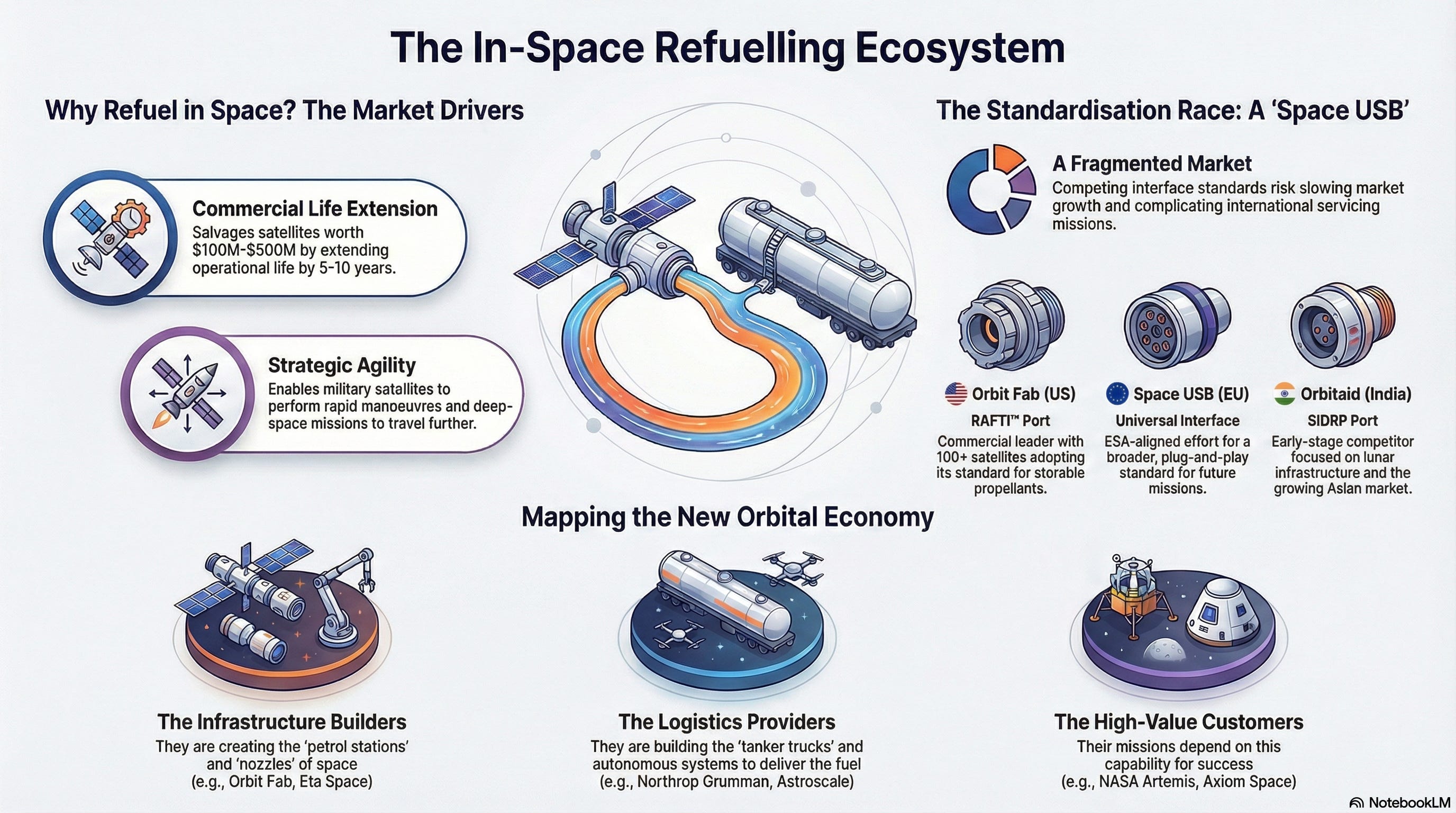
The Driver: Satellite operators in high-value Geostationary Earth Orbit (GEO) face a $100M to $500M loss when an otherwise healthy asset runs out of propellant for station-keeping.
Actionable Solution: Refueling extends the operational life of an asset by 5–10 years, providing an ROI that far exceeds the cost of the fuel itself, as the value is the salvage of a multi-million-dollar asset.
2. Mission Agility & Flexibility (Military & Exploration Imperative)
Military Imperative: Government and defense agencies require satellites that can quickly change orbits or reposition to avoid threats. Refueling creates tactical resilience by ensuring critical assets always have the propellant reserves to perform high-Delta V (change in velocity) maneuvers.
Exploration Imperative: Orbital depots allow upper stages and crew vehicles (like Starship’s Human Landing System) to launch “dry,” refill in orbit, and travel further.
II. Technical & Standardization Challenges
Transferring propellant in zero-gravity is significantly more complex than filling a gas tank on Earth. The industry needs to solve the physics of microgravity fluid management and the politics of standardization.
1. The Physics of Fluid Transfer
Cryogenic Fluid Management (CFM): For high-energy propellants, the challenge is Zero Boil-Off (ZBO) storage. Depots need to employ advanced thermal control and cryo-coolers to prevent fuel evaporation, which is a prerequisite for deep-space missions.
Propellant Acquisition (The PMD Challenge): In microgravity, fluids cling to tank walls and mix with gas bubbles (ullage). Innovators need to use specialized Propellant Management Devices (PMDs), internal systems of vanes, channels, or screens, that exploit surface tension to reliably deliver pure liquid fuel to the transfer line, ensuring gas-free expulsion to the client satellite.
Refuelling Unprepared Clients: Serving older, “unprepared” satellites requires complex robotic servicing vehicles capable of high-risk procedures, such as using robotic end-effectors to cut thermal blankets and access non-standard fill ports.
2. The Standardization Race & Fragmentation Risk
The industry is fighting for the one common interface standard, akin to a “Space USB.” The current landscape is fragmented, which hinders global market growth and complicates multi-national servicing missions.
Orbit Fab’s RAFTI™:
Technology: Rapidly Attachable Fluid Transfer Interface.
Market Position: Leads in commercial adoption (on 100+ satellites) and flight heritage for storable propellants (Hydrazine, Xenon). It is currently the primary commercial standard.
Space USB (EU):
Technology: Universal Spacefuel Bus (USB) interface; modular docking and fueling ports.
Commercial Roadmap: ESA-aligned standardization efforts; early-stage demos.
Differentiation: Focuses on a broader Plug-and-play fueling interface for In-Space Servicing, Assembly, and Manufacturing (ISAM) missions, attempting to become the multilateral European standard.
Orbitaid Aerospace (India):
Technology: SIDRP (Standard Interface Docking and Refueling Port); tanker satellites for LEO, GEO, cis-lunar, and interplanetary missions.
Commercial Roadmap: $1.5M pre-seed funding (2025); in-space docking/refueling demo; MoU with ispace for lunar integration.
Differentiation: Early-stage competitor focused on standardized ports and rapid development of lunar infrastructure, positioning itself as the primary standard for the rapidly growing Indian and Asian space markets.
III. Innovators, Commercial Scenarios, and Market Impact
The key players are split between those building the infrastructure standard and those providing the complex servicing mission.
1. Interface and Depot Architects (The Propellant Utility)
These players are focused on selling propellant as a recurring orbital commodity (Propellant as a Service - PaaS) by building the necessary infrastructure.
Core Role: RAFTI™ (Refueling Port Standard) and Tanker Depots.
Impact: Market Leader in Standardization. Their success directly enables all other servicing providers by solving the fuel transfer standard.
Eta Space:
Core Role: Cryogenic Fluid Management (CFM) Systems.
Impact: Market Leader in Cryogenics. Their success is a prerequisite for long-term Artemis/Cislunar missions.
ESA (Odyssey Depot):
Core Role: Technology Demonstrator (International).
Impact: Validates non-US, multilateral standards and technologies, addressing the fragmentation risk by proving European competency in cryo-storage and transfer.
2. Servicing & Logistics Providers (The Tanker Trucks)
These companies are focused on the vehicle autonomy and robotics required to perform the mission, making them prime customers or partners for the Interface Architects.
Northrop Grumman:
Core Role: Mission Extension Vehicle (MEV) / MRV.
Impact: First Commercial Success (MEV). The future MRV will integrate refueling capability by 2026+, shifting from mechanical extension to fluid transfer, making them a major future fuel customer.
Astroscale:
Core Role: Life Extension / Active Debris Removal (ADR).
Impact: Anchor Customer for Fuel. Signed the first-ever commercial fuel sale agreement with Orbit Fab, driving immediate demand for fuel to power their LES and debris removal missions.
Starfish Space:
Core Role: Autonomous Rendezvous & Docking (AR&D) software (CELESTIAL).
Impact: Autonomy Enabler. Their AR&D software is essential for the high-precision, low-cost docking required for all fluid coupling operations.
Atomos Space:
Core Role: Orbital Transfer Vehicles (Space Tugs).
Impact: High-Volume Fuel User. Operates reusable tugs that reposition client satellites. Their business model inherently requires high-volume refueling to maintain operational cadence.
3. Deep Space Customers (The Demand Drivers)
These organizations use ISR to make missions physically or economically possible.
NASA (Artemis):
Core Role: Lunar Gateway / HLS (Starship).
Impact: ISR is a critical path item for crewed lunar landings. The Artemis timeline (starting mid-2027) depends on Starship’s in-orbit refueling success.
ULA (Vulcan):
Core Role: ACES Upper Stage.
Impact: The ACES upper stage design integrates fluid management and possible in-orbit refueling, positioning ULA to become a major commercial transfer service provider to GEO/Cislunar.
Axiom Space:
Core Role: Commercial Space Stations.
Impact: Will require ISR to maneuver, upgrade, and potentially de-orbit modules. Represents the future high-volume, continuous LEO demand for propellants.
IV. Opportunities for New Innovators
The refuelling ecosystem is still nascent, leaving high-value gaps for specialized new entrants:
Financialization of Fuel (Orbital FinTech): Innovators are needed to develop orbital inventory management and billing software that integrates with depots. This is the sophisticated financial layer needed to track, meter (measuring propellant mass transfer), and autonomously bill complex international fuel transactions.
AI for Proximity Operations (AR&D Specialization): Create specialized AI/ML software for Autonomous Rendezvous and Docking (AR&D) optimized for fluid coupling. The precision required for high-pressure fluid seals is far more stringent than simple mechanical docking.
Cryogenic Component Specialization (The ZBO Solution): Focus on perfecting single, critical components that solve the ZBO problem, such as highly efficient, low-mass cryo-coolers or novel Multi-Layer Insulation (MLI) materials that reduce long-term fuel loss, a necessary technology for the deep-space refuelling market.
Brilliant. The emphasis on mission agility reminds me how precision in Pilates unlocks new ranges of movement, extendind capabilities.