Satellite Collision Avoidance [Innovation]
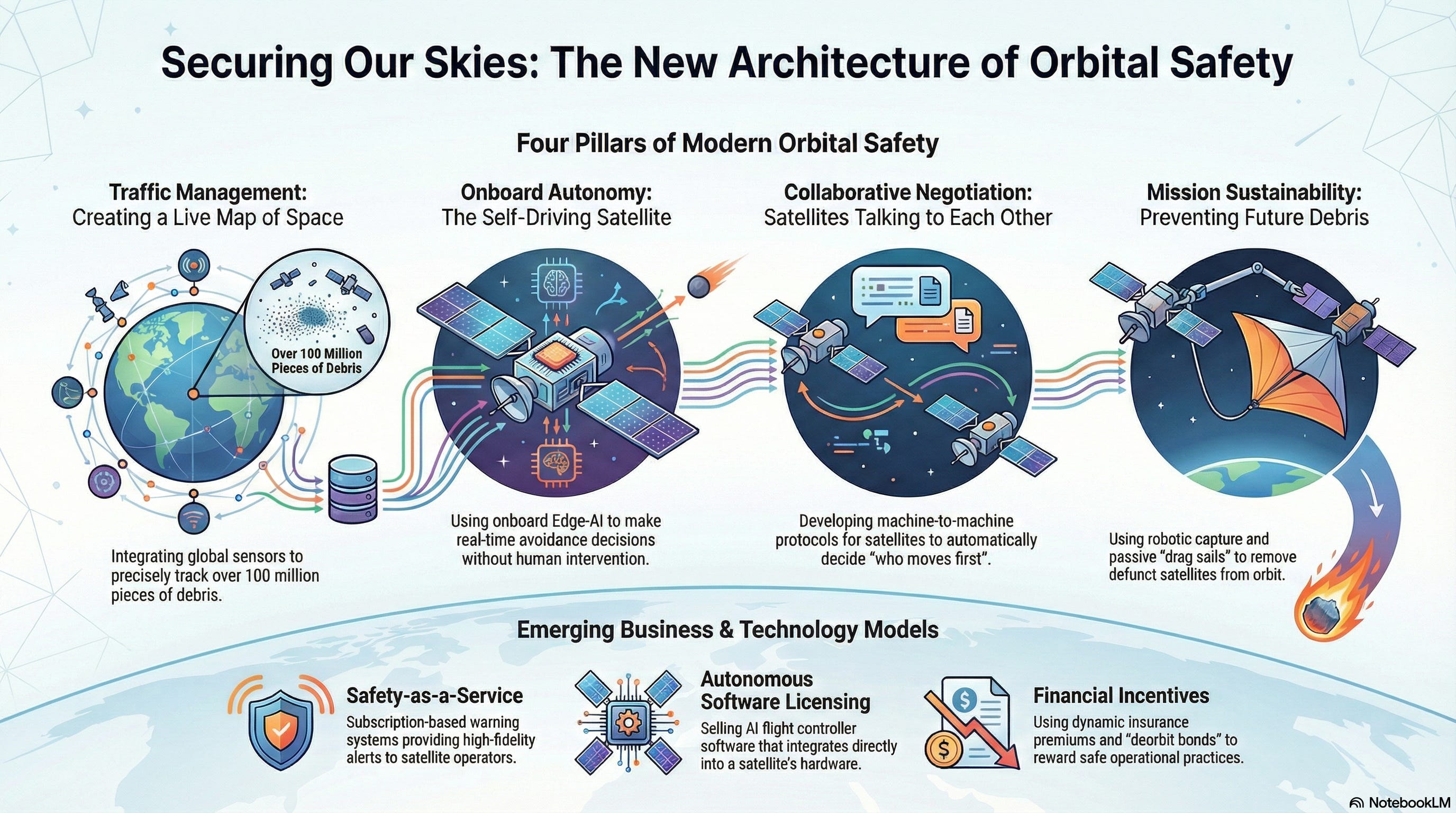
Transforming orbital safety from a reactive ground-based process into a proactive, “self-driving” ecosystem.

Satellite Collision Avoidance is moving away from passive “wait-and-see” ground tracking toward active, autonomous, and self-negotiating safety architectures.
As orbital lanes become congested with megaconstellations and the “Kessler Syndrome” threat of cascading debris grows, the human inability to manually manage thousands of daily conjunction alerts could become a bottleneck for the sustainable use of Low Earth Orbit (LEO).
By leveraging Edge-AI, computer vision, and high-precision propulsion, innovators are transforming satellites from static targets into proactive, “self-driving” agents.
These systems are being designed to navigate the chaotic “debris clouds” of LEO and the uncoordinated traffic of the new lunar economy, ensuring that the “Final Frontier” remains a navigable domain rather than a locked-in graveyard of orbital shrapnel.
I. Where is Collision Avoidance Innovation Most Needed?
1. The Traffic Management Level: Space Situational Awareness (SSA)
This tier focuses on mapping the orbital environment to a high degree of fidelity, identifying not just active satellites but the 100 million+ pieces of untracked debris.
Sensor Fusion & Global Catalogs: Integrating ground-based radar, optical telescopes, and space-based sensors into a unified “Live Map.”
Precision Orbit Determination (POD): Reducing “covariance” (the bubble of uncertainty around an object’s position) to prevent false alerts. Current innovations aim for sub-meter accuracy to eliminate “nuisance” warnings that waste satellite fuel.
2. The Autonomous Level: Onboard Decision-Making
At this level, satellites move from following ground commands to making real-time safety decisions on the “edge.”
Edge-AI Maneuvering: Satellites equipped with AI chips (like NVIDIA-class GPUs adapted for space) that process Conjunction Data Messages (CDMs) locally and execute thruster firings without human intervention.
Low-Latency Response: Essential for “short-notice” conjunctions where debris is detected only hours before impact, leaving no time for round-trip ground communication.
3. The Sustainability Level: Post-Mission Disposal (PMD)
This tier ensures that “today’s satellite doesn’t become tomorrow’s debris.”
Active Debris Removal (ADR): Using robotic arms, magnets, or harpoons to capture defunct assets.
Passive Deorbiting Tech: Innovation like “Drag Sails” or “Plasma Brakes” that use the thin upper atmosphere or Earth’s magnetic field to pull a satellite down at the end of its life without requiring fuel.
4. The Collaborative Level: Inter-Operator Negotiation
With megaconstellations like Starlink and Kuiper, satellites must “talk” to each other to decide who moves first during a potential collision.
Automated Traffic Protocols: Machine-to-machine (M2M) negotiation where two satellites compare fuel levels and mission priorities to determine the most efficient avoidance path.
Standardized Data Sharing: Unified platforms (like the EU’s CREAM project) that allow disparate operators to share ephemeris data securely.
II. Example Business Models
1. “Safety-as-a-Service” (Collision Risk Management)
Primary Tier: The Traffic Management Level (SSA)
Model: A company operates a proprietary sensor network and provides a subscription-based “Warning System.” Satellite operators pay to receive high-fidelity, processed alerts that are more accurate than public military data.
Innovator Opportunity: Developing “High-Precision Covariance Models” that use ML to predict atmospheric drag; the biggest variable in low-earth orbit (LEO) movement.
SWOT Analysis:
Strengths: Essential for megaconstellations; reduces operator “alert fatigue.”
Weaknesses: High capital expenditure (CapEx) for ground/space sensors.
Opportunities: Integration into government-mandated Space Traffic Management (STM) frameworks.
Threats: National security restrictions on sharing high-resolution orbital data.
2. “Autonomous-Avoidance-as-a-Software” (Edge-AI Integration)
Primary Tier: The Autonomous Level (Onboard Decision-Making)
Model: Rather than selling hardware or data, this company sells an AI Flight Controller license. The software is integrated into a satellite’s Bus (the main body) and interfaces directly with the propulsion system. It processes incoming Conjunction Data Messages (CDMs) from ground radars in real-time, autonomously calculates the optimal “escape burn,” and executes it without waiting for ground-crew approval.
Innovator Opportunity: Digital Twin Safety Verification. Providing a sandbox environment where operators can “stress-test” the AI’s decision-making against millions of simulated collision scenarios before the satellite is launched.
SWOT Analysis:
Strengths: Significantly reduces the human headcount needed for mission control; provides 24/7 protection regardless of ground-station visibility.
Weaknesses: Requires high trust from operators; potential for “software bugs” to cause accidental maneuvers into the path of other objects.
Opportunities: The massive growth of LEO (Low Earth Orbit) makes human-in-the-loop management mathematically impossible.
Threats: Liability ambiguity; if an autonomous satellite causes a collision, who is at fault: the operator or the software vendor?
3. “Orbital-Debris-Arbitration” (The Traffic Exchange Model)
Primary Tier: The Collaborative Level (Inter-Operator Negotiation)
Model: This organisation acts as the “Air Traffic Control Tower” for private industry. It operates a neutral, third-party platform where different megaconstellations (e.g., Starlink vs. OneWeb) share their “intent data.” The model charges a transaction fee for every successful “Negotiated Maneuver,” where the platform determines which satellite should move based on fuel-efficiency and mission priority.
Innovator Opportunity: Tokenized Maneuver Credits. A blockchain-based system where operators can trade “maneuver rights” or “orbital slots,” creating a financial incentive for companies to keep their satellites agile.
SWOT Analysis:
Strengths: Potentially solves the “Tragedy of the Commons” by creating a structured environment for cooperation; minimizes wasted fuel across the industry.
Weaknesses: Relies on competitors being willing to share sensitive proprietary orbital paths and fuel statuses.
Opportunities: Can become the de facto global standard for the “International Space Traffic Management” (ISTM) regulatory framework.
Threats: Major players (like SpaceX) might develop their own internal protocols, making a third-party platform irrelevant.
4. “Collision-Risk-Insurance-Wrappers” (Financial Risk Mitigation)
Primary Tier: The Sustainability & Traffic Management Levels
Model: A fintech-space hybrid that offers “Dynamic Insurance Premiums.” Using real-time SSA (Space Situational Awareness) data, the company adjusts an operator’s monthly insurance premium based on their proximity to debris clouds or their use of autonomous avoidance tech. Lower risk (due to better tech) equals lower premiums.
Innovator Opportunity: Incentivized Deorbit Bonds. A financial product where a portion of the insurance premium is held in escrow and returned only when the satellite is successfully deorbited at the end of its life.
SWOT Analysis:
Strengths: Uses market forces (money) to drive orbital safety behavior; highly scalable as satellite numbers grow.
Weaknesses: Highly dependent on the accuracy of third-party debris data to set “fair” prices.
Opportunities: Partnering with traditional underwriters (like Lloyd’s of London) who lack the technical expertise to model orbital collision math.
Threats: A “Kessler event” (massive collision chain) could bankrupt the fund, requiring government-backed reinsurance.
III. Enabling Technologies
To achieve the operational longevity and sub-millisecond reaction times required for the Autonomous Space Age, satellite architectures are shifting toward Edge-AI Intelligence and Active-Sensing Payloads. These technologies transform the spacecraft from a passive follower of ground commands into a “self-aware” node capable of identifying debris and executing evasive maneuvers in the high-radiation, high-velocity environment of Low Earth Orbit (LEO).
1. Onboard AI Agents & Deep Reinforcement Learning (DRL)
Traditional collision avoidance is a “geometry problem” solved by human teams on the ground over several days.
The Innovation: By integrating high-performance Neuromorphic Chips, innovators are deploying AI agents that use Deep Reinforcement Learning to simulate thousands of “what-if” orbital trajectories locally. Unlike static algorithms, these agents learn the optimal balance between safety margins and fuel preservation.
Fuel-Optimized “Free” Maneuvering: These agents can synchronize a collision avoidance burn with an upcoming station-keeping maneuver. By calculating a single vector that satisfies both safety and mission requirements, the satellite effectively executes the avoidance move “for free” in its fuel budget, extending mission life.
2. Hybrid Space-Based Sensors (LiDAR & Multi-Spectral Optical)
Satellites currently rely on ground-based radar, which can miss debris smaller than 10cm and is often limited by atmospheric weather or geographic blind spots.
The Innovation: Modern architectures utilize Flash LiDAR (Light Detection and Ranging) paired with event-based cameras. Unlike standard cameras that require sunlight, LiDAR pulses a 1550nm laser to measure the “Time-of-Flight” of a photon reflecting off a piece of debris, even in the Earth’s shadow.
Sub-Meter Covariance Reduction: By tracking a threat from the satellite itself, the “bubble of uncertainty” (covariance) is reduced from kilometers to meters. This eliminates the “false positive” alerts that currently plague operators, preventing unnecessary maneuvers that waste propellant.
3. Precision Electric Propulsion (EP) & Iodine-Based Plasma Thrusters
Traditional chemical thrusters are “all-or-nothing” systems that provide high thrust but very low precision, often over-correcting and knocking a satellite out of its operational slot.
The Innovation: Next-generation Hall-Effect Thrusters utilizing Iodine or Krypton propellants allow for infinitesimal, millinewton-level “nudges.” These systems offer high Specific Impulse (Isp), meaning they get significantly more “mileage” out of every gram of fuel.
Continuous Safety Buffer: Because EP is so efficient, a satellite can maintain a “Dynamic Safety Buffer,” constantly adjusting its orbit in small increments to avoid congested zones. This transforms collision avoidance from a “emergency event” into a background maintenance task.
4. Inter-Satellite Communication Links (ISL) & M2M Negotiation
Currently, if two satellites are on a collision course, they are “blind” to each other’s intent, often leading to both satellites moving in the same direction or neither moving at all.
The Innovation: Optical Laser Links allow for Machine-to-Machine (M2M) negotiation protocols. Using a decentralized ledger (similar to blockchain), two satellites from different constellations could “handshake” and exchange fuel status and mission priority data in milliseconds.
Autonomous Traffic Arbitration: The satellites could utilize a Game Theory algorithm to decide which asset moves. If Satellite A is low on fuel and Satellite B has an efficient electric thruster, the system automatically assigns the maneuver to Satellite B, ensuring the collective safety of the orbital plane without human intervention.
5. Advanced Drag-Modulation & Passive Deorbit Sails
At the end of a mission, a dead satellite becomes a “unguided projectile,” posing a multi-decade risk to other assets until it naturally decays.
The Innovation: High-Modularity Aero-Braking Sails made of aluminized Kapton are being integrated into 12U and 24U CubeSat frames. These sails can be “pitched” like a rudder to interact with the thin traces of atmosphere in LEO.
Electrodynamic Tethers (EDT): By deploying a multi-kilometer conductive wire, the satellite interacts with Earth’s magnetic field to generate a Lorentz force. This acts as a “magnetic brake” that pulls the satellite down into the atmosphere for incineration without requiring a single drop of fuel, ensuring the “Orbital Slot” is cleared for the next generation of innovators.
IV. Example Innovators
1. The SSA & Data Fusion Segment (The “Eyes”)
These innovators focus on the “Observation Tier,” providing the high-fidelity data required to map orbital paths and predict conjunctions.
LeoLabs (USA): Operates a global network of phased-array radars that track objects as small as 2cm. Their “Space Operations Center” provides real-time tracking for thousands of active satellites and debris.
ExoAnalytic Solutions (USA): Manages a global commercial optical telescope network (EGTN), with over 350 autonomous telescopes providing 24/7 monitoring of the Geostationary (GEO) belt.
NorthStar Earth & Space (Canada): Monitors space from space. Their constellation uses dedicated optical sensors to track “Resident Space Objects” (RSOs) with higher precision than ground-based systems.
Aldoria (France): Specialized in optical surveillance and real-time classification, Aldoria provides independent “Space Sovereignty” data for governments and private operators to ensure their assets are safe.
Kratos Defense: Utilizes a global Radio Frequency (RF) sensor network (KnownSpace) to track satellites by their signals, identifying performance anomalies and maneuver intent that radar alone might miss.
2. The Decision Support & AI Software Segment (The “Brain”)
These companies specialize in the “Autonomous Level,” translating raw data into actionable collision avoidance maneuvers using AI.
Kayhan Space (USA): Their “Pathfinder” and “Gamut” platforms automate the conjunction assessment process, screening trajectories for launch vehicles and active satellites to identify high-risk events.
Neuraspace (Portugal): An AI-native platform that automates risk assessments. Their machine-learning algorithms predict collision probabilities and suggest specific evasive maneuvers to save fuel and time.
OKAPI:Orbits (Germany): A SaaS-based Space Traffic Management platform that provides end-to-end support from mission design to automated maneuver recommendations and de-orbiting.
Privateer Space (USA): Offer “Wayfinder,” a “Google Maps for space” that integrates multiple data sources into a proprietary knowledge graph to visualize orbital risks.
Slingshot Aerospace: Known for their “Beacon” platform, they focus on data fusion and collaboration, allowing disparate operators to communicate and coordinate their safety maneuvers in a shared virtual workspace.
3. Active Debris Removal & Logistics (The “Hands”)
Focusing on the “Sustainability Level,” these innovators are developing the hardware needed to physically interact with and remove debris.
Astroscale (Japan): The market leader in satellite servicing. Their ELSA-d and upcoming ELSA-M missions demonstrate the ability to rendezvous with and magnetically capture defunct satellites for disposal.
ClearSpace (Switzerland): Commissioned by the ESA for the “ClearSpace-1” mission, they utilize a “quartet of robotic arms” to snag and deorbit large pieces of legacy debris.
D-Orbit (Italy): Their “ION Satellite Carrier” is a multi-purpose logistics vehicle that not only deploys satellites but also provides in-orbit servicing and de-orbiting capabilities.
Starfish Space (USA): Developing the “Otter” tug, a small, versatile satellite designed for satellite life extension and active debris removal via docking and towing.
Kall Morris Inc (USA): Focuses on “Uncooperative Docking,” developing specialized capture mechanisms that can grab tumbling or irregularly shaped debris that traditional docking ports cannot.
4. Niche Innovators & Emerging Infrastructure
These players provide the specialized components and specialized sensing that enable the broader avoidance ecosystem.
Digantara (India): Deploying space-based LiDAR sensors and “Space Weather” monitors to create a multimodal data pool, addressing the “Atmospheric Drag” variable that causes orbital prediction errors.
SPACEMAP (South Korea): Developers of “Space-Time AI,” which solves real-time optimization problems for satellite neighborhoods, enhancing the efficiency of constellation logistics.
Look Up Space (France): Developing a secure sensor network (SORASYS) using ground-based radars for centimeter-level object detection, focused specifically on defense and civil safety.
Erets Space: A specialized debris removal startup targeting the 1–10cm “lethal non-trackable” debris range using a combination of autonomous robotics and specialized optics.
ESA (CREAM Project): The Collision Risk Estimation and Automated Mitigation initiative is a primary innovator in developing the standardized protocols for “late-commanding” maneuvers.
V. Potential Opportunities for New Innovators
1. Orbital “Black Box” & Forensic Telemetry (The Accountability Gap)
When an orbital collision occurs, the “fog of war” often leads to litigation and finger-pointing. Current telemetry systems are usually integrated into the satellite’s main bus; if the power fails or the satellite explodes, all forensic data is lost.
The Opportunity: Developing a radiation-hardened, independent Orbital Flight Recorder (OFR); a “Black Box” for space that operates on a secondary power loop and broadcasts critical data even after a catastrophic failure.
Innovation Focus:
Independent Emergency Beacons: Utilizing ultra-low-power, long-range (LoRa) or Narrowband-IoT (NB-IoT) transmitters that can broadcast a “Final State” packet (position, velocity, thruster status) for 48 hours post-impact.
Kinetic Impact Sensors: Integrating piezoelectric sensors into the satellite’s skin that can distinguish between a micrometeoroid strike, a hardware explosion, or a collision with another asset.
Tamper-Proof Flash Storage: Utilizing Magnetoresistive RAM (MRAM) that is immune to the high-energy proton bombardment of the Van Allen belts, ensuring data integrity during re-entry or breakup.
Example Innovators: Slingshot Aerospace (US), Turion Space (US)
2. Decentralized Space Traffic Ledgers (The Transparency Gap)
As thousands of private operators enter orbit, there is no “Single Source of Truth.” Operators often use proprietary or military data that may be outdated or conflicting, leading to “Near-Miss” incidents caused by miscommunication.
The Opportunity: Building a Decentralized Space Traffic Ledger (DSTL) where every maneuver and orbital ephemeris update is cryptographically signed and recorded on a shared blockchain.
Innovation Focus:
Smart Maneuver Contracts: Developing protocols where an “Avoidance Maneuver” is only executed once both satellites in a conjunction pair “sign” a digital agreement on who moves, preventing redundant or conflicting burns.
Zero-Knowledge Proofs (ZKP): Allowing military or commercial operators to prove their satellite is moving to a safe orbit without revealing sensitive mission parameters or proprietary orbital slots.
Oracle Integration: Creating high-speed “Data Oracles” that feed real-time ground-radar observations (from providers like LeoLabs) into the ledger to automatically penalize or reward operators based on their orbital safety compliance.
Example Innovators: TruSat (ConsenSys), SpaceChain (UK), Orbit Fab (Logistics Ledger).
3. “Just-in-Time” Laser Ablation (The Small-Debris Gap)
Objects between 1cm and 10cm are the “lethal non-trackables”; too small for most radars to follow consistently but large enough to destroy a satellite. Active debris removal (ADR) using “tugs” is too expensive for these millions of small fragments.
The Opportunity: Solving the small-debris challenge via Ground or Space-Based Laser Ablation, using high-intensity pulses to vaporize a tiny layer of the debris surface, creating a “plasma jet” that nudges the object into a safer orbit.
Innovation Focus:
High-Average-Power (HAP) Fiber Lasers: Scaling lasers to the kilowatt range capable of delivering photon pressure at distances of 500km to 1,000km.
Adaptive Optics Correction: Utilizing deformable mirrors to compensate for atmospheric turbulence, ensuring the laser spot remains focused on a tumbling, high-velocity target.
Phased-Array Photon Beams: Developing space-based laser swarms that can coordinate multiple low-power beams onto a single debris target to maximize delta-v (change in velocity) without melting the target.
Example Innovators: EOS Space Systems (Australia), Lumi Space (UK), EXOTRAIL (France).
4. Automated Inter-Constellation Handshake (The Coordination Gap)
In the era of megaconstellations, the sheer volume of “Conjunction Alerts” exceeds human capacity. A Starlink satellite and a OneWeb satellite currently have no automated way to negotiate “Right of Way” in real-time.
The Opportunity: Developing Cross-Platform Traffic Coordination Protocols that act as the “TCP/IP” of orbital safety, allowing disparate satellite fleets to “handshake” and negotiate maneuvers.
Innovation Focus:
Agnostic API Gateways: Creating a universal software bridge that allows a legacy military satellite to communicate its intent to a modern AI-driven CubeSat fleet.
Maneuver Priority Algorithms: Software that calculates “Right of Way” based on objective variables: fuel remaining, mission criticality, and the cost of the burn.
Automated Beaconing: Systems that allow satellites to broadcast a “Protected Volume” signal, similar to aircraft transponders (TCAS), to warn nearby assets of their intended path.
Example Innovators: Kayhan Space (US), Neuraspace (Portugal), OKAPI:Orbits (Germany).
5. Electromagnetic Debris Shepherding (The Non-Contact Gap)
Traditional debris removal requires physically “touching” a tumbling object, which is extremely high-risk. If the docking fails, it creates even more debris.
The Opportunity: Utilizing Electrodynamic and Magnetic Shepherding to move debris without physical contact, using the Lorentz force or eddy currents to “push” or “pull” objects from a distance.
Innovation Focus:
Flux-Pinned Interaction: Utilizing superconducting magnets on a “chaser” satellite to lock onto the metallic hull of a “target” satellite, allowing the chaser to tow the debris without a mechanical arm.
Plasma Beam Shepherding: Using an ion thruster to fire a beam of plasma at a piece of debris; the momentum transfer from the plasma ions nudges the debris into a de-orbit trajectory.
Eddy Current Braking: Generating a rapidly oscillating magnetic field that induces electrical currents in a piece of aluminum debris, creating a magnetic drag that slows the object down until it re-enters the atmosphere.
Example Innovators: Astroscale (Japan), ClearSpace (Switzerland), Northrop Grumman (MEV Division).
![Open Satellite Collision Avoidance [Concept]](https://substackcdn.com/image/fetch/$s_!O0B2!,w_140,h_140,c_fill,f_webp,q_auto:good,fl_progressive:steep,g_auto/https%3A%2F%2Fsubstack-post-media.s3.amazonaws.com%2Fpublic%2Fimages%2Ff3c30c77-fa10-497a-959a-c4314c5bf86e_2752x1536.png)