
Satellite Data Downlinking [Strategy]
Operators are shifting toward a multi-layered Downlink Strategy that balances raw speed, global availability, and onboard intelligence.

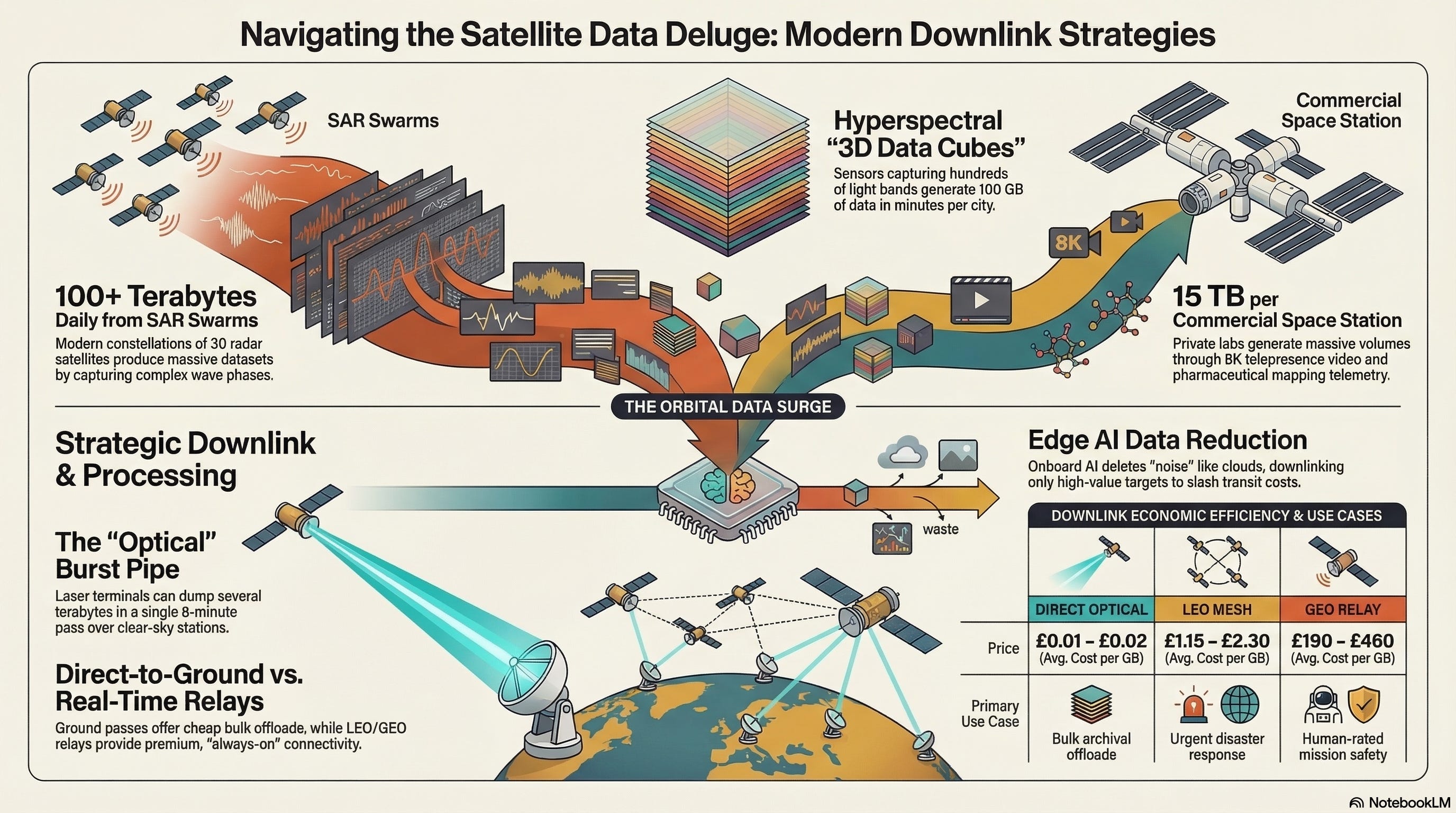
As high-resolution Synthetic Aperture Radar (SAR) and hyperspectral instruments become standard, a single satellite can generate several terabytes of data daily.
To manage this, operators are shifting toward a multi-layered Downlink Strategy that balances raw speed, global availability, and onboard intelligence.
I. High-Volume In-Orbit Data Generators
1. Commercial Space Stations
As the ISS nears decommissioning, private stations like Axiom Station and Starlab are projected to become massive data hubs.
Data Profile:
Generate multi-stream 4K/8K video for “Telepresence” (allowing ground engineers to assist astronauts), continuous life-support telemetry, and massive raw datasets from microgravity manufacturing (e.g., crystal growth and pharmaceutical protein mapping).
Volume:
A single commercial station could generate over 15 TB per day in peak research cycles.
2. Next-Gen Synthetic Aperture Radar (SAR)
Companies like ICEYE, Capella, and PredaSAR now operate dense “swarms” that provide sub-hourly revisits.
Data Profile:
SAR is notoriously data-heavy because it captures the phase of the radio wave, not just the intensity.
High-resolution “Spotlight” modes (resolving objects <25 cm) create gigabytes of data for every square kilometer imaged.
Volume:
A modern SAR constellation of 30 satellites could produce a collective 100+ TB per day.
3. Hyperspectral Imaging Constellations
Hyperspectral sensors (like those from Pixxel or Wyvern) break light into hundreds of narrow bands to detect chemical signatures.
Data Profile:
Where a standard optical satellite has 4 bands (RGB + Near-Infrared), hyperspectral satellites have 200–500.
This creates a “3D Data Cube” for every pixel.
Volume:
Capturing a single city in hyperspectral mode can generate 100 GB in minutes.
4. SIGINT & Electronic Warfare (EW) Platforms
With increased geopolitical tension, Signals Intelligence (SIGINT) satellites are capturing the entire electromagnetic spectrum over contested zones.
Data Profile:
These satellites function like giant “recorders” in the sky, vacuuming up everything from encrypted military comms to radar pulses and IoT pings.
The raw RF signal data is often too complex for onboard processing and requires downlinking for forensic analysis.
Volume: Strategic
SIGINT clusters can generate 5–8 TB per satellite per day when monitoring high-activity regions.
5. Nowcasting Weather Satellites (e.g., MTG-S)
Europe’s Meteosat Third Generation (MTG) and the US GOES series have reached a new “Nowcasting” era.
Data Profile:
The MTG-Sounder (launched recently in 2025/26) provides 3D profiles of atmospheric temperature and humidity every 30 minutes.
It uses an Infrared Sounder with 1,700 spectral channels.
Volume:
These Geostationary (GEO) giants maintain a constant “fat pipe” to the ground, streaming upwards of 2–3 TB of meteorological data every 24 hours.
II. Data Downlink Options for Operators
Operators can categorize their data into: Tactical (needs to be down now), Strategic (needs to be down today), and Archival (bulk offload).
1. Direct-to-Ground (The “Batch” Workhorse)
This remains the cheapest method for moving massive volumes where minutes of latency don’t matter.
RF (Ka/V-Band):
Still the standard for 70% of missions. It uses global networks like KSAT or AWS Ground Station.
Best for: General SAR imagery and routine station telemetry.
Optical (Laser):
Used as a “burst” pipe. When a satellite passes over a clear-sky optical ground station (e.g., in the Atacama Desert or Australia), it dumps several terabytes in a single 8-minute pass.
Best for: Hyperspectral “data cubes” and 8K raw video archives.
2. The Relay “Highways” (The “Real-Time” Premium)
Relays eliminate the need to wait for a ground pass by providing a 24/7 connection via an Inter-Satellite Link (ISL).
Space Data Highways (GEO):
Services like Airbus EDRS provide a constant link. Because GEO satellites are fixed, they offer the highest reliability for human-rated missions.
Best for: Continuous ISS/Axiom Station communications and “always-on” command.
LEO Mesh Networks (Starshield/Kuiper):
Many high-volume satellites carry a “Starlink-compatible” laser terminal. They join the mesh network to route data to the nearest ground station globally in <20ms.
Best for: Time-sensitive SIGINT and urgent disaster-response SAR.
3. The Edge Processor (The “Insight” Shortcut)
This is the most disruptive option. Instead of solving the “pipe” problem, it solves the “volume” problem.
In-Orbit Data Centers (ODCs):
High-volume data is sent via short-range ISL to a nearby “Compute Hub” (like those from Axiom or Starcloud).
Function:
The Hub runs an AI marketplace algorithm (e.g., detecting a specific missile launcher). It deletes the “background” pixels and downlinks only the high-value target data.
Best for: High-cadence monitoring where the “answer” is more valuable than the “image.”
III. Cost Estimates & Economic Models
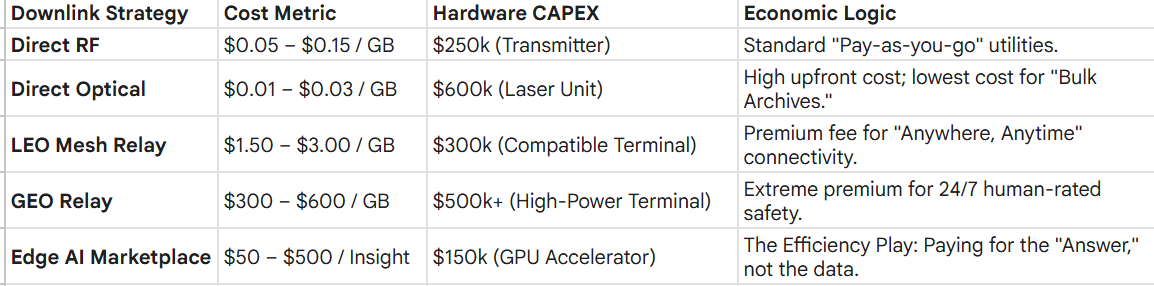
Operators may consider calculating Total Data Lifecycle Cost, which factors in hardware CAPEX, recurring OPEX, and the "opportunity cost" of latency.
1. Direct-to-Ground (The “Commodity” Model)
Direct-to-ground is characterized by high upfront hardware costs but the lowest recurring data transit fees.
RF (Ka/V-Band):
CAPEX:
High-end Ka-band space terminals can cost $150,000 – $350,000.
OPEX (GSaaS):
Pay-per-pass models (e.g., AWS Ground Station, KSAT) range from $3 – $15 per minute. For a 1 Gbps link, this averages $0.04 – $0.12 per GB.
Economic Profile:
Ideal for “Strategic” data where you can wait for a scheduled pass.
Optical (Direct Laser):
CAPEX:
Laser Communication Terminals (LCTs) are premium, costing $400,000 – $800,000 due to the precision pointing required.
OPEX:
While still emerging, laser ground station access is priced around $20 – $40 per minute. However, because throughput can reach 100 Gbps, the efficiency is unmatched at roughly $0.01 – $0.03 per GB.
Economic Profile:
Best for “Archival” bulk dumps where massive volume justifies the hardware investment.
2. Relay Networks (The “Premium” Pipeline)
Relays shift the burden from CAPEX to OPEX. You pay for the convenience of bypassing geography.
GEO Relays (e.g., Airbus EDRS):
Pricing Structure:
Usually sold as “guaranteed capacity” contracts.
Cost:
Approximately $250 – $600 per GB.
Economic Profile:
This is the most expensive “Tactical” option, reserved for high-stakes human spaceflight or national security where a dropped connection is not an option.
LEO Mesh (e.g., Starshield / Kuiper):
Pricing Structure:
Data-cap or “Always-On” subscription models.
Cost:
Estimated at $1,500 – $3,000 per TB ($1.50 – $3.00 per GB).
Economic Profile:
The “middle class” of downlink. It provides tactical speeds at a fraction of GEO costs by leveraging the scale of mega-constellations.
3. Edge AI & ODCs (The “Efficiency” Play)
Edge processing is an investment in Data Reduction. Spending more on the satellite can reduce the total mission budget.
Onboard Hardware:
Radiation-tolerant AI accelerators (e.g., Xilinx Versal, NVIDIA IGX) add $50,000 – $200,000 to the satellite bus cost.
The “Marketplace” Fee:
Developers charge licensing fees for “Apps” (e.g., Methane Detection). These can be $100 – $500 per “Insight” or a monthly SaaS fee.
Cost Avoidance Logic:
Scenario:
A Hyperspectral satellite captures 10 TB of data ($20,000 to downlink via LEO Relay).
Edge Solution:
AI identifies that 95% of the frame is cloud-covered. It deletes the noise and downlinks only 500 GB of clear data ($1,000 to downlink).