Satellite Licensing [Strategy]
This article covers mission-specific license requirements, ongoing post-launch compliance, strategic jurisdiction selection, cost analysis, and specialized vendors to assist in the process.

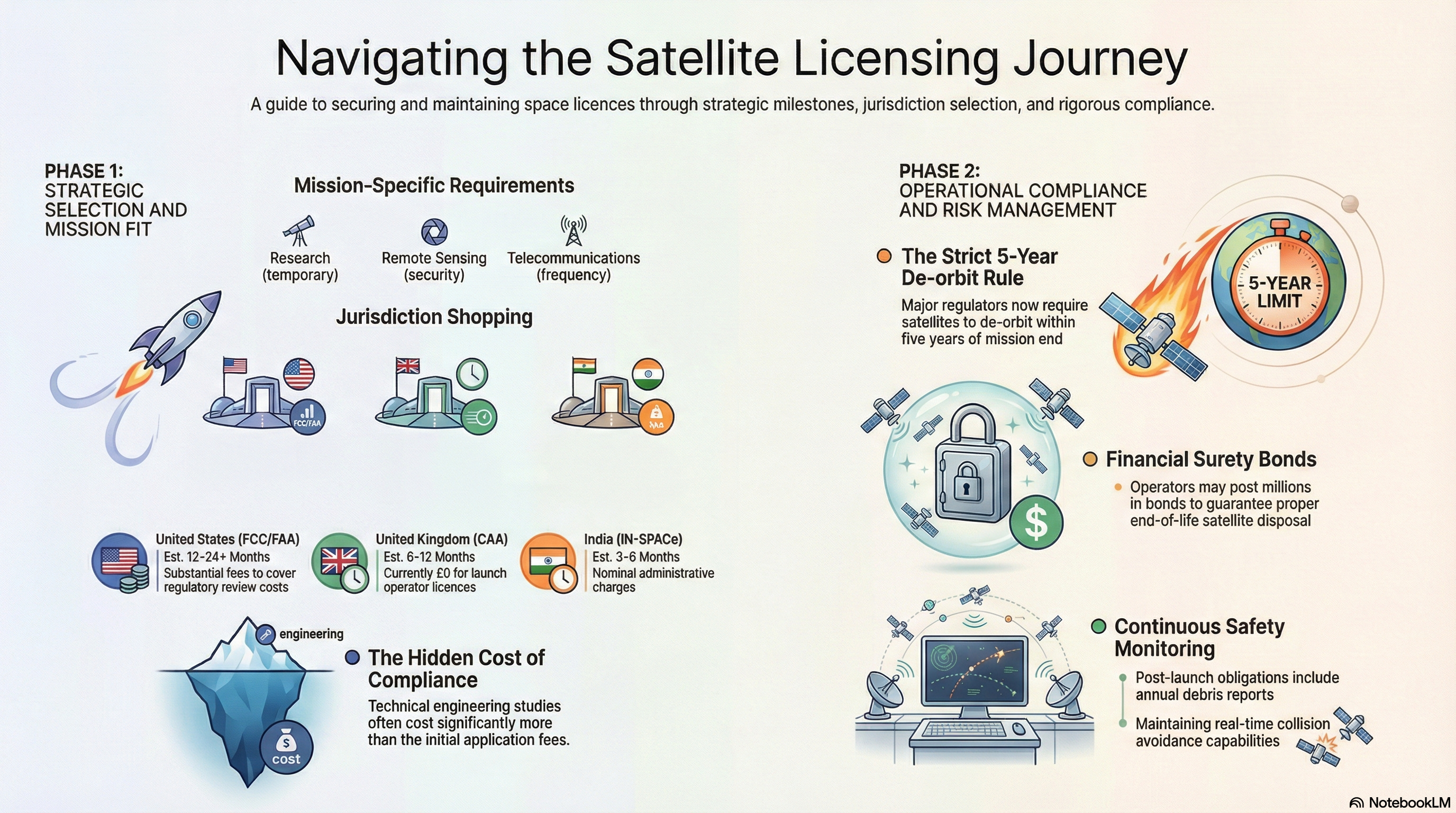
For satellite operators, securing launch licenses is a critical milestone that requires strategic planning.
This article covers the essential aspects of this journey, including mission-specific license requirements, ongoing post-launch compliance, strategic jurisdiction selection, cost analysis, and specialized vendors to assist in the process.
Failure to understand these regulatory requirements can lead to massive delays, exorbitant costs, or legal liability.
I. Satellite Mission Profiles & Relevant Licenses
The type of license required depends heavily on what the satellite does and where it goes.
A. Scientific Research & Technology Demonstration
Testing new satellite components, experimental communication protocols, or conducting scientific experiments in space.
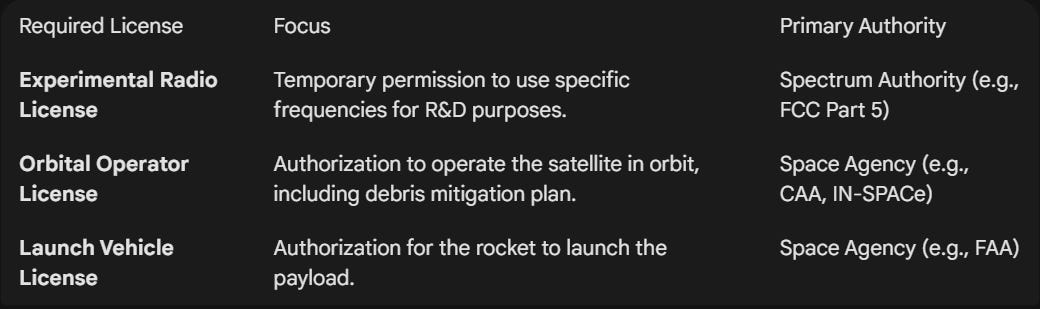
Relevant Licenses: Experimental Radio License, Orbital Operator License (for debris mitigation plan), Launch Vehicle License.
Focus: Temporary Authorization. These licenses are generally easier to obtain because they are designed for research and development.
Restrictions: They strictly prohibit the operator from earning revenue from the data collected or providing commercial services. If the experiment succeeds and the operator wants to commercialize, they must transition to a commercial Space Station License.
B. Remote Sensing Missions (Earth Observation)
These satellites use cameras, radar, or other sensors to take images or collect data about Earth’s surface.
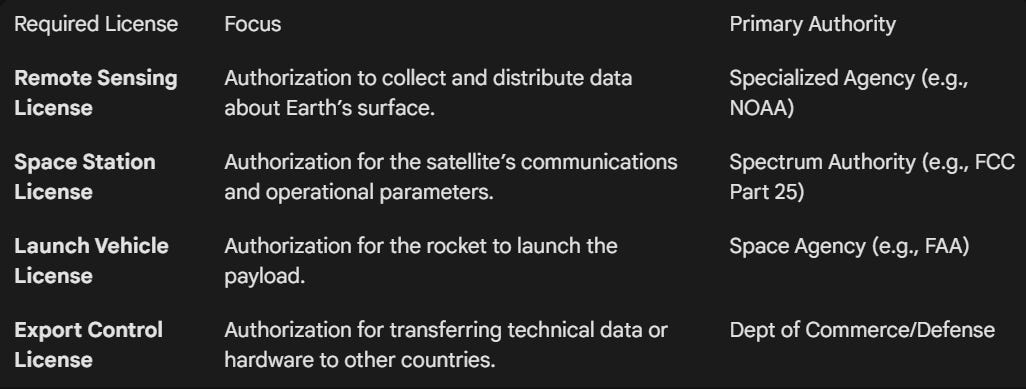
Relevant Licenses: Remote Sensing, Space Station (if satellite has downlink capabilities), Launch Vehicle, Export Control (e.g. ITAR/ ETAR).
Focus: National Security & Data Privacy. Operators must submit a detailed Data Protection Plan. This ensures they do not violate national security interests by imaging restricted areas (such as military bases, critical infrastructure, or borders) at too high a resolution.
Strategic Requirement: You may need to provide a plan for “shutter control”; the ability to temporarily restrict imaging capabilities over specific areas during a national emergency.
C. Telecommunications Missions (Broadband, TV, IoT)
These satellites act as radio relay stations, connecting users to the internet, television, or machine-to-machine data.
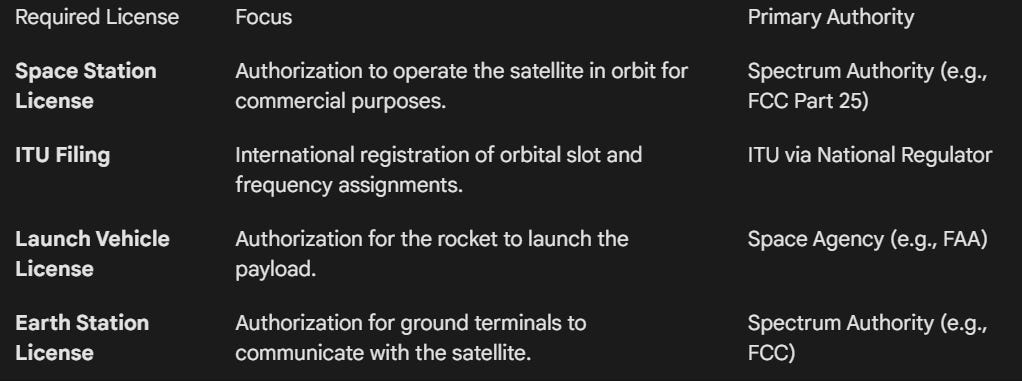
Relevant Licenses: Space Station (for orbital operation), Spectrum Allocation (ITU), Launch Vehicle, Earth Station (for ground terminals)
Focus: Radio Frequency Interoperability. You must prove you have secured specific radio frequencies and provide rigorous technical studies demonstrating that your satellite will not cause harmful interference with existing operators, particularly those in the same orbital plane.
Orbit Strategy:
GEO (Geostationary Orbit): Fixed spot, high altitude ($35,786 \text{ km}$). Requires intense ITU coordination for specific slots to avoid interfering with neighboring satellites.
LEO (Low Earth Orbit): Lower altitude ($500-1,200 \text{ km}$), moving rapidly. Requires complex collision avoidance plans and coordination with other constellation operators.
II. Ongoing Compliance Requirements (Post-License)
Licensing is not a one-time event; it is the beginning of a continuous compliance lifecycle that lasts until the satellite is decommissioned and disposed of.
1. General Post-Launch Obligations (All Mission Types)
Debris Mitigation Monitoring:
Providing annual reports on the status of the satellite, its propellant levels, and its remaining orbital lifetime.
Collision Avoidance:
Maintaining capability to maneuver to avoid debris and coordinating with space traffic management entities (e.g., US Space Command, Eurospace).
ITU Filing Maintenance:
Ensuring the satellite is “brought into use” (BIU) within the regulatory timeframe (typically 7 years) and maintaining operational status to keep the frequency assignments.
Annual Regulatory Fees:
Paying recurring fees to the national regulator to maintain the license.
2. Scientific Research & Technology Demonstration
Experimental Usage Reports:
Submitting data logs demonstrating that the satellite only used the assigned frequencies for authorized experimental purposes.
Revenue Audit:
Proving that no commercial revenue was generated from the R&D data.
License Renewal:
Experimental licenses are temporary; they must be renewed before expiration if the mission continues.
B. Remote Sensing Missions (Earth Observation)
Operational Logs:
Maintaining records of imaging locations and resolutions for audit by the regulator.
Data Security Audits:
Periodic verification of the implementation of the Data Protection Plan, including cybersecurity measures for data storage and transmission.
“Shutter Control” Testing:
Demonstrating the capability to halt data collection over restricted areas upon request by national authorities.
C. Telecommunications Missions (Broadband, TV, IoT)
Interference Reporting:
Immediate notification to the regulator if the satellite causes or receives harmful radio frequency interference.
Constellation Deployment Milestones:
For LEO constellations, proving that specific percentages of the constellation are launched and operational within set timeframes (e.g., 2 years for 10%, 5 years for 50%).
Ground Station Compliance:
Ensuring all earth stations (ground terminals) are operating within the parameters of their license.
III. Where to Get Licensed?
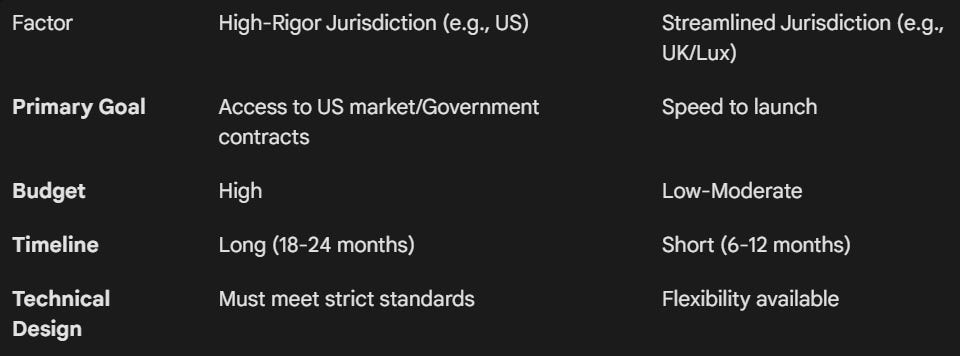
Deciding where to obtain satellite licensing is a critical strategic decision that influences a mission’s cost, timeline, and commercial viability. This process, often called “jurisdiction shopping,” requires balancing legal obligations with business goals.
1. Identify “Launch State” Obligations
Under international law (the Outer Space Treaty), the nation from which a satellite is launched is liable for damages and responsible for supervising the mission.
Default Jurisdiction:
If you launch from a specific country, you will likely need a license from that country.
Payload Approval:
Even if launching from Country A, your home country (Country B) may require a license for you to operate a payload as a national entity.
2. Assess Market Access Needs
Where do you intend to sell your data or services?
National Preference:
To sell services to a government, you may need a license from that specific country.
Regulatory Alignment:
Licensing in a country with strict standards (like the US or EU) can make it easier to satisfy regulatory requirements in other stringent markets.
3. Evaluate Regulatory Rigor & Timeline
Different nations have vastly different application processes.
United States:
Robust, mature, but famously slow. Ideal for large companies requiring massive capital and access to the US market.
United Kingdom:
Streamlined, modern process focused on speed to attract small-sat launchers.
Luxembourg/France:
Favorable to commercial space, particularly for remote sensing (France) or space resource exploitation (Luxembourg).
India:
Emerging, rapid growth with a single-window agency (IN-SPACe) designed to facilitate private sector entry.
4. Cost Analysis & Financial Liability
The financial requirements for satellite licensing go far beyond simple administrative fees. A strategic analysis needs to account for the total cost of compliance, which varies wildly depending on the jurisdiction and the risk profile of the mission.
A. Application Fees & Technical Studies
Variable Pricing:
Application fees range from nominal administrative charges in emerging markets (e.g., c.$120 in India) to substantial fees in mature markets designed to cover the regulator’s cost of review (e.g., tens of thousands of dollars in the US).
Hidden Technical Costs:
The true cost of licensing often lies in the required technical studies, not the application fee itself.
Regulators require rigorous engineering analysis to prove that a satellite will not cause harmful radio frequency interference or collide with other space objects.
These studies often require hiring specialized consultants, costing tens or hundreds of thousands of dollars.
B. Insurance Requirements
Space launch is inherently risky, and governments are responsible under international law for damages caused by their national entities.
Third-Party Liability (TPL) Insurance:
Almost all jurisdictions require operators to carry TPL insurance to cover damage to people or property on Earth, as well as damage to other satellites in orbit.
Risk-Based Calculation:
The required insurance amount is determined by a risk assessment, such as the Maximum Probable Loss (MPL) model used by the US FAA or the Modelled Insurance Requirement (MIR) used by the UK CAA.
These models calculate the worst-case scenario for damage, meaning higher-risk missions (e.g., large constellations in crowded orbits, risky launch trajectories) require significantly higher, more expensive insurance premiums.
C. Bonding & Financial Surety
To prevent the proliferation of space debris, regulators are increasingly requiring financial guarantees that a satellite will be disposed of properly at the end of its mission.
De-orbit Assurance:
Some nations (notably the US via the FCC) require operators to post a Surety Bond before launch.
Financial Impact:
If the satellite fails to de-orbit or move to a graveyard orbit within the stipulated timeframe, the regulator can forfeit the bond to pay for removal services.
These bonds can be immense (potentially tens of millions of dollars for large systems) significantly impacting a company’s capital allocation.
5. Review Debris Mitigation Standards
Regulators have different timelines for when a satellite must de-orbit after its mission ends.
The “5-Year Rule” (Strict):
Major jurisdictions like the US (via the FCC) and ESA have moved to a strict 5-year maximum post-mission lifetime for satellites in Low Earth Orbit (LEO).
This requires satellites to be designed with active propulsion capabilities to maneuver into the atmosphere for a burn-up.
The “25-Year Rule” (Lenient):
Some jurisdictions still adhere to the older, international guideline of a 25-year post-mission lifetime.
This allows for slower, passive orbital decay, but these regimes are rapidly updating to stricter standards.
Design Limitations:
If your satellite design is not capable of rapid de-orbiting (e.g., small satellites without propulsion, or those operating at very high LEO altitudes), you must seek a license in a jurisdiction with more lenient debris requirements.
Market and Vehicle Restrictions:
Choosing a lenient jurisdiction may limit your ability to launch on certain vehicles (as launch providers enforce their own strict safety standards) or access certain markets, as other nations may deny authorization for satellites they deem unsafe.
IV. Comparison of Satellite Licensing Fees and Processing Times (US, UK, India)
This table compares the estimated costs and timelines for securing the necessary licenses to operate and launch a satellite in major jurisdictions based on typical commercial applications.
Note: Processing times are estimates based on regulatory guidelines and can vary significantly based on application complexity, completeness, and backlog.
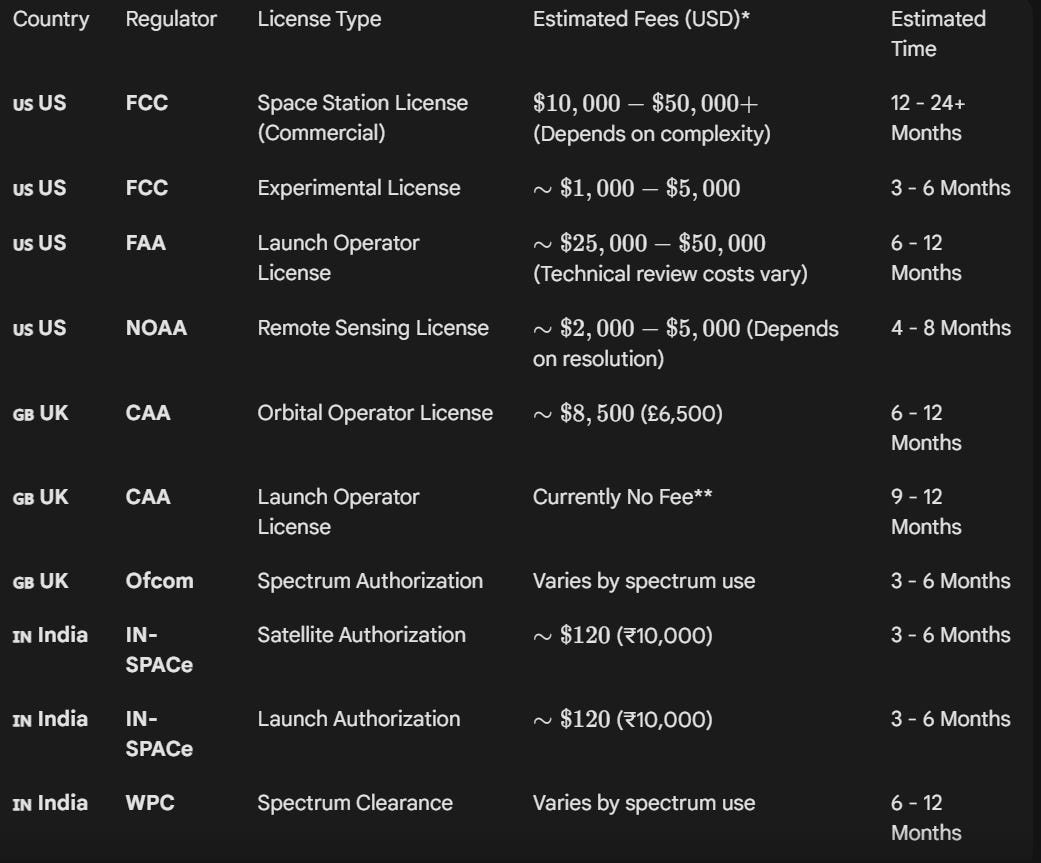
*Fees are estimates based on currency conversion rates as of early 2026 and may exclude legal or consultant fees.
**The UK government currently does not charge fees for launch operator licenses to encourage sector growth, though this is subject to change.
V. Launch Licensing in Europe
In Europe, the ability to issue commercial launch licenses is rapidly evolving, moving away from a single centralized model toward a fragmented system where individual nations regulate activities launched from their own soil.
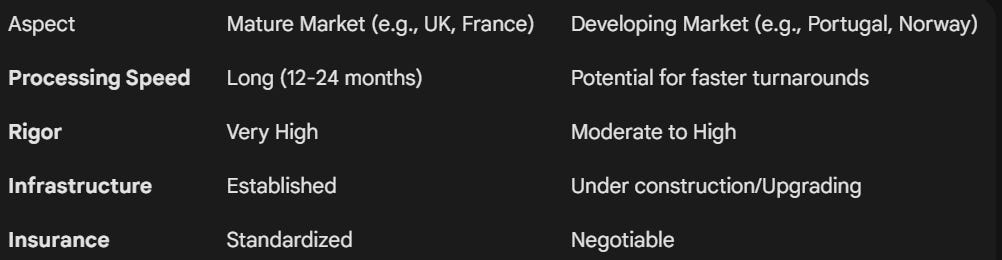
Here are the primary European countries currently offering or developing launch licensing frameworks:
🇬🇧 United Kingdom
The UK has one of the most developed regulatory frameworks for commercial launch, focused on small-satellite launchers.
Regulator: Civil Aviation Authority (CAA).
Key Legislation: Space Industry Act 2018.
Status: Active. Licenses have been granted for both vertical launch sites (e.g., SaxaVord in Scotland) and horizontal launch attempts (e.g., Spaceport Cornwall).
🇫🇷 France
France hosts the main European Space Agency (ESA) launch site, making it a cornerstone of European space access.
Regulator: Centre national d’études spatiales (CNES) in coordination with the Ministry of Defense.
Key Site: Guiana Space Centre (Kourou).
Status: Active. While primarily known for ArianeGroup launches, France has a mature framework for licensing commercial vehicles operating from Kourou.
🇳🇴 Norway
Norway is actively developing its capability to launch small satellites from the mainland.
Regulator: Norwegian Space Agency.
Key Site: Andøya Spaceport.
Status: Developing/Active. Norway has established laws for launching objects into space and has invested heavily in infrastructure to support commercial vertical launches.
🇸🇪 Sweden
Sweden operates one of the most established launch ranges in Europe, primarily for sounding rockets, but is transitioning to orbital capabilities.
Regulator: Swedish Space Corporation (SSC) / Swedish National Space Agency.
Key Site: Esrange Space Centre.
Status: Active. Esrange is currently upgrading to support orbital launches for commercial entities.
🇵🇹 Portugal
Portugal has passed legislation to create a legal framework for commercial launch operations, specifically targeting the Azores archipelago.
Regulator: Portuguese Space Agency (Portugal Space) / ANACOM (Spectrum).
Key Site: Santa Maria Island (Azores).
Status: Developing.
VI. Specialized Vendors for Licensing Assistance
Navigating the multi-layered maze of satellite regulations requires highly specialized knowledge across law, engineering, and international policy.
Engaging experienced vendors can prevent catastrophic delays, ensuring your mission complies with national and international safety and spectrum standards.
Below are examples of specialized vendors categorized by region:
🇺🇸 United States
Law Firms:
Cooley LLP: Renowned for tech-sector focus, handling complex regulatory filings for NewSpace startups and established operators.
Milbank LLP: Deep expertise in satellite financing and complex orbital operator licensing.
Hogan Lovells US LLP: Comprehensive “drawing board to implementation” legal practice for satellite operators and manufacturers.
Wiley Rein LLP: Leading firm for FCC licensing, spectrum management, and policy advocacy.
Technical Consultants:
The Aerospace Corporation: Non-profit corporation providing technical engineering support and orbital debris analysis for US government agencies and commercial clients.
Specialized Aerospace Engineering Firms: Various boutique firms (e.g., Analytical Graphics, Inc./Ansys) providing simulation software and consulting for FAA licensing, spectrum coordination, and orbital maneuver analysis.
🇬🇧 United Kingdom
Law Firms:
Alden Legal: A specialized niche firm focusing purely on satellite, space, and communications law.
Fieldfisher: Strong aerospace practice advising on the Space Industry Act 2018 and regulatory reviews.
CMS UK: Provides end-to-end legal support, including Ofcom licensing and commercial contracts.
Regulatory Consultants:
AB5 Consulting: Specialized consultants focusing on ITU filings, Ofcom spectrum licensing, and technical compliance.
River Advisers: Experts in UK space policy, helping navigate the Civil Aviation Authority (CAA) licensing landscape.
VII. Example Tools for Filings & Compliance
For satellite operators, the transition from manual spreadsheets to automated systems is a necessity for maintaining “Flight Readiness” and regulatory standing.
1. Spectrum Management & ITU Filing Tools
The International Telecommunication Union (ITU) and national regulators (like the FCC or Ofcom) require precise technical data. These tools automate the generation and validation of these complex filings.
ITU Space Application Software (v10):
The official suite for creating and submitting space network filings.
It includes SpaceCap (data capture), SpaceVal (validation), and SpaceQry (querying the Master International Frequency Register).
River Advisers / Specialized Portals:
Many operators use proprietary software layers provided by consultants to manage the “Bring Into Use” (BIU) countdowns and coordination triggers automatically.
Visualyse Professional:
A leading tool for analyzing radio frequency interference (RFI) between satellite networks, essential for the technical studies required by regulators to prove your constellation won’t “jam” others.
2. Orbital Debris & Maneuver Compliance
Regulators now mandate rigorous proof that your satellite won’t become space junk. Automation here focuses on predictive modeling and real-time tracking.
ESA DRAMA (Debris Risk Assessment and Mitigation Analysis):
A software suite used to verify that a mission complies with space debris mitigation standards. It automates calculations for:
OSCAR: Orbital lifetime and end-of-life disposal.
SARA: Casualty risk during atmospheric re-entry.
NASA DAS (Debris Assessment Software):
The US equivalent, specifically designed to assist in preparing the Orbital Debris Assessment Report (ODAR) required for FCC and FAA licensing.
Neuraspace / Kayhan Space:
Modern SaaS platforms that automate Conjunction Assessment (CA).
They ingest Space-Track data and automatically suggest collision avoidance maneuvers, keeping an automated audit log for regulatory compliance.
3. Remote Sensing & Data Privacy Automation
For Earth Observation (EO) missions, compliance shifts toward who can see the data and where the cameras are pointing.
OneTrust / OvalEdge:
While general GRC (Governance, Risk, and Compliance) tools, they are increasingly used to automate Data Protection Plans (DPP).
They can map data flows from the satellite to ground stations to end-users, ensuring GDPR or national security “shutter control” protocols are auditable.
SkyWatch / Automated Metadata Tagging:
Software that automatically scrubs or “blurs” sensitive pixels in satellite imagery based on geospatial “no-go” zones (like military bases) to comply with Tier 1/Tier 2 licensing restrictions.
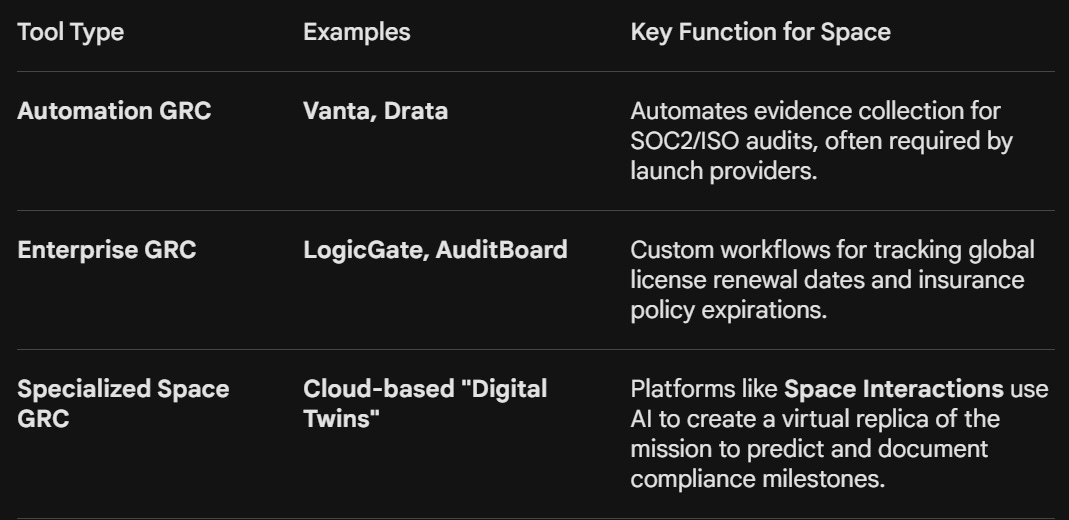
4. General Regulatory GRC
Managing the hundreds of deadlines (annual fees, status reports, renewal dates) across multiple jurisdictions requires an automated “single source of truth.”