
Securing Satellite Communications [Strategy]
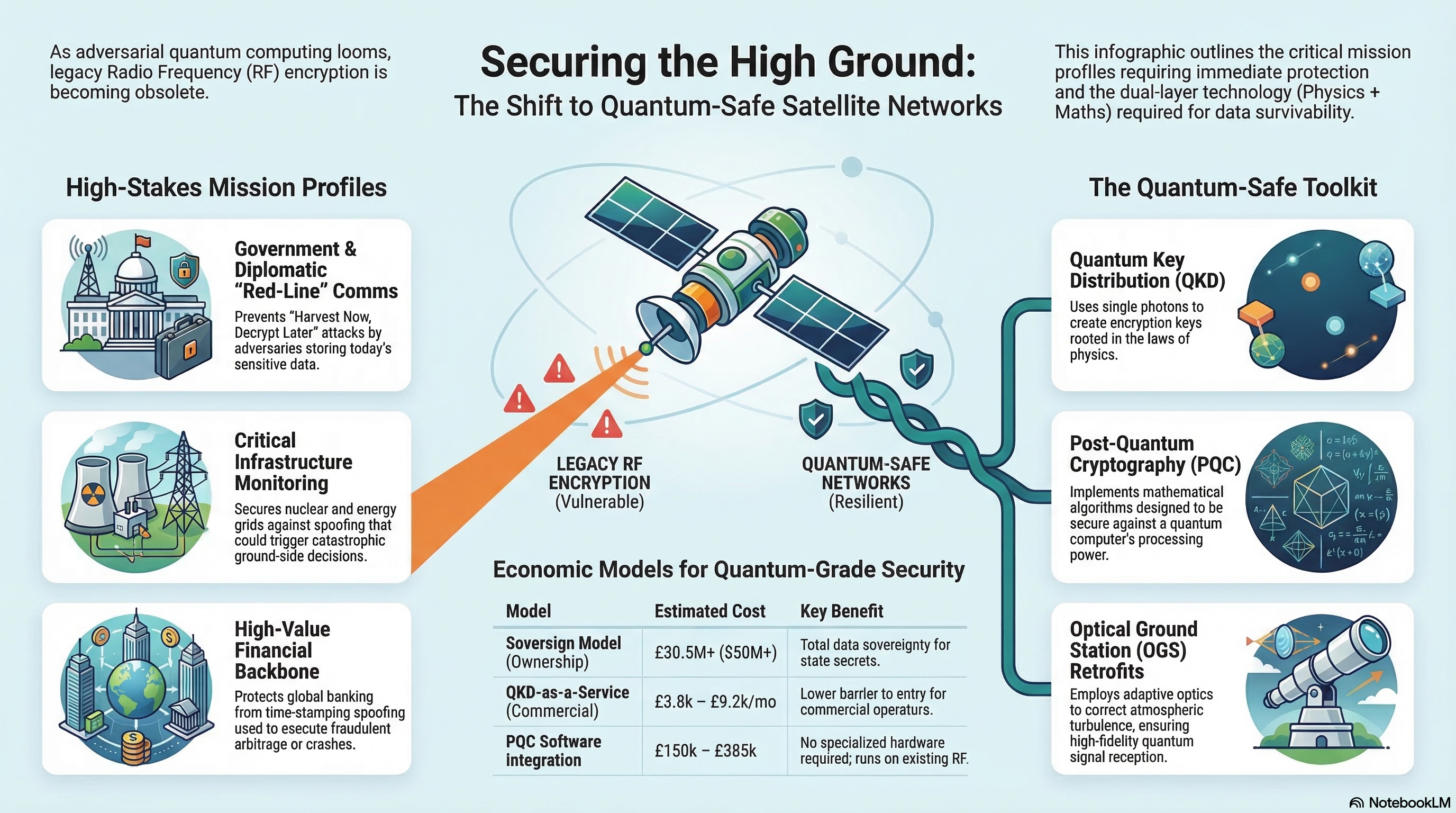
In an era where adversarial quantum computing looms on the horizon, the focus for mission success is pivoting from simple data throughput to Data Survivability.

As data downlink volumes grow, so does the surface area for cyber threats.
In an era where adversarial quantum computing looms on the horizon, the focus for mission success is pivoting from simple data throughput to Data Survivability.
Securing these massive data flows requires a shift from legacy Radio Frequency (RF) encryption to a robust “Quantum-Safe” architecture.
This strategy integrates physical-layer security through optical links and mathematical-layer security via next-generation cryptography.
I. Mission Profiles Needing Highest Security
The definition of “secure” is shifting from simple encryption to Quantum-Safe Resilience. Missions that handle sovereign data or provide critical infrastructure are increasingly mandated to implement end-to-end cryptographic shielding.
1. Government & Diplomatic “Red-Line” Comms
The most sensitive mission profile involves the transmission of classified state secrets and diplomatic cables.
These links must be immune to “Harvest Now, Decrypt Later” (HNDL) attacks, where adversaries store encrypted data today to crack it once a Large-Scale Quantum Computer (LSQC) is built.
Security Layer:
Continuous Quantum Key Distribution (QKD) combined with Post-Quantum Cryptography (PQC).
2. Tactical SIGINT & Electronic Warfare (EW) Clusters
SIGINT clusters (e.g., HawkEye 360 or military equivalents) vacuum up the entire electromagnetic spectrum.
Because this raw RF data can contain unencrypted adversary military communications, the downlink itself is a high-value target for intercept and spoofing.
Security Layer:
“Metadata Shielding” to hide the timing and destination of downlinks, preventing adversaries from mapping operational cadences.
3. Critical Infrastructure Monitoring (Nuclear & Energy)
Satellites monitoring the health of nuclear power plants, power grids, and water treatment facilities are now considered part of the “Kill Chain” if compromised.
False data injection (spoofing) could lead to catastrophic ground-side decisions.
Security Layer:
Hardware-based Root of Trust (RoT) and cryptographically signed telemetry that ensures the command link is as secure as the data downlink.
4. High-Value Financial & Fintech Backbone
As global banking moves toward sub-millisecond high-frequency trading via satellite constellations, the financial sector requires protection against Time-Stamping Spoofing.
If an adversary can delay or alter the timestamp of a transaction via the satellite link, they can execute “flash crashes” or arbitrage fraud.
Security Layer:
Quantum-Secured Time Transfer (QSTT).
By using entangled photons to synchronize clocks, any attempt to intercept or delay the signal is immediately detected by the laws of quantum mechanics.
II. Securing Communications Options for Operators
With the launch of the Eagle-1 satellite and the expansion of the EuroQCI, operators are shifting away from vulnerable, wide-beam RF links toward a “defense-in-depth” architecture.
This combines the physical security of QKD with the mathematical resilience of PQC, ensuring protection against both classical interceptors and future quantum computers.
1. Onboard QKD Terminals (The “Quantum Shield”)
Operators are increasingly installing compact Quantum Key Distribution (QKD) payloads (like the Tesat Spacecom units) to generate “unbreakable” keys via the laws of physics.
Function:
The satellite emits single photons in specific quantum states.
Any attempt to eavesdrop collapses the wave function, alerting the operator and rendering the key void.
Advantage:
Provides Information-Theoretic Security; even an infinitely powerful computer cannot break the encryption because the security is rooted in physics, not math.
Current State:
Programs like the EU’s Eagle-1 are proving that these terminals can be miniaturized for SmallSat buses, moving QKD from a laboratory experiment to a standard bus component.
2. Post-Quantum Cryptography (PQC) Integration
While QKD secures the “pipe,” Post-Quantum Cryptography secures the “data” itself. PQC consists of new mathematical algorithms designed to be secure against a quantum computer’s processing power.
Function:
Operators are upgrading flight software to include NIST-standardized algorithms (such as CRYSTALS-Kyber for key encapsulation and CRYSTALS-Dilithium for digital signatures).
Advantage:
Unlike QKD, PQC does not require specialized optical hardware.
It can be deployed over existing RF (X/Ka-band) links, making it the primary defense for satellites that cannot carry a heavy optical payload.
Hybrid Key Exchange:
Using a PQC algorithm to wrap a QKD-generated key.
If the optical link is lost due to cloud cover, the PQC layer still provides a “Quantum-Safe” barrier.
3. Optical Ground Stations (OGS) with Adaptive Optics
To receive quantum keys, operators are moving away from traditional parabolic dishes toward Optical Ground Stations (OGS) that function like high-speed astronomical observatories.
The Challenge:
Quantum signals are fragile; even slight atmospheric pocket changes can scatter a single-photon signal.
A Solution:
Modern OGS (like the Heriot-Watt HOGS facility) use Adaptive Optics (AO).
These are deformable mirrors that adjust their shape thousands of times per second to counteract atmospheric turbulence in real-time, ensuring the signal reaches the detector with high fidelity.
4. Moving to “Trusted Node” Architectures
Because quantum signals degrade quickly in fiber optic cables (limited to ~100–200 km), satellites act as the “Global Bridge” in a Trusted Node network.
Process:
A satellite establishes a QKD link with OGS-A (e.g., in London), generates a key, and stores it in a Secure Hardware Element.
It then flies over OGS-B (e.g., in Tokyo) and repeats the process.
The Handshake:
By XORing these two keys, the satellite can facilitate a secure connection between London and Tokyo, effectively bridging global distances that terrestrial fiber cannot reach.
5. Red-Teaming & Side-Channel Protocols
Even with QKD and PQC, the “last mile” of security involves protecting the hardware itself. Operators can perform Quantum Red-Teaming to prevent “Side-Channel” attacks.
Detector Blinding:
Adversaries may try to “blind” the OGS detectors with a high-power classical laser to force them into a non-quantum state where the eavesdropper can intercept keys.
Countermeasure:
Implementation of spatial and spectral filters and “watchdog” power monitors that shut down the link if a non-quantum light surge is detected.
Trojan Horse Attacks:
Eavesdroppers may send light into the satellite’s telescope to “read” the orientation of the internal optics.
Countermeasure: Installation of optical isolators and “one-way” shutters that prevent any external light from reflecting back out of the payload.
III. Cost Estimates & Economic Models
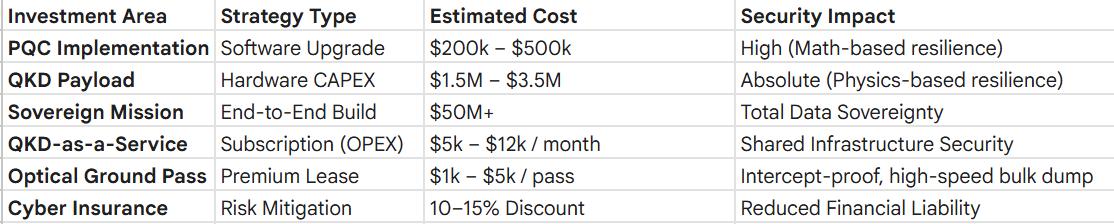
Securing a mission with quantum-grade technology requires a significant CAPEX shift, though emerging “QKD-as-a-Service” models are lowering the barrier to entry.
1. Economic Models (Ownership vs. Service)
The Sovereign Model (Government):
Logic:
Full ownership of the satellite and ground segment.
Cost:
High ($50M+ total mission cost), but ensures Data Sovereignty.
Essential for missions where no third party (like a cloud provider) can be allowed to touch the keys.
The QKD-as-a-Service (Commercial):
Logic:
Companies like SES or Airbus provide “key leases.”
The operator pays a subscription to receive quantum-secure keys from a shared constellation (e.g., IRIS²).
Cost:
Estimated at $5,000 – $12,000 per month per terminal, significantly lower than the CAPEX of building a private network.
2. The “Quantum-Ready” Upgrade (CAPEX)
PQC Software Integration:
Implementing NIST-standard Post-Quantum algorithms into existing flight software is relatively low-cost in terms of hardware, but requires $200,000 – $500,000 in specialized engineering and security audits.
QKD Payload:
Adding a QKD terminal currently adds an estimated $1.5M – $3.5M to the satellite’s cost.
3. Ground Segment Security (OPEX)
Secured Ground Station as a Service (GSaaS):
Using a “Hardened” ground station (shielded against EMP and physical intrusion) typically costs 2x to 3x more per minute than standard commercial RF passes.
Leased Optical Links:
Laser-based data delivery is currently priced as a premium “bulk” service, averaging $1,000 – $5,000 per pass for high-security tactical data.
4. The Insurance & Resilience Model
Premium Reduction:
Space insurers are beginning to offer discounts on mission insurance for operators who can prove “Quantum-Resilient” command and control architectures.
The Cost of Failure:
For a SIGINT or Critical Infrastructure mission, the economic model isn’t just about the cost of the hardware; it’s about the $500M+ liability associated with a compromised sovereign data link.
IV. Implementing QKD Terminals into a CubeSat
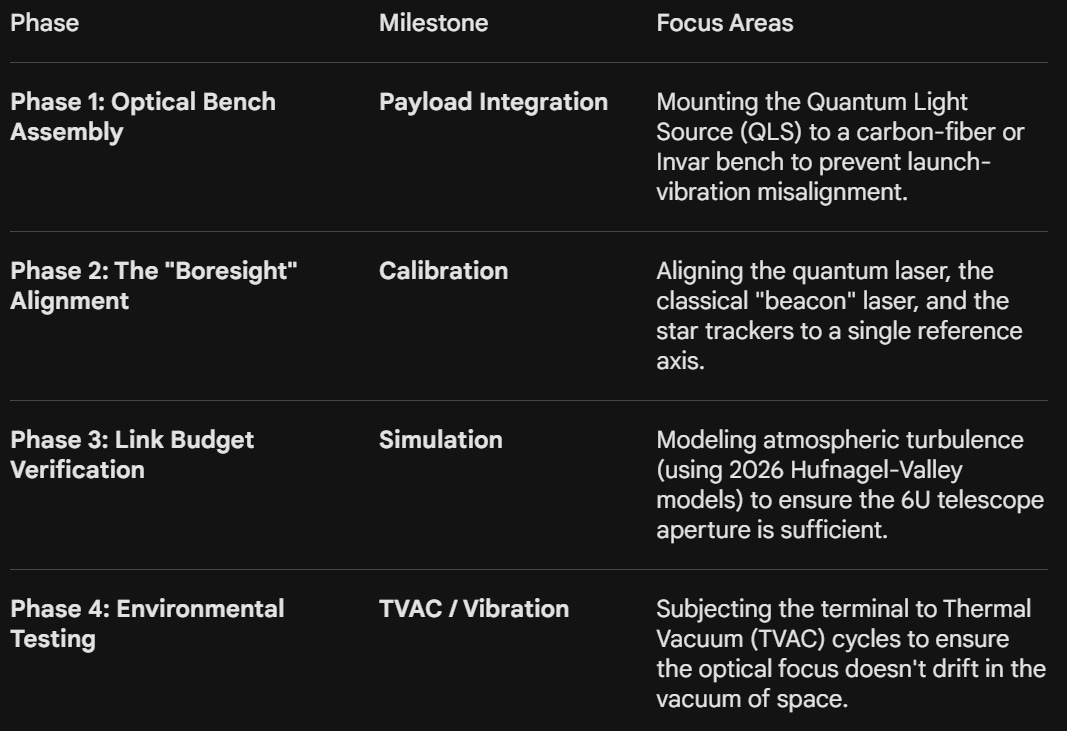
Because QKD relies on the transmission of single photons, the requirements for Point, Acquisition, and Tracking (PAT) and thermal stability are an order of magnitude higher than standard missions.
The following is an example implementation plan for a 6U or 12U CubeSat; the current industry standard for quantum technology demonstrators.
1. The “Quantum-Ready” Bus (Subsystem Requirements)
A standard CubeSat bus must be “hardened” and upgraded in key areas to support a QKD payload.
Ultra-High Precision ADCS:
While a typical SAR satellite needs ~0.1° pointing accuracy, QKD requires microradian-level precision.
Requirement:
Dual star-trackers and high-torque reaction wheels.
Implementation:
Integration of a Fast Steering Mirror (FSM) within the optical path to compensate for high-frequency jitter that the satellite bus cannot dampen.
Clock Synchronization (Timing):
Single-photon detection requires the satellite and ground station to be synchronized to within 1 nanosecond.
Implementation:
An onboard Chip-Scale Atomic Clock (CSAC) or a dedicated “sync laser” pulse that provides a temporal reference for the quantum signal.
Thermal Management:
Quantum sources (like Entangled Photon Pair Sources) are highly sensitive to temperature fluctuations, which can shift the laser wavelength or degrade polarization.
Implementation:
Active Peltier cooling (TEC) for the laser diode and a thermally isolated “optical bench” mounting.
2. Example Payload Stack (Typical 6U Configuration)
The QKD payload typically occupies 3U to 4U of the total 6U volume.
Quantum Random Number Generator (QRNG):
The “entropy engine” that ensures the keys are truly random.
Quantum Light Source (QLS):
Typically a Weak Coherent Pulse (WCP) or Entangled Source emitting at 850nm or 1550nm.
Telescope Assembly:
A compact 80mm to 100mm aperture telescope for beam transmission.
The “Beacon” Laser:
A higher-power classical laser used by the ground station to “lock on” to the satellite before the quantum stream begins.
3. Risk Mitigation (The “Lost Key” Strategy)
Integrating QKD into a CubeSat introduces a high risk of Link Interruption due to clouds or tracking loss.
Implementation: Key Buffering & PQC Fallback.
The satellite should generate and store a “reserve” of quantum keys during clear-sky passes.
If the quantum link is blocked by weather during a critical transmission, the bus could automatically pivot to Post-Quantum Cryptography (PQC) algorithms as a temporary secure bridge until the next optical pass.
4. Economic Impact of Integration
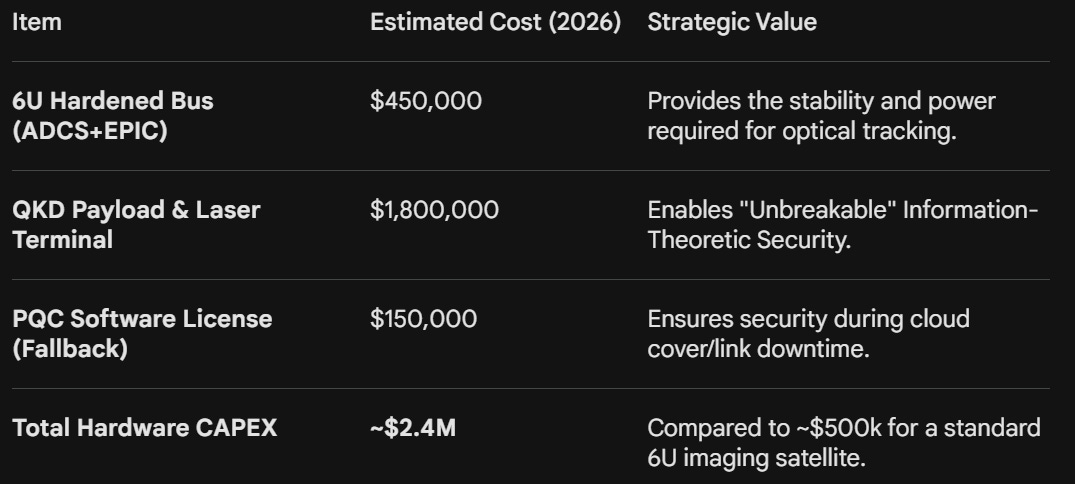
Mass Increase:
~2.5 kg to 4 kg.
Power Consumption:
15W to 25W during active passes (requires high-efficiency deployable solar arrays).
Integration Time:
Typically 6–9 months longer than a standard CubeSat due to optical alignment complexities.
V. Example Hardware Vendors for QKD on Satellites
For a successful QKD integration, a procurement strategy could focus on specialized providers.
1. Precision Pointing & Fast Steering Mirrors (FSM)
To achieve the microradian-level accuracy required to hit a ground-based telescope from 500 km, these vendors are the industry standard:
BlueHalo (USA):
Known for their high-performance, space-qualified FSMs that eliminate platform jitter.
Their terminals are specifically designed for LEO-to-ground laser comms.
BAE Systems:
A leader in the development of advanced steering mirrors, including the technology used on the James Webb Space Telescope, now miniaturized for tactical SmallSats.
Cedrat Technologies (Europe):
Specialists in piezoelectric actuators used in “Fine Steering” mechanisms, offering ultra-fast response times to counteract satellite vibrations.
2. Timing & Synchronization (CSAC)
Quantum packets must be “time-tagged” with nanosecond precision. Standard satellite clocks drift too much for this.
Microchip Technology (Symmetricom):
Their SA.45s and SA65 Chip-Scale Atomic Clocks (CSAC) are a gold standard.
They offer some of the lowest Size, Weight, and Power (SWaP) for atomic-grade stability.
Safran / Orolia:
Recently introduced radiation-hardened rubidium clocks specifically for LEO constellations requiring high-holdover performance in GNSS-denied environments.
3. Quantum Payload & Key Generation
ID Quantique (Switzerland):
A pioneer in Quantum Random Number Generators (QRNG) and QKD systems.
They provide the core “entropy chips” used to create the encryption keys.
Quantum Optics Jena (Germany):
A specialist in Entanglement-Based (EB) QKD hardware.
Their compact payloads are specifically designed for the CubeSat form factor.
Creotech Instruments (Poland):
A rising leader in the EuroQCI ecosystem, providing integrated quantum-secure electronics and ground station receiver components.
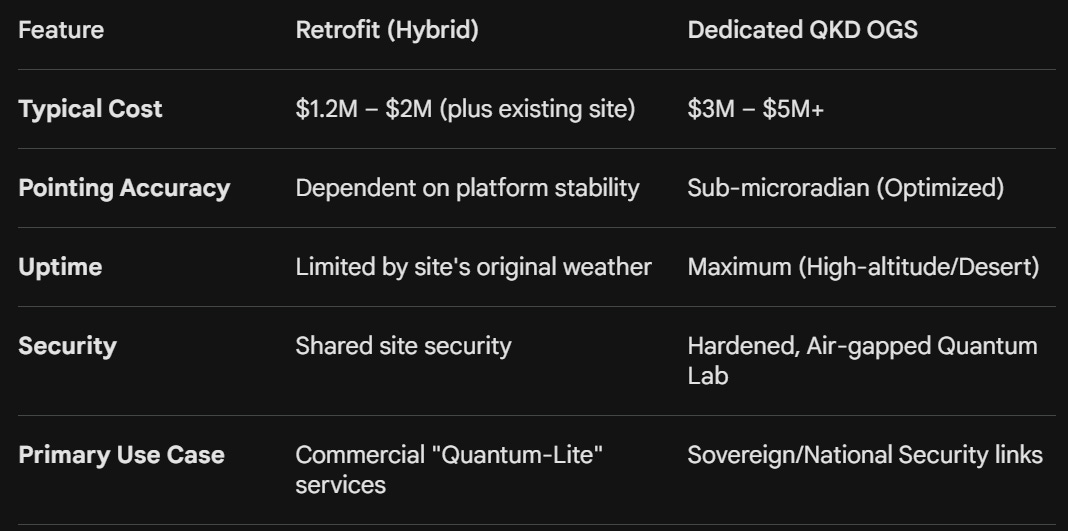
VI. Ground Segment Strategy (Retrofitting vs. New OGS Build)
Oerators face a choice between retrofitting existing Radio Frequency (RF) sites into “Hybrid” stations or building purpose-built Optical Ground Stations (OGS).
While RF is the legacy standard, QKD’s reliance on single photons makes “retrofitting” more of a complete technological overhaul than a simple upgrade.
1. Retrofitting Existing RF Ground Stations (The Hybrid Approach)
Retrofitting is rarely a “plug-and-play” scenario for QKD. Traditional RF parabolic dishes cannot be “converted” into optical receivers; instead, a Co-located Hybrid Architecture is used.
Physical Architecture:
The existing RF dish (e.g., 5m Ka-band) remains for command, control, and telemetry (TT&C).
A separate optical dome is installed within the same facility perimeter to share power, backhaul, and security infrastructure.
The “Beacon” Integration:
The RF link is used as the “coarse” pointing reference.
The satellite uses its RF ephemeris to orient toward the ground station, after which the optical system takes over for “fine” acquisition.
Economic Advantage:
Saves 30%–40% on site acquisition, physical security (fencing/guards), and fiber backhaul costs.
Technical Challenge:
Local RF interference is a non-issue, but vibration coupling from large motor-driven RF dishes can disrupt the microradian-level precision of the nearby optical telescope.
2. Developing a Purpose-Built QKD OGS (The Clean-Sheet Approach)
A dedicated OGS is designed entirely around the single-photon link budget. Unlike RF stations, which are often placed in accessible industrial zones, a QKD OGS has very specific geographical requirements.
Atmospheric Characterization:
Sites are selected for high “Cloud-Free Line of Sight” (CFLOS) probability.
Major hubs are clustered in the Atacama Desert, Canary Islands, and Western Australia.
The “Clean” Optical Path:
Purpose-built stations use Coudé Focus telescope designs, where the light is routed through the telescope axes into a stationary, vibration-isolated laboratory “pit” beneath the dome.
This is where the delicate QKD detectors (SNSPDs—Superconducting Nanowire Single Photon Detectors) are kept at cryogenic temperatures.
Adaptive Optics (AO) Core:
A new OGS includes an integrated AO suite from vendors like ALPAO or BlueHalo to “un-twinkle” the satellite signal, essential for maintaining the high secret-key rates (SKR) required for commercial viability.
VII. QKD Site Selection Checklist
Unlike RF stations that can push through rain and clouds, QKD is governed by the Single Photon Link Budget: if the atmosphere is too thick, too turbulent, or too bright, the secret key rate (SKR) drops to zero.
1. Atmospheric & Meteorological Profile (The “Clear Sky” Mandate)
CFLOS (Cloud-Free Line of Sight):
Target sites with >75% annual clear-sky probability.
Strategic Locations: Atacama Desert (Chile), Canary Islands (Spain), and the Nullarbor Plain (Australia).
Fried Parameter:
This measures the “seeing” quality (atmospheric turbulence).
You need a high Fried Parameter (ideally >15 cm at 500 nm) to ensure the beam doesn’t “dance” off your detector.
Precipitable Water Vapor (PWV):
Low humidity is critical to reduce absorption, especially if using the 1550 nm wavelength window.
High-altitude “Alpine” sites (>2,500 m) are preferred.
2. Optical Noise & Celestial Geometry
Bortle Scale (Light Pollution):
QKD detectors are so sensitive they can be “blinded” by city lights.
Site must be Bortle 1 or 2.
Solar Exclusion Angle:
The station must be able to operate as close to the sun as possible to maximize daytime key generation.
Implementation: Strategic use of narrow-band spectral filters (e.g., 1 nm or even atomic line filters) to suppress solar background noise.
Zenith Access:
The station should have an unobstructed view from 20° to 90° elevation.
Passes below 20° are usually too turbulent for a stable quantum link.
3. Infrastructure & Geopolitics
Vibration Isolation:
The telescope must be located away from heavy highways, rail lines, or large-scale RF antenna farms.
A 10 Hz vibration from a passing truck can cause a tracking loss of hundreds of meters at the satellite’s altitude.
Sovereign Data Borders:
Because the ground station acts as a “Trusted Node,” it must be located within a jurisdiction that complies with your mission’s data sovereignty laws.
Fiber Backhaul:
A QKD OGS is useless without a secure terrestrial “Quantum-Safe” fiber link to the end-user (e.g., a data center or government HQ).
VIII. Example Hardware Vendors for OGS & Retrofits
Developing a ground segment capable of receiving single photons requires a blend of astronomical-grade optics and ultra-sensitive quantum detectors. Procurement focuses on high-speed adaptive optics and cryogenically cooled sensors.
1. Optical Telescopes & Mounts (The Foundation)
These vendors provide the mechanical precision required to track a LEO satellite moving at 7 km/s with sub-arcsecond jitter.
ASA (Astro System Austria):
A premier provider of fast-tracking “Direct Drive” telescope systems.
Their OGS solutions are specifically designed for satellite laser communication, offering the high slew rates necessary for LEO-to-ground links.
Planewave Instruments (USA):
Known for their RC700 and Gimbal mounts, which have become a staple for commercial laser ground stations due to their reliability and relatively low cost compared to traditional observatory mounts.
Officina Stellare (Italy):
Specialists in complete “turnkey” Optical Ground Stations.
They provide the full optical train, from the primary mirror to the Coudé focus, optimized for quantum and classical laser comms.
2. Adaptive Optics & Turbulence Correction
To maximize the Secret Key Rate (SKR), the “twinkle” of the atmosphere must be removed in real-time to focus light into the tiny core of a fiber or detector.
ALPAO (France):
A leader in Deformable Mirrors (DM) and wavefront sensors.
Their high-speed AO systems can correct atmospheric distortions at frequencies over 2 kHz, which is essential for low-elevation quantum passes.
Flexible Optical (OKO Tech):
Provides cost-effective adaptive optics solutions often used in research-grade OGS retrofits and technology demonstrators.
BlueHalo (USA):
Beyond satellite terminals, they provide comprehensive ground-side atmospheric compensation systems designed to maintain link stability through varying “seeing” conditions.
3. Single-Photon Detectors (The Receiver)
The “heart” of the OGS. These sensors must detect individual photons with minimal “dark counts” (false positives).
Single Quantum (Netherlands):
Specialists in SNSPDs (Superconducting Nanowire Single Photon Detectors).
These are the gold standard for QKD due to their near-perfect efficiency and ultra-low timing jitter, though they require cryogenic cooling.
ID Quantique (Switzerland):
Offers a range of accessible Indium Gallium Arsenide (InGaAs) photon counters and integrated QKD receiver modules that are easier to deploy for “Retrofit” or “Hybrid” stations.
Excelitas Technologies:
Provides high-performance Silicon Avalanche Photodiodes (APDs) used in the 850 nm wavelength range, ideal for lower-cost quantum demonstrators.