
Space-Based Directed Energy Weapons [Innovation]
Utilizing concentrated electromagnetic energy or subatomic particles to disable or destroy targets at the speed of light.

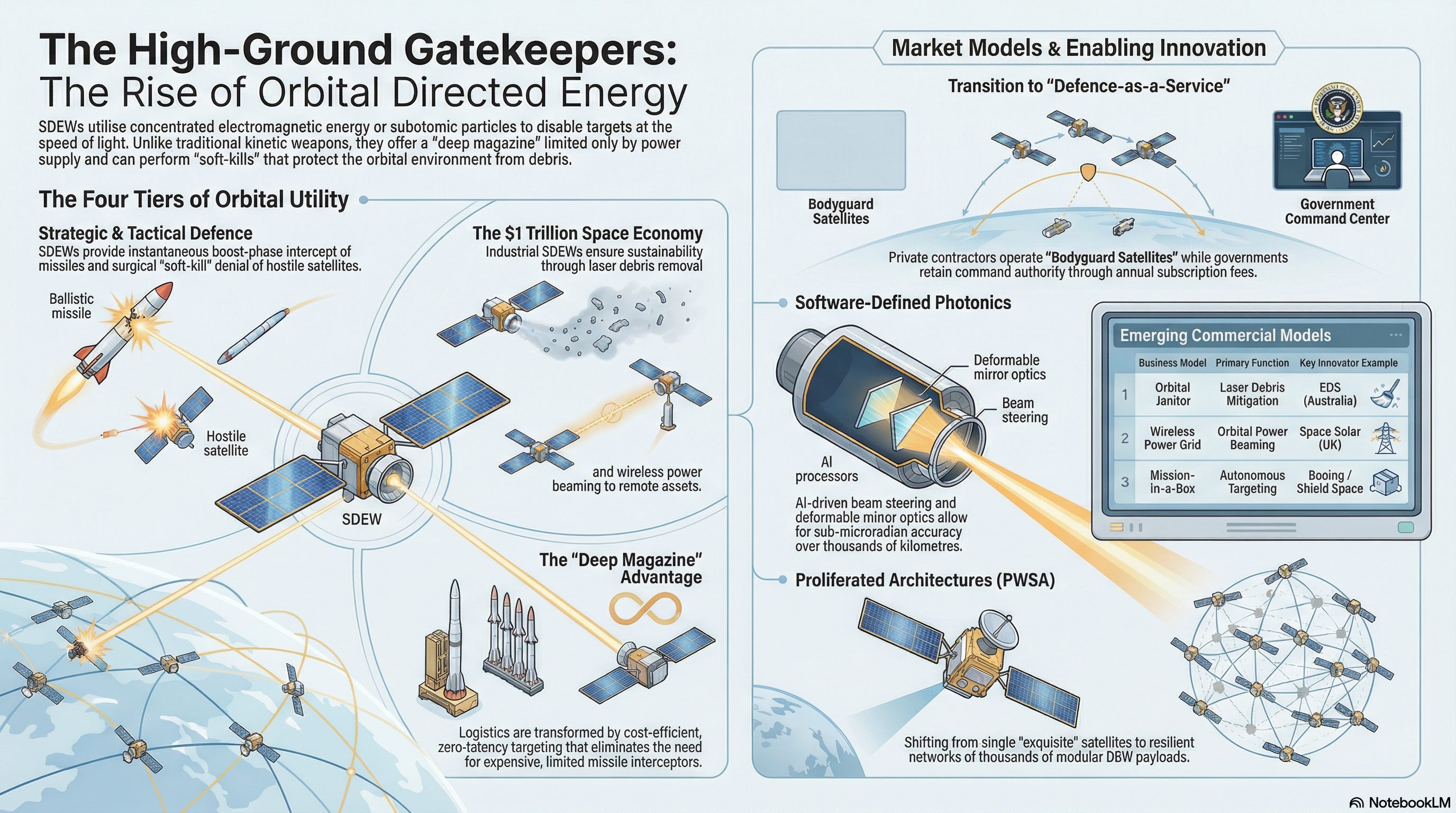
Space-Based Directed Energy Weapons (SDEWs) utilize concentrated electromagnetic energy or subatomic particles to disable or destroy targets at the speed of light.
SDEW platforms are being designed to intercept high-speed targets like ballistic missiles, hypersonic glide vehicles (HGVs), or adversarial satellites using a focused beam of coherent light.
Innovation marks a shift from kinetic interceptors (which require physical “hit-to-kill” contact) to speed-of-light engagement, where the primary constraint is not the velocity of a missile, but the thermal management and power generation of the laser itself.
I. What are Space-Based DEWs being developed for?
While terrestrial lasers act as the “point-defense” shields for bases and ships, SDEWs serve as the “High-Ground Gatekeepers.” The demand for orbital energy systems is driven by the need for instantaneous response over global distances, bypassing the geographic and aerodynamic limits of Earth-bound interceptors.
1. The Strategic Level: Boost-Phase Intercept & ICBM Defense
This tier focuses on the most critical window of nuclear deterrence: catching a missile while its engines are still burning and its trajectory is predictable.
Instantaneous Intercept: Engaging Intercontinental Ballistic Missiles (ICBMs) during the “boost phase” (first 1-5 minutes of flight). Because light travels at 300,000 km/s, SDEWs can strike a rising missile from thousands of miles away before it can deploy multiple independent reentry vehicles (MIRVs) or decoys.
Global Overlays: Maintaining a “constellation of vigilance” that provides 24/7 coverage over launch sites in denied territories, where ground-based interceptors cannot reach in time.
2. The Tactical Level: Counter-Space & Satellite Resilience
At this level, DEWs act as surgical tools to maintain “orbital superiority” without creating the cloud of debris associated with kinetic anti-satellite (ASAT) missiles.
Soft-Kill Denial (Dazzling): Using low-power lasers to temporarily “blind” the optical sensors of adversary spy satellites during sensitive ground movements or launches.
Electronic Disruption (HPM): Deploying High-Power Microwaves to “fry” the internal logic of a hostile satellite, rendering it a “zombie” without physically breaking it apart. This preserves the orbital environment for future use.
Active Shielding: Protecting high-value assets (like GPS or MILSTAR constellations) by intercepting incoming kinetic “kill vehicles” launched by adversaries.
3. The Industrial Level: Orbital Maintenance & Sustainability
This tier focuses on the civilian and commercial necessity of keeping “The Commons” of space open and safe for the growing $1 trillion space economy.
Laser Ablation for Debris Removal: Using ground or space-based lasers to “nudge” small pieces of space junk. By vaporizing a tiny amount of material on the surface of the debris, the laser creates a miniature jet of gas that slows the object down, forcing it to burn up in the atmosphere.
Power Beaming: Utilizing DEW technology to “beam” energy from solar-rich orbits to satellites in the Earth’s shadow or even to remote lunar outposts, reducing the need for heavy on-board batteries.
4. The Logistical Level: Speed-of-Light Engagement & Cost Efficiency
This tier addresses the “Economic War of Attrition” where the cost of the defense must be lower than the cost of the attack.
The “Deep Magazine”: Unlike missile interceptors that cost millions of dollars per shot and have limited storage, a DEW system has a “magazine” limited only by its power supply. This is essential for defeating large-scale drone swarms or multi-missile salvos.
Zero-Latency Targeting: Eliminating the “lead time” required for kinetic projectiles. In the vacuum of space, there is no wind, gravity-drop, or atmospheric drag to calculate, making SDEWs a precision instrument for long-range engagement.
II. Example Business Models
The commercialization of directed energy in space could lead to specialized service models catering to both defense and commercial clients.
1. The “Defense-as-a-Service” (DaaS) Orbital Shield
Primary Tier: The Strategic Level (Missile Defense) and Tactical Level (Active Shielding)
Model: Private contractors (e.g., Northrop Grumman or Lockheed Martin) own and operate a constellation of “Bodyguard Satellites.” Sovereign nations pay an annual subscription fee for “Active Protection Zones.” The provider maintains the satellite health and power levels, while the government retains the “Command and Control” (C2) authority to fire.
Innovator Opportunity: Adaptive Optics as a Service. Providing sub-contracted mirror and lens modules that can automatically correct for thermal blooming and mirror warping in real-time.
SWOT Analysis:
Strengths: Reduces the massive upfront CAPEX for governments; ensures constant tech refreshes.
Weaknesses: High liability risks if an intercept fails; potential “monopoly” on national security.
Opportunities: Expanding to protect high valur commercial “Mega-Constellations” (e.g. Starlink) .
Threats: Nationalization of orbital assets during times of war.
2. The “Orbital Janitor” (Laser Debris Mitigation)
Primary Tier: The Industrial Level (Sustainability)
Model: A “Fee-per-Nudge” system. Space agencies (NASA/ESA) or private constellation owners pay a service provider to move specific pieces of debris out of their orbital paths using ground-based or space-based lasers. This is potentially significantly cheaper than launching a dedicated “capture” mission with a robotic arm.
Innovator Opportunity: Debris Tracking Integration. Combining high-precision radar with the laser system to offer an end-to-end “Detect-and-Deflect” package.
SWOT Analysis:
Strengths: Directly addresses the “Kessler Syndrome” threat; clear ROI for satellite operators.
Weaknesses: The “Dual-Use” dilemma; a debris-nudging laser can technically be used as a weapon, leading to treaty concerns.
Opportunities: Becoming a “Standard” for space insurance compliance.
Threats: Inter-governmental bickering over who is responsible for paying for “International Waters” debris.
3. The “Wireless Power Grid” (Orbital Power Beaming)
Primary Tier: The Logistical Level (Power Supply)
Model: Companies act as “Orbital Utility Providers.” They deploy massive solar arrays in “high-noon” orbits and beam energy via microwaves or lasers to smaller, battery-limited satellites. Clients pay for “Kilowatt-Hours” delivered in orbit, allowing them to build lighter, cheaper satellites without large solar panels.
Innovator Opportunity: Rectenna Integration Kits. Providing “plug-and-play” energy-receiving antennas for satellite manufacturers.
SWOT Analysis:
Strengths: Massive reduction in satellite weight/launch cost; extends the life of aging assets.
Weaknesses: Energy loss during the “beaming” process (efficiency gaps).
Opportunities: Powering lunar bases during the 14-day lunar night.
Threats: Improvements in battery density making external power less necessary.
III. Enabling Technologies
To achieve the precision and power required for orbital engagement, SDEW architectures are shifting toward Software-Defined Photonics and Quantum-Grade Adaptive Optics.
1. Large-Scale Additive Manufacturing (DED & Hybrid Printing)
Traditional laser weapon housing and thermal sinks are heavy and complex to manufacture.
The Innovation: SDEW developers are utilizing Directed Energy Deposition (DED) to 3D-print high-thermal-conductivity engine housings and radiator panels. This allows for complex cooling channels that cannot be machined traditionally.
Iterative Design: By treating the weapon system as a digital file, engineers can optimize the beam director’s weight “on-the-fly,” ensuring the system fits within the strict mass constraints of a micro-launcher or standard satellite bus.
2. Autonomous Beam Steering & ATP (Acquisition, Tracking, Pointing)
Engaging a target at thousands of kilometers requires accuracy measured in microradians.
The Innovation: Modern SDEWs utilize AI-driven ATP software (like those developed by Boeing and Northrop Grumman) that moves the decision-making onto the satellite. Redundant onboard processors use high-speed cameras and LIDAR to track a target against a predictive “safety corridor.”
Human-out-of-the-loop: This technology eliminates the latency of ground-based control, allowing the weapon to react to hyper-velocity threats (like hypersonic glide vehicles) that move too fast for human operators.
3. Deformable Mirror Optics & Phase Conjugation
Lasers in space must be perfectly focused over immense distances, yet thermal expansion can warp mirrors.
The Innovation: The use of Deformable Mirrors that can change their shape hundreds of times per second to compensate for thermal distortion or minute vibration.
Linerless Architectures: Advanced “phase conjugation” crystals allow the laser to “self-correct” its beam quality as it passes through the weapon’s own internal optics, ensuring a perfect “point-of-impact” even at extreme ranges.
4. Containerized & Proliferated Space Architectures
The primary bottleneck for space defense was the reliance on a few “exquisite,” multi-billion dollar satellites.
The Innovation: Shifting toward Proliferated Warfighter Space Architectures (PWSA); thousands of smaller, cheaper satellites each carrying a modular DEW payload.
Geographic Agility: This “networked” approach means if one satellite is destroyed, the rest of the constellation can still focus their energy on a target, creating a resilient, “cloud-based” weapon system.
IV. Example Innovators
1. The Strategic Segment (The “Heavyweights”)
These innovators provide the megawatt-class power and system integration required for national-level missile defense.
Lockheed Martin (USA): The industry benchmark; their HELIOS and TALWS programs specialize in fiber laser combination for boost-phase intercept.
Northrop Grumman (USA): Pioneers of Liquid Laser technology, providing superior thermal management for extended firing windows.
Boeing (USA): Specializes in high-precision beam directors and the Free Electron Laser (FEL) concept for tunable wavelength engagement.
General Atomics (USA): Known for their HELLADS program, focusing on high-energy liquid-state lasers with world-class power-to-weight ratios.
BAE Systems (UK/Global): Leading the integration of DEW modules into the next generation of “Combat Air” space links.
2. The Precision & Disruptive Segment (The “Snipers”)
Focusing on surgical effects, these companies specialize in “soft-kill” and electronic disruption.
RTX / Raytheon (USA): Their CHIMERA HPM system is designed to “fry” drone swarms and satellite electronics with microwave pulses.
Thales Group (France): Developing advanced laser-dazzling payloads to protect sovereign satellites from surveillance.
Leonardo (Italy/UK): A key partner in the DragonFire consortium, focusing on high-precision beam pointing and tracking.
QinetiQ (UK): Provides the precision phase-combining technology that allows multiple beams to merge into a single lethal strike.
MBDA (Europe): Their Laser Directed Energy Weapon (LDEW) program is designed for rapid integration across land, sea, and space platforms.
3. The Power Beaming & Support Segment (The “Enablers”)
Focusing on the infrastructure needed to keep DEW systems “armed” and powered.
Space Solar (UK): A frontrunner in Wireless Power Beaming; they are developing the commercial infrastructure to beam energy from “power satellites” to orbital platforms.
Space Power (UK): They are developing the commercial infrastructure to beam energy from “power satellites” to orbital platforms.
Star Catcher (USA): Building a “space energy grid” (Star Catcher Network), designed to eliminate power constraints for satellites via optical power beaming.
Aetherflux (USA): A startup aiming for 2026 laser power demos to beam solar energy from space to Earth and orbital assets.
Mitsubishi Heavy Industries (Japan): Leading the world in long-distance microwave power transmission, a key enabler for SDEW constellations.
Solaren (USA): Developing space-based solar power arrays designed to provide gigawatt-level energy for both civilian and defensive use.
Emrod (New Zealand): Utilizing long-range microwave energy transfer to provide a “magazine-as-a-service” for satellites in Earth’s shadow.
Virtus Solis (USA): Utilizing robotic assembly in orbit to build massive, low-cost solar energy harvesters.
4. Agile & Emerging Niche Innovators
Smaller players providing specialized components or unique deployment models.
Epirus (USA): Utilizing GaN (Gallium Nitride) semiconductors to shrink HPM systems into small-sat form factors.
EOS - Electro Optic Systems (Australia): Their 100kW laser systems recently won NATO deals for ground-to-space drone defense.
Cailabs (France): Developing “Multi-Plane Light Conversion” to improve beam quality for long-distance space communication and DEWs.
Mynaric (Germany): While focused on Lasercom, their high-speed tracking terminals are a possible tech-bridge for SDEW targeting.
HENSOLDT (Germany): Providing the advanced sensor suites required for acquisition and tracking in the cluttered LEO environment.
Rheinmetall (Germany): Pioneers in modular laser weapon stations designed for rapid deployment on mobile platforms.
Rafael (Israel): Their Iron Beam technology could be miniaturized for future deployment on high-altitude and orbital platforms.
V. Potential Opportunities for New Innovators
New innovators are focusing on the technical space between generating power and delivering a lethal or useful beam to a distant target.
1. Autonomous “Mission-in-a-Box” Targeting Safety
Traditional weapon systems require massive ground-based command centers and human “fire-control” officers, which creates a significant latency bottleneck for light-speed engagement.
The Opportunity: Developing a plug-and-play Autonomous Target Identification System (ATIS) that is platform-agnostic. This “Mission-in-a-Box” could allow orbital assets to verify threats in milliseconds without needing a multi-million dollar ground link.
Innovation Focus:
AI-Driven Threat Fencing: Utilizing onboard machine learning to distinguish between a civilian weather satellite and a hostile kill vehicle, reducing “nuisance” engagement triggers.
Independent GNSS-Inertial Fusion: Creating modular pointing units that rely on multi-constellation GPS fused with high-grade MEMS gyroscopes to ensure weapon lock even during electronic jamming.
Edge-Compute Decision Decoupling: Separating the weapon’s fire-control computer from the satellite’s primary bus via an air-gapped architecture to prevent cyber-compromise.
Example Innovators: Boeing (ATP software), Northrop Grumman, Shield Space (UK).
2. “Last-Mile” Orbital Relay Mirrors (Space Reflectors)
Primary power satellites are often stuck in specific orbits, limited by the Earth’s curvature. There is a growing gap between where energy is generated and where the threat actually is.
The Opportunity: Building dedicated Relay Mirror Satellites specifically designed to “catch” and redirect laser beams from primary platforms. These “Space Reflectors” pick up the beam in LEO and ferry it to unconventional orbits (like Molniya or deep space) that a single weapon cannot reach alone.
Innovation Focus:
Adaptive Optics Integration: Utilizing deformable mirrors that correct for beam divergence across thousands of kilometers of space vacuum.
Modular Reflective Berths: Developing universal mechanical segments that can be assembled in-orbit to form larger, high-gain circular mirrors.
Multi-Drop Targeting: Algorithms that calculate the most efficient “beam route” to bounce energy across three different relay satellites to strike a target on the opposite side of the planet.
Example Innovators: NASA (LISA hardware), Leonardo (DragonFire mirrors), Cailabs (France).
3. Thermal Management & “Zero-Boil-Off” Storage
As DEW power levels climb toward the megawatt class, waste heat becomes a liability. High-energy firing sessions currently risk melting the weapon’s own internal optics.
The Opportunity: Developing Bio-Derived High-Performance Coolants and the specialized “Zero-Boil-Off” (ZBO) hardware required to store them for long-duration “on-call” missions.
Innovation Focus:
Active Vapor Cooling: Engineering micro-cryocoolers that prevent coolant evaporation during the 48-hour “standby” period required for responsive defensive postures.
Phase-Change Heat Sinks: Utilizing advanced materials that absorb massive thermal spikes during 10-second firing bursts and slowly dissipate that heat via radiators over hours.
Additive-Manufactured Micro-Channels: 3D-printing complex cooling lattices directly into laser gain mediums to allow for deeper, more sustained firing cycles.
Example Innovators: Honeywell (thermal systems), ESA (Space Optics section), Pangea Aerospace (Regenerative cooling).
4. Distributed “Digital Twin” Engagement Simulation
The high failure rate of early directed energy trials is often due to unforeseen thermal warping. New innovators are entering the market by providing the High-Fidelity Virtual Prototyping required to increase the odds of first-shot success.
The Opportunity: Creating a “Digital Twin” SaaS platform that integrates real-time solar weather data, material fatigue sensors, and photonics simulation to model a firing sequence 10,000 times before the beam is ever activated.
Innovation Focus:
Structural Health Telemetry: Integrating fiber-optic strain sensors into 3D-printed mirror mounts that feed live data back to a digital twin for predictive maintenance.
Hardware-in-the-Loop (HiTL) Testing: Providing cloud-based simulation environments where the beam-steering software can be “flown” against virtual hardware malfunctions.
Regulatory Compliance Automation: Software that automatically generates the thousands of pages of safety documentation required by space treaties based on simulated engagement data.
Example Innovators: Slingshot Aerospace, Ansys (Space Systems), Emergent (AI Tooling).
Russian and Chinese development of radiofrequency directed energy weapons (RF DEW) for counterspace (2025): https://www.thespacereview.com/article/4986/1
This article points out that, while the world has focused on kinetic "grappler" satellites and missiles, Russia and China have quietly pulled ahead in deploying High-Power Microwave (HPM) weapons in orbit.
- The "Silent" Threat: Unlike kinetic weapons that create messy debris, RF DEWs (HPM and Ultra-Wide Band weapons) are "soft-kill" tools. They use electromagnetic energy to fry a satellite’s internal electronics without physically breaking the hull.
- The Russian Lead: The authors highlight the Numizmat (Kosmos 2558) satellite as a primary example of a deployed RF ASAT (Anti-Satellite) system. They argue that because these weapons don't leave a "smoking gun" of debris, they are harder for the international community to track and condemn.
- China’s Secret Progress: While China’s testing is shrouded in secrecy, the article notes their development of Relativistic Klystron Amplifiers (RKA) and Stirling engines to power high-energy beams from small satellite platforms.
- Hardening is Ineffective: A key takeaway is that traditional radiation hardening (designed for nuclear EMPs) is often insufficient against the specific high frequencies and short pulses of modern HPM weapons.