
Space Company Growth Engineering [Strategy]
This article provides a roadmap for transforming speculative space ventures into sustainable growth engines by shifting the focus from technical engineering to scalable commercial utility.

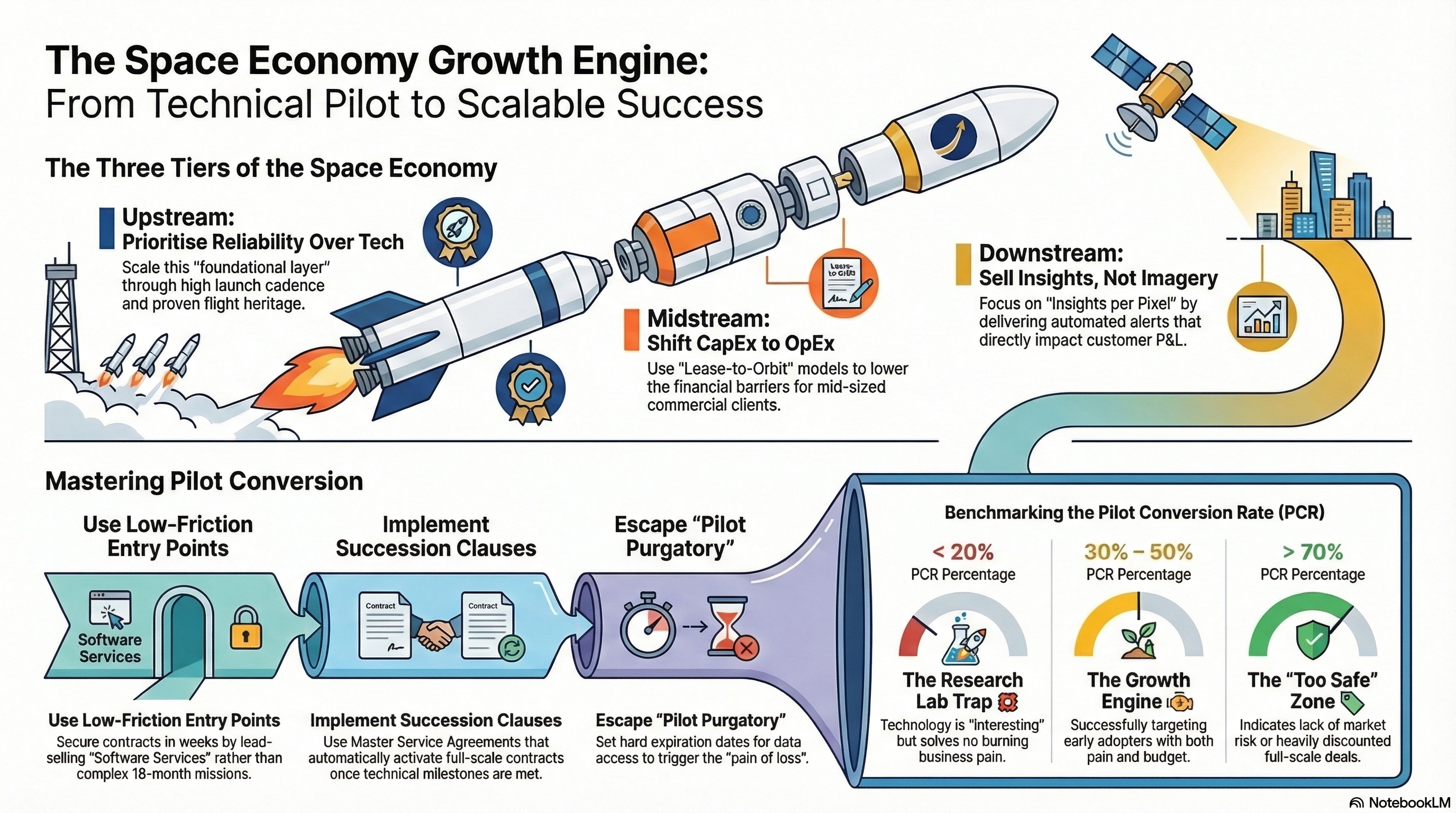
This article provides a roadmap for transforming speculative space ventures into sustainable growth engines by shifting the focus from technical engineering to scalable commercial utility.
It begins by deconstructing the space economy into its three primary tiers (Upstream infrastructure, Midstream operating systems, and Downstream data analytics) while detailing example sales strategies and growth levers for each.
To overcome the industry’s notoriously long procurement cycles, the article includes methods for strategic pilot acquisition, emphasizing low-friction entry points that address terrestrial pain points rather than hardware specifications.
Finally, the guide explores the mechanics of pilot conversion, offering actionable insights on implementing succession clauses, benchmarking conversion rates, and utilizing ROI-driven pivots to move beyond experimental testing into high-value, recurring operational contracts.
I. Examples of Space Business Segments
1. Infrastructure and Launch Services (Upstream)
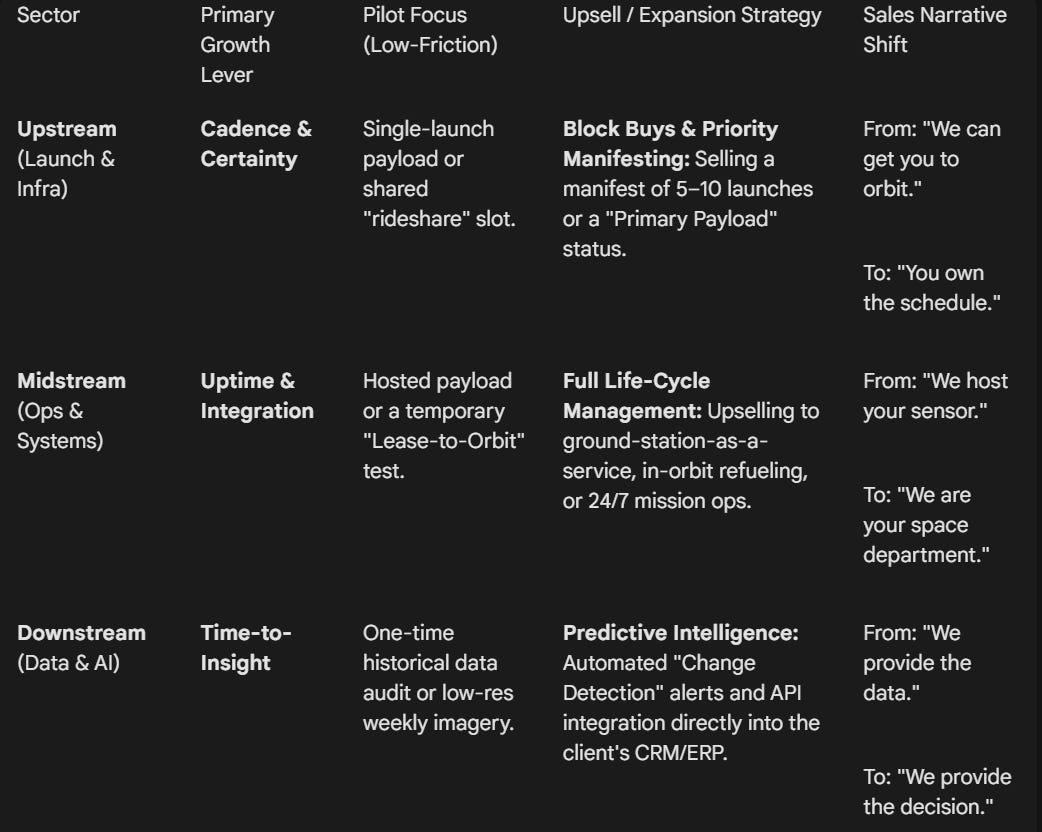
The Upstream sector is the “foundational layer” of the space economy. It is characterized by high capital expenditure (CapEx) and long development cycles, but it controls the gateway to all other services.
Examples
Micro-launchers & Heavy-lift:
Tailoring launch windows to specific customer needs rather than “ridesharing” on someone else’s schedule.
Space Tugs (OTVs):
Providing “last-mile delivery” to move satellites from a standard drop-off point to a specific custom orbit.
Modular Manufacturing:
Building standardized satellite buses or components that can be mass-produced.
Sales Strategies (Reliability & Cost):
Flight Heritage:
In this segment, the first three successful launches are your most important sales assets.
Customers prioritize “certainty of arrival” over “cutting-edge tech.”
Volume Discounting:
Moving away from one-off mission pricing toward “Block Buys”; selling 5–10 launches at a time to anchor customers like constellation operators.
Growth Potential:
Growth is fueled by Cadence.
The “Engine” here scales when the time between launches shrinks from months to days.
2. Satellite Operations & Space Systems (Midstream)
Midstream companies act as the “Operating System” of space. They provide the platform and the maintenance that allow data to be gathered or experiments to be run.
Examples:
Satellite-as-a-Service (SaaS):
A client pays a subscription to use a sensor already in orbit, rather than building and launching their own satellite.
In-Orbit Servicing & Manufacturing (ISAM):
Companies focusing on refueling aging satellites or 3D printing structures in zero-G that couldn’t survive a launch from Earth.
Ground Segment-as-a-Service (GSaaS):
Providing the network of antennas and cloud processing to get data from space to the user’s desk.
Sales Strategies (Reducing Customer CapEx):
The “Leasing” Model:
Instead of a $50M upfront cost, offer a monthly “Lease-to-Orbit” model.
This shifts the cost from a customer’s Capital Expenditure (CapEx) to their Operating Expenditure (OpEx), making it easier for mid-sized firms to say “yes.”
Standardized Integration:
Selling “Plug-and-Play” slots for hosted payloads.
If a customer can prep their hardware in weeks instead of years, the sales cycle collapses.
Growth Potential:
Growth is driven by Interoperability.
The more “space-native” services you provide (like refueling), the more you extend the Lifetime Value (LTV) of existing assets.
3. Data & Earth Observation (Downstream)
This is where space meets the “End User.” It is the most scalable part of the sector because it is essentially a software and analytics business.
Examples:
Precision Intelligence:
Using Synthetic Aperture Radar (SAR) to “see” through clouds and at night for maritime tracking or illegal logging detection.
Economic Indicators:
Analyzing parking lot occupancy or oil tank levels to provide hedge funds with real-time market data.
Climate & ESG Monitoring:
Providing verifiable data on methane leaks or carbon sequestration for corporate compliance.
Sales Strategies (Outcome-Based Selling):
Vertical Specialization:
Rather than selling “Satellite Imagery”, selling “Yield Prediction” to farmers or “Risk Assessment” to insurance adjusters.
The word “space” shouldn’t even appear in the first 10 minutes of the sales pitch.
API-First Delivery:
Integrating data directly into the customer’s existing software (like Bloomberg terminals or ArcGIS).
If the customer has to log into a new portal to see data, the “engine” will stall.
Growth Potential:
Growth is driven by Insights per Pixel.
The value isn’t in the image; it’s in the automated alert that tells a customer, “Something has changed that will cost you money.”
II. Securing Initial Pilots
The “pilot” is the critical bridge between a technical demonstration and a scalable growth engine.
Because of the high stakes and capital intensity, customers rarely move from a cold lead to a multi-year contract.
The goal of the pilot is to embed your service into the customer’s operational workflow so that removing it becomes a business risk.
1. The Hook
Many space companies lead with their hardware (e.g., “We have a sub-meter resolution SAR satellite”). High-growth companies lead with a terrestrial pain point.
The Strategy:
Offer a “Low-Friction Entry Point.”
Instead of selling a $2M orbital mission, sell a Digital Twin or a Historical Data Audit for $50k.
The Goal:
Get through procurement as a “Consultancy” or “Software Service” rather than a “Space Mission.”
This bypasses the 18-month aerospace bidding cycle and gets you an active contract in weeks to months.
2. The Execution
The pilot must prove Product-Market Fit within a compressed timeframe (typically 3–6 months).
Define “Success Criteria” Early:
Before the pilot starts, sign a document with the customer that defines exactly what data or performance metric constitutes a “success.”
Example: “If our satellite data identifies 90% of maritime anomalies within 2 hours, the pilot is successful.”
Shadow the Workflow:
Watch how the customer uses the data.
If they have to manually export data into an Excel sheet, your engine has friction.
The Upsell Trigger:
Identify a “Gated Need” during the pilot.
If the customer loves the weekly data but expresses a need for daily updates, you have found your path to the next tier.
3. Leveraging “Dual-Use” Contracts
A sustainable growth engine in space often relies on a hybrid sales funnel: Government (defense/civil) and Commercial.
The Strategy:
Use Government contracts to fund the R&D (Non-Dilutive Funding) while simultaneously building a “Commercial Off-The-Shelf” (COTS) version of the product.
The Goal:
Use the “flight heritage” gained from government missions as a primary sales credential for risk-averse commercial clients.
III. Converting Pilots
To transition from “Technical Proof” to “Economic Scaling,” the pilot should be engineered for conversion from the first handshake.
A. The “Succession” Clause
A Succession Clause treats the pilot and the full-scale contract as a single legal vehicle with a “fork in the road.”
1. The Pre-Negotiated “Phase 2”
Instead of a 5-page pilot agreement, issue a Master Service Agreement (MSA) that includes a “Work Order 1” (The Pilot) and a “Work Order 2” (Full Scale).
The Mechanism:
The contract states that if Technical Milestone X and Operational Milestone Y are met, “Work Order 2” activates automatically unless the client opts out within 30 days.
Why it works:
It shifts the burden of action.
Instead of the champion having to “ask for money” again, the budget is already earmarked.
It moves the conversation from “Should we buy this?” to “Did it work?”
B. Defining “Success Criteria” (The Quantifiable Hook)
Ambiguity is the enemy of conversion. You must define success in the language of the client’s P&L, not your engineering specs.
Weak Criteria:
“The satellite imagery is clear and delivered on time.”
Succession-Ready Criteria:
“The system identifies 95% of illegal mining equipment within 4 hours of overpass, reducing the client’s ground-patrol costs by 15%.”
The Sales Lever:
By agreeing to these metrics upfront, you create an objective “Yes/No” trigger.
If you hit the numbers, the client’s internal stakeholders have already pre-approved the ROI case.
C. Pilot Conversion Rate (PCR)
The PCR is a validator of Product-Market Fit. “Technical Success” is often confused with “Business Success,” this metric keeps the sales team honest.
1. Benchmarking Your PCR
The “Research Lab” Trap (PCR < 20%):
If you are launching successful pilots but no one is buying the full service, your technology is “interesting but not essential.”
You are solving a scientific curiosity, not a burning business pain.
The “Growth Engine” Sweet Spot (PCR 30–50%):
This indicates you are targeting the right “Early Adopters” who have both the pain point and the budget to scale.
The “Too Safe” Zone (PCR > 70%):
While it looks good, an abnormally high PCR might mean you aren’t taking enough market risks or your “pilot” is actually just a discounted full-scale contract.
2. Diagnosing and Escaping “Pilot Purgatory”
Pilot Purgatory occurs when a client keeps requesting “just one more data set” or “one more test orbit” without signing a long-term deal. This is usually a sign of hidden stakeholders or lack of perceived ROI.
The “Sunset” Strategy:
Every pilot must have a hard expiration date for data access.
If the pilot is 3 months, the data feed cuts off at day 91. The “pain of loss” is often a stronger closer than the “hope of gain.”
The ROI Pivot:
When a client asks for more tests, pivot the conversation:
“We can certainly run another test, but the data from the last 90 days already shows a potential $2M in annual savings. Every month we spend testing is $160k in lost efficiency for your team. Should we move to the operational phase now to capture those savings?”
The Executive “Check-In”:
If the technical team is stalling, use your “Success Criteria” report to reach out to the executive sponsor.
Show them the validated results and ask if the business case for Phase 2 still aligns with their quarterly goals.
IV. Growth Engine Tools
The following tools and templates can be designed to move a space venture from a handshake to a scalable contract.
1. The “Succession-Ready” Pilot Template
Create a one-page summary that can be attached to every initial Pilot Work Order. It transforms a technical test into a pre-approved business expansion.
The Baseline:
Define the current “State of Play” (e.g., “Customer currently spends $X on manual ground inspections”).
The “North Star” Metric:
One quantifiable KPI that triggers the succession (e.g., “System detects 90% of anomalies with <5% false positives”).
The Automated Renewal Clause:
A checkbox indicating that if the North Star Metric is met over a 90-day period, the “Operational Phase” (Year 1) activates automatically.
2. The ROI Pivot Script
When a customer is stuck in “Pilot Purgatory” and requests more data without a commitment, use your own script to shift the focus from engineering to the bottom line.
“We can certainly extend the testing phase by another 30 days. However, based on the success of the last milestone, we have already validated a potential savings of [Dollar Amount] per month. By delaying the transition to full operations, the organization is essentially opting into a monthly loss of [Dollar Amount]. Should we move to the Master Service Agreement now to begin capturing that ROI?”