Space-to-Ground Optical Downlinking [Strategy]
As satellite constellations increase in size and data density, optical Space-to-Ground downlinking enabled by Optical Ground Stations (OGS) are poised to transition to critical infrastructure.

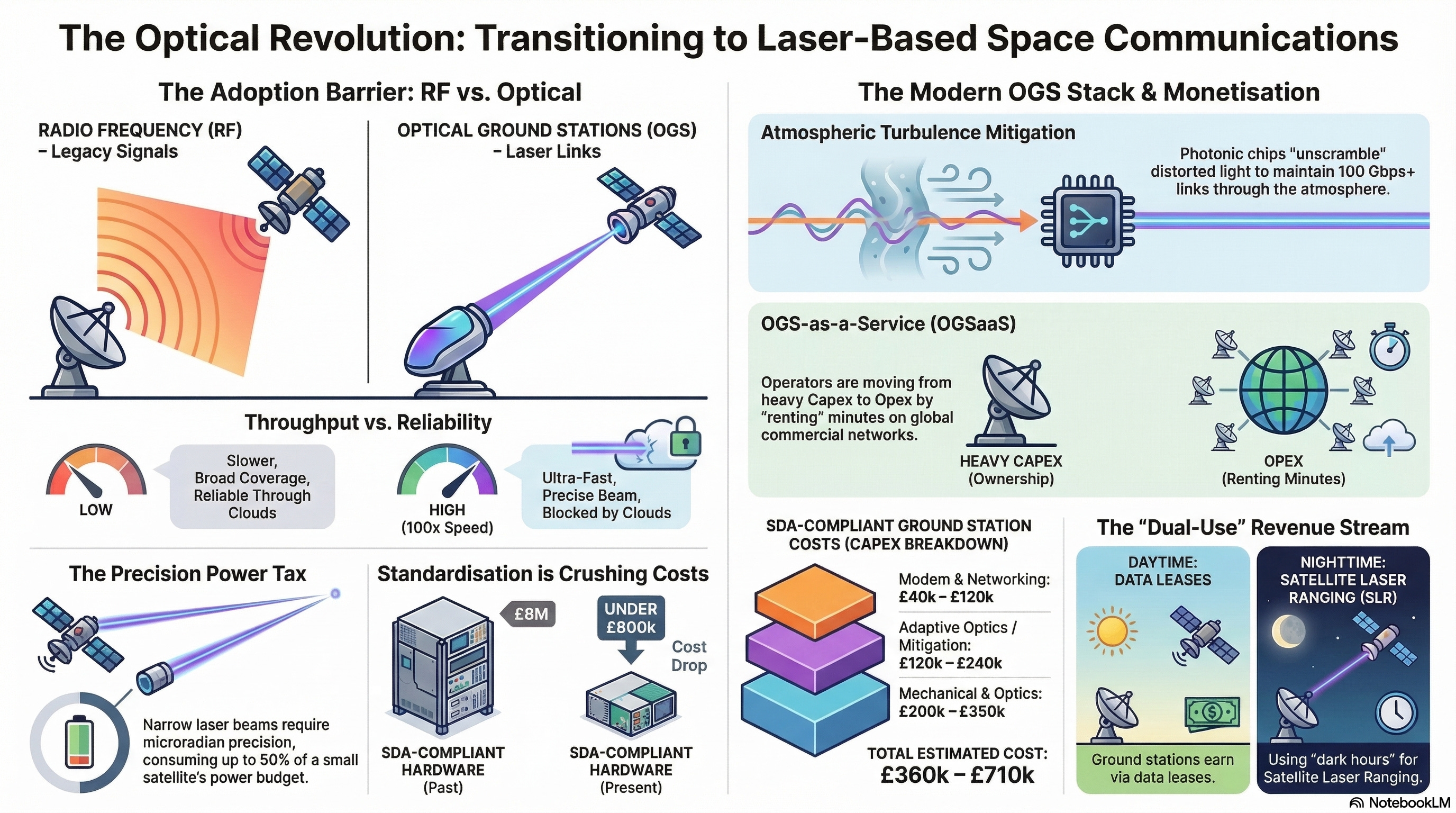
Optical Ground Stations (OGS) represent the critical “landing sites” for a new era of space-to-ground connectivity. By leveraging 1550 nm laser links, operators can achieve 10x to 100x the throughput of RF with a near-zero regulatory footprint.
However, transitioning to an optical downlink strategy requires a calculation of atmospheric risk versus potential massive data rewards.
I. The Adoption Barrier (Why RF Still Dominates)
While “LaserCom” is considered the future, certain friction points prevent it from becoming the universal standard today:
1. The “Cloud Outage” Risk
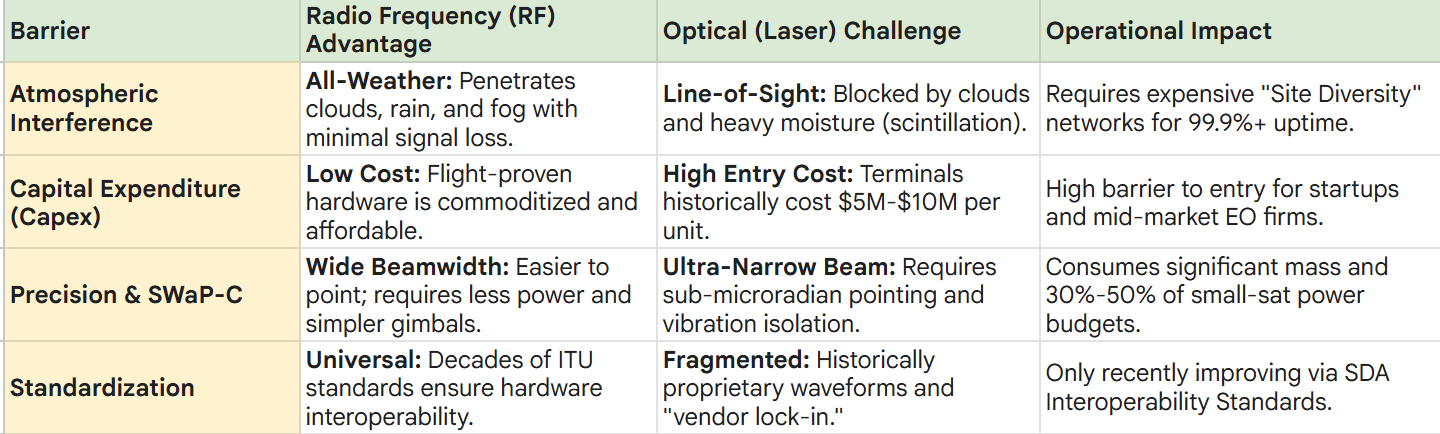
RF signals (especially L-band and S-band) can penetrate thick cloud cover, rain, and fog with minimal degradation. In contrast, a single heavy cloud can completely block an optical link.
The Result:
Operators who require 99.99% availability (like emergency services or military command) cannot yet rely on optical as a primary link without a massive, expensive network of geographically diverse ground stations.
2. High Entry Cost & Low Heritage
Until recently, an Optical Communication Terminal (OCT) for a satellite cost between $5M and $10M, compared to a few hundred thousand dollars for a flight-proven RF system.
The Result:
For a startup or a mid-sized Earth Observation company, the Capex of adding a laser terminal often outweighs the benefit of the extra data speed, especially if their existing RF ground station contracts are already paid for.
3. Precision Requirements (SWaP-C)
An RF antenna has a wide “beamwidth”; you only need to point it generally at the ground station. A laser beam is incredibly narrow (microradians).
The Constraint:
This requires high-precision gimbals and vibration-isolation mounts. For “CubeSats” or small satellites, the Size, Weight, and Power (SWaP) required to keep a laser locked onto a ground station can consume 30% - 50% of the satellite’s total power budget.
4. Lack of Standardized Protocols
Historically, every laser terminal manufacturer used proprietary waveforms. If you bought a terminal from Vendor A, you couldn’t talk to a ground station built by Vendor B.
The Status:
This is only now being solved by the SDA (Space Development Agency) Standards, which are forcing manufacturers to move toward interoperability.
II. Emerging Trends
The industry is currently deploying several “bridge technologies” to overcome these hurdles:
1. Hybrid RF/Optical Payloads
The most significant trend is the Hybrid Terminal. Satellites are being launched with both a laser for high-speed “data dumps” and a small RF antenna for “Command & Control” (C2).
If it’s cloudy, the satellite sends critical health data via RF; if it’s clear, it offloads Terabytes via laser.
2. Space-to-Space “Data Relays”
Instead of every satellite needing its own OGS, satellites are using Optical Inter-Satellite Links (OISL) to pass data to a “Relay Satellite” in a higher orbit (like GEO).
This relay satellite stays in constant contact with a single, high-performing OGS in a desert location where it never rains.
Example: The SDA Transport Layer acts as a giant “router in the sky” for smaller imaging satellites.
3. All-Optical “Space Data Centers”
With the rise of on-orbit AI processing, we are seeing the emergence of Orbital Data Centers. These assets collect data from various sensors via laser, process it using high-density radiation-hardened GPUs, and only downlink the “answers” to Earth. This reduces the total volume of data that needs to pass through the atmosphere.
4. QKD (Quantum Key Distribution) integration
As cyber-threats evolve, OGS sites are being upgraded with Quantum-ready receivers.
Laser communication is the only way to distribute quantum encryption keys from space, as RF frequencies cannot support the quantum states required for this level of security.
III. Maximizing the Value of Optical Downlinking
Operators may use the following tactics to squeeze more revenue from every photon:
1. Adaptive “Burst” Scheduling
Operators can maximize value by using Predictive Cloud Analytics to identify 3-to-5-minute windows of perfect clarity.
Tactics: Instead of a slow, continuous stream, the satellite performs a high-speed “dump” of 50–100 Gbps only when the atmospheric scintillation is at its lowest.
Value Add: This reduces the satellite’s “Power-per-Bit,” saving onboard battery life for other mission-critical tasks (like active imaging).
2. Priority “Hot-Data” Routing
A satellite operator can tier their downlink:
Tier 1 (Laser): Immediate downlink of low-latency mission data (e.g., wildfire detection, battle-space ISR) at a premium price.
Tier 2 (RF): Slower, routine telemetry and system health checks.
Tier 3 (Buffer): Non-urgent data stored on-board and downlinked only when the satellite passes over a “low-cost” OGS during an off-peak window.
3. On-Orbit Edge Processing
To maximize optical value, minimize “trash” data.
Strategy: Use onboard AI (e.g., NVIDIA IGX or similar rad-hardened chips) to discard cloudy frames or redundant pixels before the laser fires.
Impact: You only pay for the transmission of high-value, actionable pixels, effectively increasing your “Information Density” per pass.
IV. Minimizing Optical Downlinking Costs
Building a proprietary OGS network can be a “Capex trap.” To minimize costs, operators can adopt Modular and Virtualized ground segments.
1. Leveraging OGSaaS (The “AWS” for Space)
Instead of building 10 private stations to ensure cloud diversity, operators “burst” into commercial networks like KSAT or SSC.
Cost Saving: Transition from a heavy Capex model to a variable Opex model where you only pay for the “minutes” used.
Network Diversity: You gain access to a global grid that could cost over $100M to build independently.
2. Standardization via SDA Compliance
By using hardware that follows the SDA (Space Development Agency) interoperability standards, operators avoid “Vendor Lock-in.”
Cost Saving: If a specific OGS provider raises rates, an SDA-compliant satellite can seamlessly switch to a competitor’s ground station without hardware modifications. This “plug-and-play” capability has dropped terminal costs from $10M to under $1M in the 2025–2026 cycle.
3. The “Hybrid-Minimum” Approach
Avoid the “All-Optical” trap.
Strategy: Equip the satellite with a low-cost, COTS (Commercial Off-The-Shelf) laser terminal for data, but keep a legacy S-band RF antenna for basic “Command and Control.”
Why: This ensures the satellite is never “lost” due to a cloud, meaning you don’t need to over-engineer the optical system for 99.99% reliability saving millions in complex atmospheric-correction hardware.
4. Direct-to-Cloud “Fiber Landing”
Locate OGS sites directly on top of major fiber-optic “PoPs” (Points of Presence).
Cost Saving: Bypassing expensive “backhaul” leases (the terrestrial lines that carry data from the telescope to the data center) can reduce monthly OGS operating costs by up to 30%.
V. End-to-End OGS Stack (COTS-Focused)
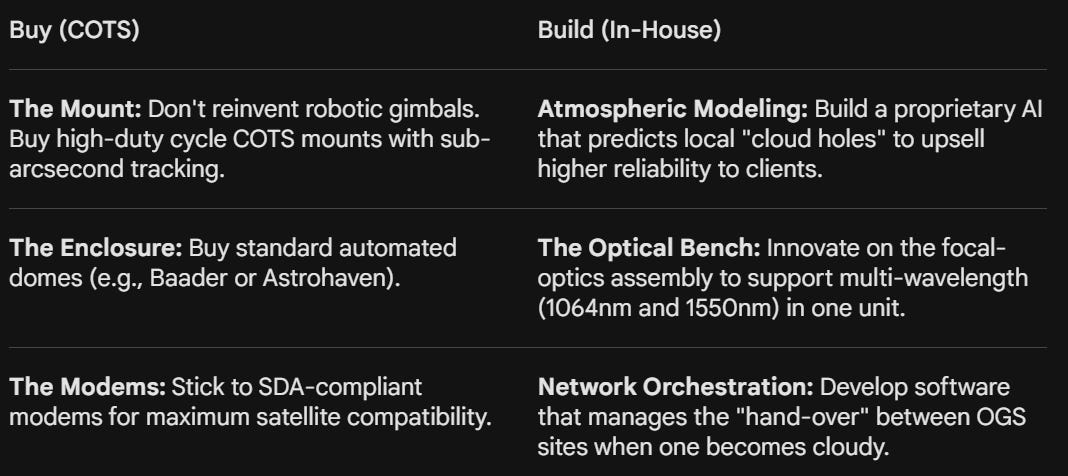
A modern OGS consists of four primary layers. In-house innovation should focus on the software and optics where the most significant performance gains (and margins) are found.
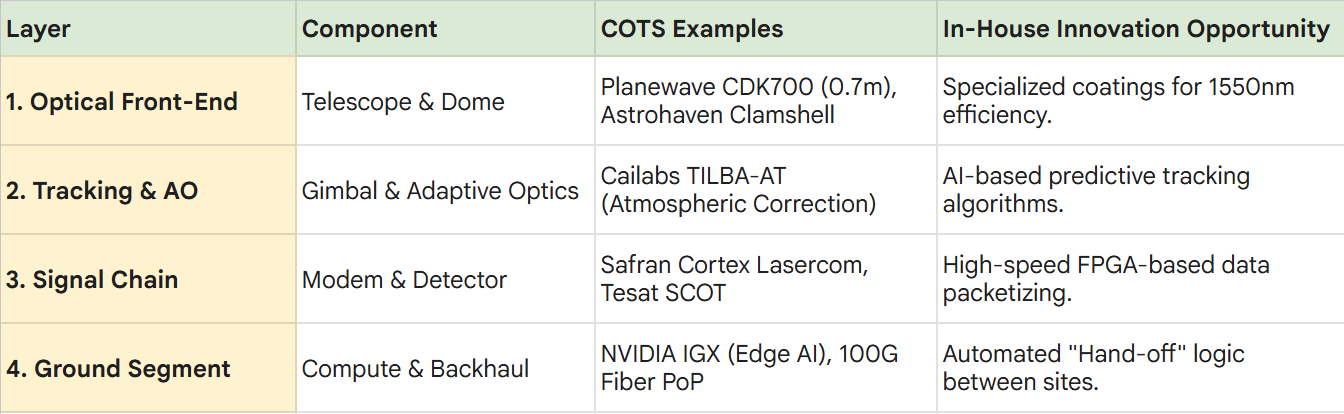
For a competitive, SDA-compliant LEO-tracking station, the estimated costs are:
Mechanical & Optics ($250k - $450k): High-precision 0.5m - 0.7m telescope and high-speed robotic mount.
Adaptive Optics / Turbulence Mitigation ($150k - $300k): Essential for maintaining a link through the atmosphere.
Modem & Networking ($50k - $150k): High-speed optical transceivers and fiber interface hardware.
Site Prep & Integration ($100k - $200k): Power, foundation, climate-controlled enclosure, and fiber backhaul.
Total Initial Capex: c.$550,000 to $1,100,000
1. Mechanical & Optics (The “Bus”)
For LEO tracking, speed and structural stiffness are more important than sheer aperture size.
Telescope ($150k – $250k):
COTS Choice:
PlaneWave CDK700 (0.7 m) or CDK500 (0.5 m).
These use “Corrected Dall-Kirkham” optics, which provide a wide, flat field of view; essential for acquiring fast-moving LEO targets.
Spec Requirement:
Must have a high-reflectivity coating optimized for 1550 nm (C-band) to ensure minimal photon loss.
Gimbal/Mount ($100k – $200k):
COTS Choice:
Direct-drive mounts (e.g., PlaneWave L-series or Mathis Instruments).
Spec Requirement:
Slewing speeds of at least 20∘/sec to track LEO satellites from horizon to horizon without “keyhole” stalls at the zenith.
In-House Innovation:
Develop a proprietary Active Boresight Alignment system. Using a secondary “guide camera” and machine learning to maintain sub-microradian alignment between the transmit and receive paths in real-time.
2. Adaptive Optics & Turbulence Mitigation
The atmosphere is the “noise” in your fiber-optic cable. This layer “cleans” the light so it can be injected into a single-mode fiber.
The Mitigation Engine ($150k – $300k):
COTS Choice:
Cailabs TILBA-ATMO. Unlike traditional AO which uses fragile deformable mirrors, TILBA uses Multi-Plane Light Conversion (MPLC); a passive, non-mechanical photonic chip that “unscrambles” distorted light.
Spec Requirement:
Must support SDA Tranche 2 waveforms and be capable of handling 100 Gbps+ data rates without introducing latency.
In-House Innovation:
Predictive Wavefront Sensing. Using a dedicated atmospheric LIDAR to “see” turbulence 100 meters ahead of the telescope and pre-adjusting the signal processing parameters. This increases the “link budget” during high-wind or high-heat conditions.
3. Modem & Networking (The “Digital Core”)
This layer converts photons into IP packets. Compliance with the Space Development Agency (SDA) is mandatory for government contracts.
Optical Modem ($50k – $120k):
COTS Choice:
Safran Cortex Lasercom or Tesat SCOT. These are built specifically for space-to-ground links and support the standard O-ISL (Optical Inter-Satellite Link) waveforms.
Spec Requirement:
Support for DPSK (Differential Phase Shift Keying) or OOK (On-Off Keying) modulations as per SDA interoperability standards.
Switching ($5k – $30k):
COTS Choice:
NVIDIA Mellanox Spectrum-4 switches. High-throughput (400G/800G) is necessary because a single 0.7 m telescope can burst 100 Gbps+ during a pass.
In-House Innovation:
Protocol Acceleration. Developing a custom FPGA-based “Space-to-Cloud” gateway that strips satellite-specific headers and converts them to standard AWS/Azure-friendly UDP/TCP streams on-the-fly, reducing the processing load on the client’s cloud side.
4. Site Prep & Infrastructure
The “hidden” costs that often determine the station’s long-term profitability.
Enclosure (60k – $120k):
COTS Choice:
Astrohaven Clamshell Domes. These provide 360∘ visibility and can open/close in under 30 seconds; critical for protecting the optics during sudden weather shifts.
Foundation & Pier ($20k – $40k):
Requirement:
A “decoupled” concrete pier. The telescope must sit on a massive concrete pillar that does not touch the floor of the building, isolating it from wind vibration and foot traffic.
Fiber Backhaul ($20k – $40k initial):
Requirement: Redundant dark-fiber path to the nearest Tier-1 data center. Many OGS sites are co-located with solar farms to leverage existing high-power grids and fiber paths.
VI. Monetizing an OGS (Revenue Models)
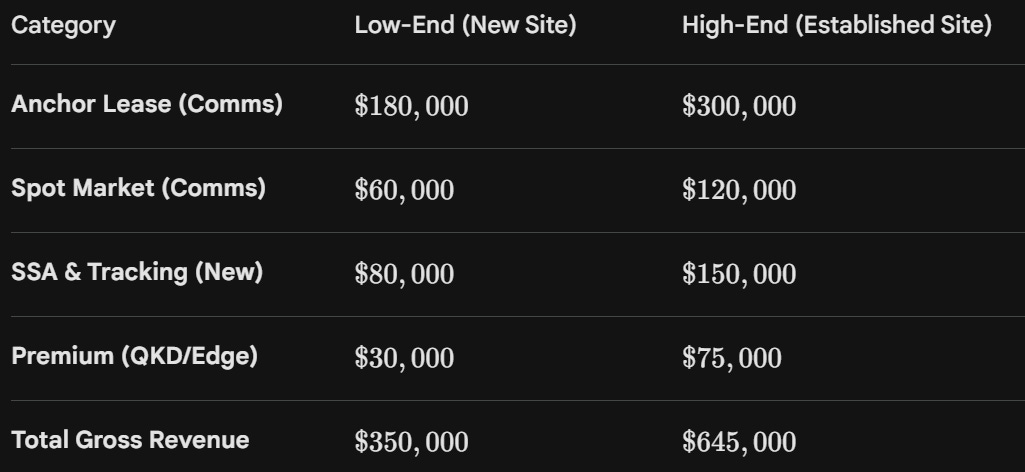
Monetizing an Optical Ground Station (OGS) is about selling high-availability data windows and quantum-secured pathways. As RF spectrum becomes increasingly congested and expensive to license, the “license-free” nature of optical becomes a major financial lever.
1. The Anchor Lease
This is a long-term (3–5 year) “Take-or-Pay” contract with a large constellation operator (e.g., SDA, Amazon, or SpaceX).
Annual Revenue Estimate: $180,000$ to $300,000 per station.
Pricing Strategy: Fixed monthly fee ($15k–$25k) for guaranteed daily windows.
Maximizing Value: Offer SDA Interoperability as a standard. Major government-backed constellations will only sign leases with stations that guarantee “Plug-and-Play” compatibility with their fleet’s optical terminals.
2. O-GSaaS Spot Pricing
Selling unused capacity to secondary missions, Earth Observation (EO) startups, or research institutions.
Annual Revenue Estimate: $60,000 to $120,000$ (assuming 4–8 hours of daily spot-market utilization).
Pricing Strategy: $10 to $45 per minute of tracking.
Maximizing Value: Implement Automated Scheduling APIs. Integrate your station into a global marketplace (like AWS Ground Station or Azure Orbital). This allows satellite operators to “buy” your station with one click when they see a clear sky over your coordinates, maximizing your station’s utilization during peak weather windows.
3. Space Situational Awareness (SSA) & Tracking
Utilizing the OGS during “dark hours” (when satellites aren’t overhead for downlinks) or using the telescope’s tracking sensors to identify, characterize, and catalog orbital objects.
Annual Revenue Estimate: $80,000$ to $150,000$ per station.
Pricing Strategy:
Data Subscription: Selling “observation logs” to commercial SSA aggregators (e.g., LeoLabs, Slingshot Aerospace).
On-Demand Characterization: Charging $500–$2,000 per “event” to help an operator identify a malfunctioning satellite or verify a deployment.
The “Dual-Use” Advantage:
Unlike RF stations, an OGS can perform Satellite Laser Ranging (SLR). By firing a low-power laser at a satellite and measuring the bounce-back time, you can determine its position with centimeter-level accuracy; orders of magnitude better than radar.
4. Premium Services
Adding “intelligent” layers to the raw data stream.
Annual Revenue Estimate: $30,000 to $75,000
Service Examples:
On-Site Edge Processing: Charging a premium to run AI algorithms on the data at the station before sending it over fiber (reducing the client’s cloud ingress costs).
Quantum Key Distribution (QKD): Acting as a “Quantum Gateway.” QKD-ready stations could charge a 50% premium per pass for distributing ultra-secure encryption keys.
Maximizing Value: Pitch your OGS as a “Sovereign Gateway.” Military and government clients will pay a premium for dedicated, non-shared hardware that processes sensitive data on-site.
VII. Monetizing In-House OGS R&D & IP
If you’ve cracked the code on sub-microradian tracking or atmospheric turbulence mitigation, your most valuable product might not be the “station” itself, but the Intellectual Property (IP) behind it.
1. Software-Defined Optics (Licensing Model)
If you have developed a superior Atmospheric Correction Algorithm or an AI-driven Handover Manager, you can license this to other OGS operators.
The Product: A software “Black Box” or API that integrates with third-party telescopes (e.g., Planewave).
Revenue Model: SaaS / Royalty-based. Charge a “Success Fee” per successful satellite pass or an annual license fee ($50k - $100k) per station.
Target: Telecom giants or regional governments building their own sovereign networks but lacking the specialized “LaserCom” expertise.
2. Component Spin-offs (COTS Strategy)
High-performance OGS require specialized hardware that often doesn’t exist at the right price point. If you’ve built a custom part to solve your own problem, chances are others need it too.
The “Golden Screw” Strategy: Sell specific high-margin sub-assemblies.
Example: A ruggedized, high-speed Optical Bench or a Deformable Mirror Controller.
Target: Research labs, universities, and defense contractors who are “building” but need the specialized “guts” of the system.
3. “Digital Twin” & Simulation Services
Testing a laser link is expensive. If you have built a high-fidelity Atmospheric Simulator to test your OGS before construction, that simulator is a product.
The Product: Virtual environment testing for satellite terminal manufacturers to “proof” their hardware against your ground station’s specs before launch.
Revenue Model: Consulting/Testing Fee. $20k - $50k per “virtual mission” campaign.
4. The “Franchise” Model (OGS-in-a-Box)
Once you have perfected your first 2–3 stations, the most scalable path is to become an OGS OEM (Original Equipment Manufacturer).
The Model: You provide the design, the software stack, and the specialized optics. A local partner (e.g., a telco in Australia or Chile) provides the land, the power, and the fiber.
Monetization: You take an Upfront Integration Fee (c.$200k) and a Revenue Share (10%-20%) of all data passing through that station.
5. Example Strategy
Phase 1 (Build): Deploy a COTS-heavy station to prove the location and start the “Anchor Lease” revenue.
Phase 2 (Optimize): Use in-house R&D to replace COTS parts with proprietary “Moats” (Adaptive Optics / AI).
Phase 3 (Scale): License your “Moats” and software stack to global partners, turning your OGS operation into a high-margin technology firm.
VIII. OGS Commercial Landscape
1. OGS Vendors (Hardware & Systems)
If you are looking to purchase a turnkey station or specialized components, these players lead the “industrial-grade” market:
Cailabs (France): Their TILBA-OGS is currently the gold standard for atmospheric turbulence mitigation. They use “Multi-Plane Light Conversion” (MPLC) to stabilize the beam without the extreme complexity of traditional deformable mirrors.
Core Strength: High reliability in less-than-ideal weather conditions.
Mynaric (Germany/US): While famous for satellite terminals (CONDOR), Mynaric offers the CAPRICORN OGS. It is designed for mass production and high-rate LEO downlinks (10 to 100 Gbps).
Core Strength: Compliance with SDA (Space Development Agency) standards, ensuring interoperability with US defense and commercial constellations.
BridgeComm (USA): Specializes in high-speed point-to-point optical links and modular OGS terminals. They focus heavily on “Managed Optical Services” for government and high-security clients.
Core Strength: Multi-domain connectivity (Space-to-Ground, Ground-to-UAV).
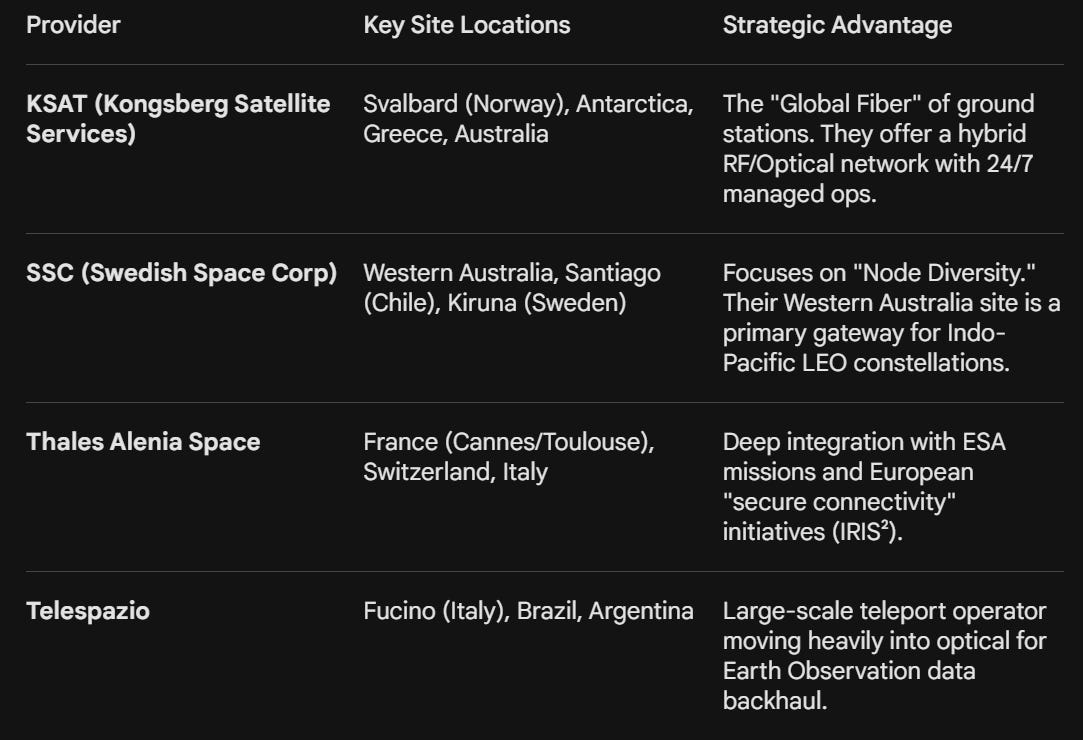
2. Global OGS Service Networks (Capacity for Hire)
If you prefer to “rent” rather than “build,” several providers have established commercial sites in geographically strategic locations:
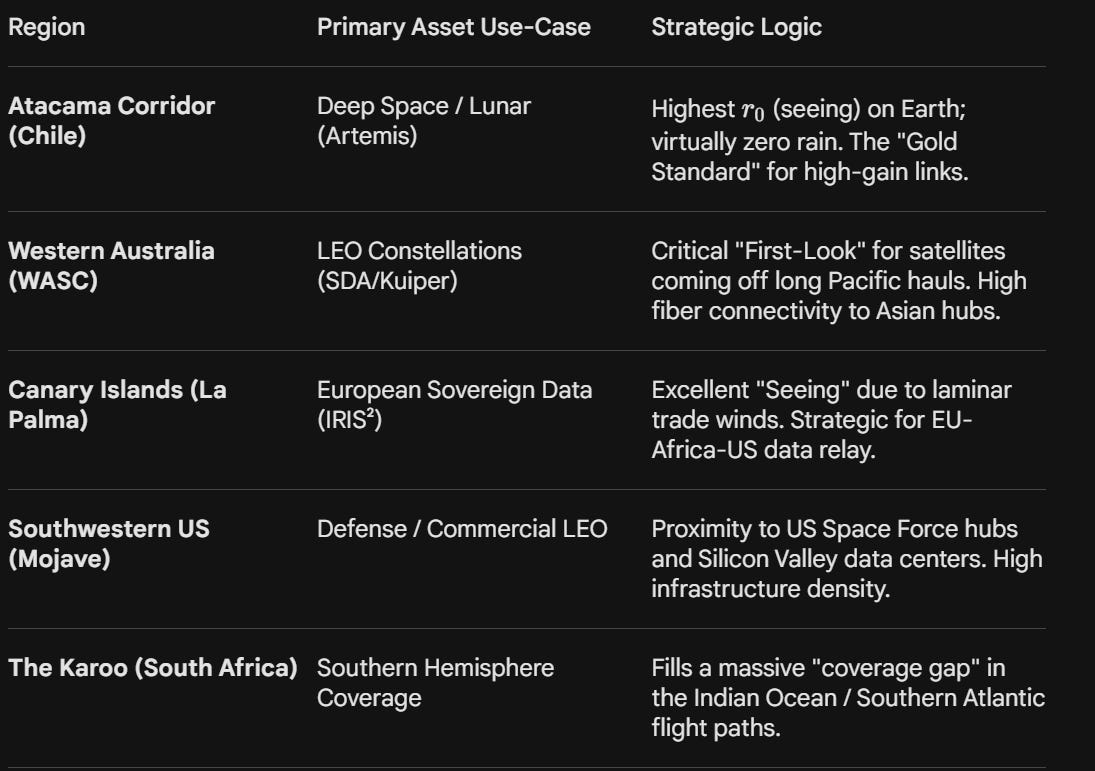
IX. Strategic OGS Site Selection
To maximize an OGS, a site should be evaluated against granular technical pillars:
1. Cloud Statistics
The primary killer of OGS revenue is Cloud Fraction.
The Metric:
You require a “Clear Sky Probability” of >85% annually.
The Strategy:
Sites like the Atacama Desert or the Mojave reach >92%.
However, value lies in Spatial Diversity. An OGS strategy is more “bankable” if you have a secondary site 300–500 km away on a different weather microclimate.
If Site A is clouded out by a marine layer, Site B must be statistically likely to be clear.
2. Atmospheric “Seeing” & Isoplanatic Angle
Even on a clear day, “twinkling” (scintillation) can break a 100 Gbps laser link.
The Parameter:
Fried Parameter. This measures the size of the “pockets” of air that aren’t turbulent. A “good” site has an Fried Parameter > 15 cm at 1550 nm.
The Selection Logic:
High-altitude sites (>2,000 m) are preferred because they sit above the densest, “wettest” part of the atmosphere.
This reduces the workload on your Adaptive Optics (AO) and increases the total data throughput per pass.
3. Proximity to “Tier-1” Data Centers & Fiber PoPs
LaserCom delivers “Fiber-in-the-Sky” speeds (100 Gbps+). If your OGS is connected to the world via a slow 1 Gbps microwave link or a high-latency satellite backhaul, the optical advantage is neutralized.
The Requirement:
The site should be within 50 km of a major Fiber Point of Presence (PoP) or a subsea cable landing station.
The Latency Trap:
For LEO broadband (Starlink/Kuiper), the goal is “Glass-to-Glass” latency.
Every millisecond spent routing data terrestrially from a remote desert to a processing hub in Virginia or Dublin devalues the contract.
4. Horizon Clearance & “Masking”
LEO satellites move fast. To maximize “Contact Time,” the telescope needs a clear view down to 10°–15° elevation.
The Obstacle:
Mountains, tall trees, or even nearby buildings create “Masks.” A site with a 20° obstruction loses roughly 30%-40% of its potential data-transfer window per pass.
The Checklist:
Prioritize flat plateaus or “Inselbergs” (isolated hills) where the horizon is unobstructed in all directions.