
Spacecraft Clean Decay [Innovation]
Demand is driven by the explosive growth of mega-constellations, the need to protect the ozone layer from metallic seeding, and the mandate for “Design-for-Demise” (D4D) compliance.

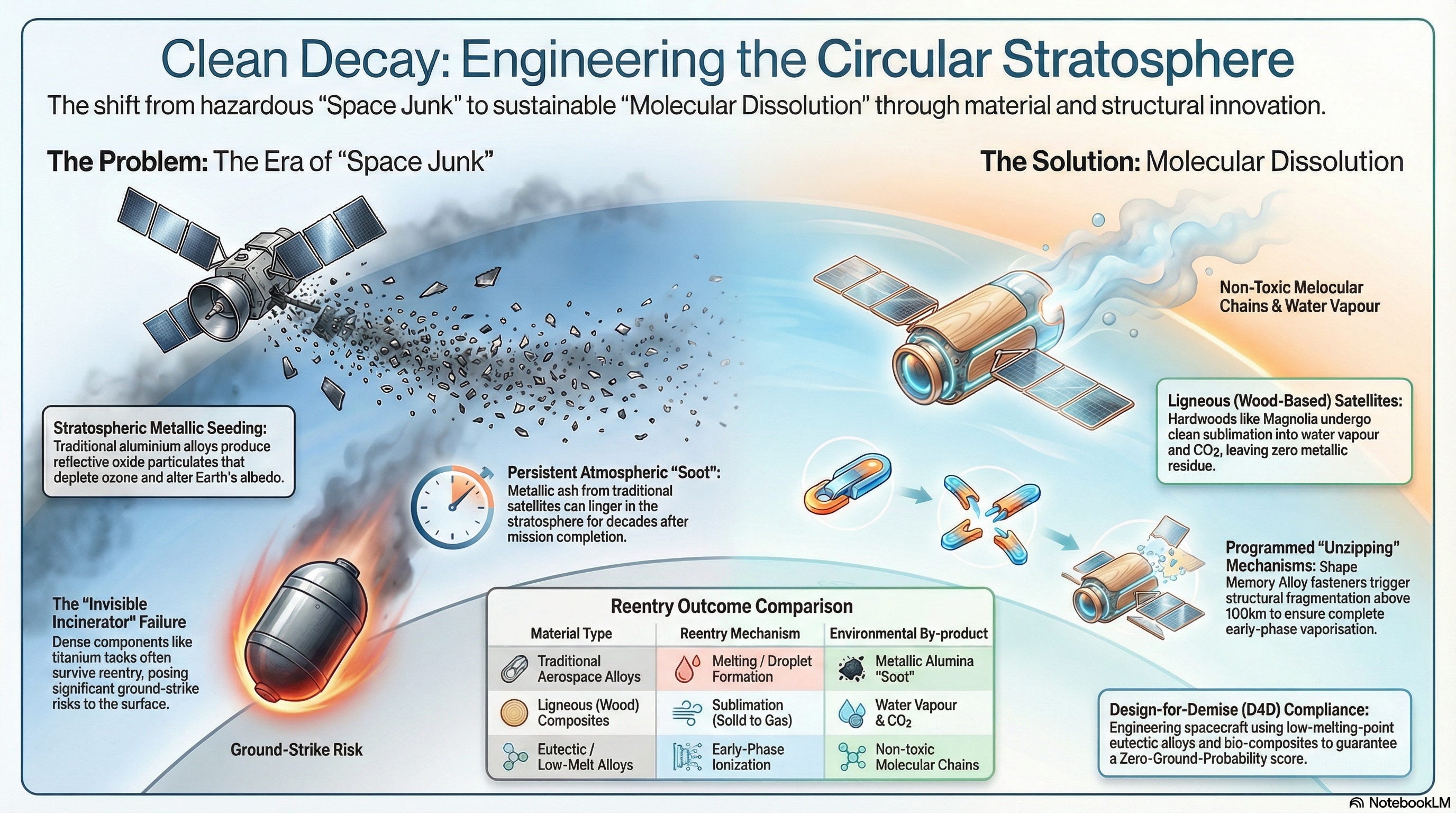
While traditional disposal methods treat atmospheric reentry as an “invisible incinerator,” Clean Decay innovation seeks to transform it into a “Molecular Dissolution” process.
A Clean Decay system is a specialized suite of materials and structural designs engineered to ensure that spacecraft (upon mission completion) vaporize into harmless, naturally occurring compounds rather than leaving a wake of metallic “space soot” in the upper atmosphere.
Clean Decay innovation presents an opportunity to shift from the era of “Space Junk” to a “Circular Stratosphere” model, where the end-of-life phase of a satellite is as precisely engineered as its launch.
I. Where is Clean Decay most needed?
The demand for Clean Decay systems is driven by the explosive growth of mega-constellations, the need to protect the ozone layer from metallic seeding, and the mandate for “Design-for-Demise” (D4D) compliance.
1. The Atmospheric Level: Stratospheric Chemistry Protection
This tier focuses on preventing the accumulation of alumina and other metallic oxides that catalyze ozone depletion and alter the Earth’s albedo.
Aluminum-Lite Architectures: Replacing traditional high-strength aluminum alloys (which produce reflective, long-lasting oxide particulates) with magnesium or carbon-fiber-reinforced polymers (CFRP) that gasify more readily.
Oxide-Free Ablators: Developing next-generation thermal shields that bypass the use of heavy metals, ensuring the byproduct of reentry is largely water vapor, nitrogen, and carbon dioxide.
Aerosol Impact Mitigation: Engineering materials that achieve “complete ionization” during the 1,500°C to 2,500°C reentry window, preventing the formation of solid ash that can linger in the stratosphere for decades.
2. The Structural Level: Design-for-Demise (D4D)
At this level, engineers act as “Destruction Architects.” The value lies in ensuring that no single component (no matter how dense) survives to reach the Earth’s surface.
Low-Melting-Point Jointing: Utilizing “dissolvable” fasteners and structural joints that melt early in the reentry sequence, breaking the satellite into smaller pieces to maximize the surface area exposed to plasma.
Composite Tanks & Optical Benches: Replacing titanium and stainless steel propellant tanks with high-performance composites that shatter and vaporize, eliminating the risk of “ground-strike” debris.
Early-Phase Fragmentation: Designing satellite chassis that unzipper under moderate thermal stress, ensuring that sensitive internal components are exposed to heat long before they reach the lower, denser atmosphere.
3. The Biological Level: Bio-Based & Organic Composites
This tier focuses on the shift toward “Ligneous Satellites.” The goal is to utilize renewable materials that behave predictably during high-heat ablation.
Lignin-Based Resins: Using plant-derived polymers instead of toxic petroleum-based phenolics to bind carbon fibers, reducing the release of hydrogen cyanide and other toxins during burn-up.
Engineered Wood Satellites (LignoSat): Utilizing vacuum-treated hardwoods (like Magnolia) for external hulls; wood does not melt or fragment like metal, but instead undergoes “clean” sublimation, leaving zero metallic residue.
Natural Fiber Reinforcement: Integrating flax or hemp-based composites into non-load-bearing panels to ensure high-velocity decomposition into organic molecular chains.
4. The Regulatory Level: Traceability & Compliance
This tier provides the data and assurance needed to meet increasingly strict international space sustainability standards.
Spectroscopic Tagging: Embedding specific non-toxic trace elements into materials so that ground-based sensors can verify the successful “vaporization signature” of a satellite in real-time.
Predictable Demise Modeling: Utilizing high-fidelity aerothermodynamic software to prove to regulators that a satellite has a “Zero-Ground-Probability” (ZGP) score before it is ever granted a launch license.
De-Orbit Augmentation: Integrating “Clean Drag” devices, such as biodegradable electrodynamic tethers, that accelerate reentry while ensuring the tether itself leaves no chemical trace.
II. Example Business Models
These models focus on commercializing the “Ecological Lifecycle” of orbital assets, turning the necessity of atmospheric protection into a high-margin, regulatory-compliant service for the New Space economy.
1. The “Atmospheric-Credit-as-a-Service” (ACaaS) Model
Primary Tier: The Atmospheric Level (Stratospheric Chemistry Protection) and Regulatory Level.
Model: Operating as a carbon-credit equivalent for the upper atmosphere. Companies pay the ACaaS provider to “offset” the metallic pollution of their traditional satellites by deploying a specific ratio of Clean Decay units. The provider manages a “Stratospheric Purity Ledger,” certifying that a constellation’s net reentry impact is chemically neutral.
Innovator Opportunity: Molecular Impact Certification. Developing a “Green-Label” for satellites. Much like “Organic” or “Fair Trade,” this certification allows satellite operators to charge a premium to ESG-conscious telecommunications clients by proving their hardware leaves zero alumina “ash” in the ozone layer.
SWOT Analysis:
Strengths: First-mover advantage in space sustainability markets; aligns with emerging UN and ITU “Space Sustainability Rating” (SSR) standards.
Weaknesses: Dependent on international regulatory body enforcement; high cost of spectroscopic verification.
Opportunities: Expanding into “Aerosol Trading Markets” where companies trade “pollution rights” for the upper atmosphere.
Threats: National space agencies providing free “demise-modeling” software, reducing the value of proprietary certification.
2. The “Ligneous-Bus-Licensing” (LBL) Model
Primary Tier: The Biological Level (Bio-Based & Organic Composites) and Industrial Level.
Model: Instead of building satellites, this model focuses on the IP of “incinerable” hardware. The company licenses patented wood-composite chassis designs (like LignoSat) and bio-resin formulations to mega-constellation manufacturers. Revenue is generated through “Per-Chassis Royalties” for every satellite launched that utilizes their “Clean-Burn” structural DNA.
Innovator Opportunity: Rapid-Sublimation Materials. Developing “Phase-Change Structural Inserts” that stay rigid during the cold of space but turn into gas at exactly 800°C, ensuring the satellite “unzips” perfectly during reentry.
SWOT Analysis:
Strengths: Scalable “Intel-Inside” model; low CAPEX compared to launching hardware; solves the “Design-for-Demise” engineering bottleneck.
Weaknesses: Complex IP protection across international borders; bio-materials require extensive radiation-hardening validation.
Opportunities: Partnering with 3D-printing firms to create “printable wood” satellite frames for rapid prototyping.
Threats: Traditional aerospace aluminum alloys becoming significantly cheaper or more “demisable” through new dopants.
3. The “Orbital-Janitor-Subscription” (OJS) Model
Primary Tier: The Structural Level (Design-for-Demise) and Logistical Level.
Model: A “Disposal-as-a-Service” subscription for CubeSat operators. The OJS provider attaches a modular “Clean Decay Kit” to a client’s satellite before launch. This kit includes a bio-degradable drag sail and a “thermite-trigger” that ensures the satellite core reaches vaporization temperatures early. Customers pay a “Death-Row Fee” to guarantee their asset never becomes persistent debris.
Innovator Opportunity: Autonomous De-Orbit Triggers. Developing “Dead-Man Switches” that detect satellite failure and automatically deploy a bio-degradable tether to drag the dead asset into the atmosphere for a clean burn-up.
SWOT Analysis:
Strengths: Directly addresses the “Zombie Satellite” problem; essential for operators in crowded LEO shells.
Weaknesses: Adds mass and complexity to the initial launch; “trigger” failure could lead to premature reentry.
Opportunities: Government contracts for the mandatory “cleaning” of lower orbits to keep “lanes” open for national security assets.
Threats: Active Debris Removal (ADR) companies using “harpoons” or “nets” to capture and move satellites to graveyard orbits instead of burning them.
4. The “Spectroscopic-Compliance-Audit” (SCA) Model
Primary Tier: The Regulatory Level (Traceability & Compliance).
Model: Acting as the “Space Police” for reentry. The SCA provider operates a global network of ground-based and orbital sensors that track the “Plasma Fingerprint” of reentering objects. They sell forensic data to insurers and regulators to prove whether a satellite vaporized “cleanly” as promised or if it shed hazardous debris.
Innovator Opportunity: Plasma-Signature Tagging. Selling specialized “Doped Ablators” that, when burned, produce a unique spectral color (like a chemical flare), allowing for 100% verifiable tracking of a specific satellite’s destruction.
SWOT Analysis:
Strengths: A way to verify “Clean Decay” claims; essential for insurance companies to settle “Ground-Strike” liability claims.
Weaknesses: Requires a massive global sensor footprint; signal interference from natural meteors.
Opportunities: Becoming the “Black Box” data provider for the entire reentry industry.
Threats: Satellite operators building their own telemetry-based “reentry confirmation” systems, bypassing third-party auditors.
III. Clean Decay Material Types & Demise Mechanisms
Unlike traditional aerospace alloys designed for structural endurance, Clean Decay materials are engineered for “Programmed Failure.” Each type uses a specific physical or chemical trigger to ensure the spacecraft dissolves into non-toxic gases during reentry.
1. High-Density Bio-Composites (Ligneous Materials)
These materials replace aluminum chassis with vacuum-treated, densified hardwoods or lignin-based resins reinforced with natural fibers.
Mechanism: Unlike metals that melt into droplets, wood undergoes sublimation; it transitions directly from a solid to a gas. This prevents the formation of solid “ash” and metallic particulates in the stratosphere.
Research Example: The LignoSat project (Kyoto University and Sumitomo Forestry), which tested Magnolia and Cypress wood on the ISS to prove that organic structures do not warp or decay in the vacuum of space.
Application: SmallSat Buses. Ideal for 1U–6U CubeSats where the structural load is low, ensuring the entire frame “gasifies” into CO2 and water vapor upon reentry.
2. Eutectic & Low-Melting-Point Alloys
These are specialized metallic blends (often involving Magnesium or Zinc-based alloys) designed to lose structural integrity at much lower temperatures than aluminum or titanium.
Mechanism: By utilizing a low-enthalpy of fusion, these materials turn into a liquid or vapor state at the very “top” of the atmosphere (90–110 km altitude). This early fragmentation ensures internal components are exposed to heat for a longer duration.
Research Example: ESA’s Design-for-Demise (D4D) initiatives, which explore “frangible” joints made of shape-memory alloys that trigger a structural “unzipping” once a specific thermal threshold is reached.
Application: Critical Fasteners & Joints. Using these materials for bolts and brackets ensures the satellite breaks into a “cloud” of small parts early, maximizing total surface area for complete vaporization.
3. Vaporizing Resin Matrix (VRM) Composites
Instead of traditional carbon-phenolic ablators, VRMs use advanced polymers that undergo “clean” endothermic decomposition without leaving a carbonaceous char.
Mechanism: The resin is engineered to break down into low-molecular-weight hydrocarbons that act as a transpiration coolant before completely vanishing. It leaves no solid residue, effectively “self-erasing” the shield.
Research Example: NASA’s HEEET (High-Efficiency Ablative Thermal Protection System) derivatives, which explore varying the density of the weave to ensure that different layers of the shield vanish at predictable intervals.
Application: Atmospheric Probes. Perfect for high-speed return capsules or planetary probes where a heavy, permanent heat shield would be a liability for long-term orbital sustainability.
4. Transparent Ceramic Thin-Films (Theoretical Frontier)
This approach moves away from bulk materials toward ultra-thin, high-emissivity ceramic coatings that can be “switched” or programmed to fail.
Mechanism: These films are stable during the mission but are susceptible to plasma-induced chemical erosion. Once the reentry plasma reaches a certain ion density, the “skin” of the satellite undergoes a rapid catalytic reaction that dissolves it.
Research Example: Advanced materials research into Transition Metal Dichalcogenides (TMDCs) that can be engineered to be stable in orbit but highly reactive when exposed to atomic oxygen at high temperatures.
Application: Mega-Constellation Disposal. Because these films are incredibly light, they could be applied to thousands of satellites to ensure that even the most stubborn components (like camera lenses or reaction wheels) are consumed by the plasma flow.
IV. Enabling Technologies
Clean Decay systems rely on High-Fidelity Demise Modeling and Autonomous Fragmentation Triggers. These technologies allow satellites to predict and control their own destruction while ensuring that the transition from a solid spacecraft to stratospheric gas is complete and non-toxic.
1. Multi-Physics Reentry Simulators (SCARAB & DEBRIS)
Predicting exactly how a complex object like a satellite will break apart at Mach 25 requires immense computational power.
The Innovation: Software suites like SCARAB (Spacecraft Atmospheric Re-Entry and Aerothermal Break-up) provide high-fidelity, spacecraft-oriented modeling that tracks the thermal and mechanical loads on every bolt and panel.
Predictive Demise: These tools allow engineers to identify “demise bottlenecks” (components like titanium tanks or glass lenses that might survive reentry) and redesign them with lower-melting-point materials before the satellite is ever built.
2. SMA “Unzipping” Actuators
To ensure complete vaporization, a satellite could break into its constituent parts as early as possible to maximize surface area.
The Innovation: Shape Memory Alloy (SMA) fasteners act as “thermal fuses.” When these joints reach a specific transition temperature (100°C to 200°C) during the initial stages of reentry, they radically change shape or “detach.”
Structural Fragmentation: This triggers a programmed “unzipping” of the satellite chassis at altitudes above 100 km. By exposing internal electronics and sensors to the plasma flow earlier, the system ensures they are consumed long before they reach the denser lower atmosphere.
3. Bio-Degradable Electrodynamic Tethers (EDTs)
Sustainability in space could extend to the devices used to end a mission.
The Innovation: Electrodynamic Tethers utilize the Earth’s magnetic field to generate Lorentz force drag, pulling a satellite down without using propellant.
Clean Disposal: Modern EDTs are being developed using conductive, bio-derived polymers or ultra-thin cellulose-coated tapes. Unlike traditional copper or aluminum wires, these tethers vaporize into organic gases, ensuring the de-orbiting mechanism itself leaves no trace in the orbital environment.
4. High-Emissivity Catalytic Coatings
The speed of “burn-up” is often limited by how effectively a material can absorb and transfer atmospheric heat.
The Innovation: Applying Catalytic Surface Coatings that promote the recombination of atomic oxygen on the satellite’s skin.
Heat Amplification: These coatings intentionally increase the local heat flux by triggering exothermic chemical reactions with the surrounding plasma. By “superheating” the surface of the spacecraft, the coating accelerates the ablation process, ensuring even heat-resistant components like ceramic circuit boards reach their vaporization point.
V. Example Innovators
The Clean Decay ecosystem is composed of material scientists, aerospace engineers, and regulatory tech firms dedicated to ensuring the “Circular Stratosphere.”
1. The Material & Structural Segment (The “Foundation”)
Sumitomo Forestry (Japan): Partners in the LignoSat project; pioneers in vacuum-treating wood for use as a primary satellite structural material to ensure metal-free sublimation.
Kyoto University (Japan): Leading the academic research into the “Ligneous Spacecraft” movement, specifically testing the durability of magnolia and cherry wood against cosmic radiation.
Magnotec (Germany/Australia): Specializing in high-purity magnesium alloys that offer high strength-to-weight ratios but vaporize at significantly lower temperatures than aluminum.
SGL Carbon (Germany): Providing high-performance carbon-fiber composites that could be engineered to fragment into microscopic, non-reflective particles rather than large clumps.
Bcomp (Switzerland): Innovators in natural fiber reinforcements (flax/linen) that are being explored for satellite fairings and internal panels to replace glass fibers.
Solvay (Belgium): Developing high-temperature thermoplastic composites that can be “triggered” to melt and shred during the early stages of atmospheric friction.
2. The Fragmentation & De-Orbit Segment (The “Gatekeepers”)
D-Orbit (Italy): Pioneers of the ION Satellite Carrier, which includes dedicated “Decommissioning-as-a-Service” modules for controlled reentry.
Astroscale (Japan): While focused on debris removal, they are a key driver in “Design-for-Demise” standards to ensure captured satellites burn up completely.
Metis Technology Solutions (USA): Working with NASA on the DPL (De-Orbit Planner) to simulate and verify the total destruction of complex spacecraft.
Lebesgue (France): Developing “Eutectic Fasteners” (bolts that melt at specific altitudes) to ensure a satellite breaks apart into its smallest possible surface area.
3. The Monitoring & Regulatory Segment (The “Auditors”)
Vyoma (Germany): Utilizing a constellation of space-based sensors to track reentry events and has the potential to verify the “Clean Decay” signatures of participating operators.
LeoLabs (USA): Providing the high-resolution radar tracking necessary to confirm that no large debris (ground-strike risk) survives the reentry of a satellite.
OKAPI:Orbits (Germany): Developing the Sustainability Dashboard that could allow operators to calculate and trade “Atmospheric Credits” based on their D4D scores.
Kayhan Space (USA): Creators of the Pathfinder platform, which could integrate reentry-demise probability into real-time space traffic management.
Digantara (India): Building a comprehensive “Space Map” that could include the spectroscopic tracking of reentry plasma to monitor stratospheric chemical injection.
Neuraspace (Portugal): Could use their AI to predict the fragmentation patterns of different satellite bus types to minimize the risk of un-vaporized “survivor” components.
VI. Potential Opportunities for New Innovators
To transition from a “take-make-dispose” linear economy to a self-sustaining Circular Stratosphere, innovators must solve the challenges of material predictability, automated demise triggers, and atmospheric impact verification. This creates a high-value frontier for startups to build the essential “Disposal Infrastructure” for the mega-constellations of the 2030s.
1. “Zero-Ash” Material Verification & Certification
As regulations tighten around stratospheric aerosol injection, satellite operators will need third-party verification that their hardware is truly “Clean Decay” compliant.
The Opportunity: Developing “Spectral Fingerprinting” for satellite materials. By doping structural components with unique, non-toxic trace elements, an innovator can allow ground-based or orbital sensors to verify the complete vaporization of a satellite during reentry.
Innovation Focus:
Standardized Demise Passports: Creating a digital twin for every satellite that predicts its chemical exhaust profile, allowing regulators to “clear” it for reentry.
Atmospheric Impact Auditing: Providing a “Stratospheric Purity Grade” for constellations, which can be used to lower insurance premiums or meet ESG mandates.
Example Innovators: Vyoma (Space-based monitoring), Digantara (Orbital mapping)
2. Autonomous “Thermite-for-Demise” (T4D) Modules
Some components (like titanium tanks or optical glass) are too stubborn to melt through friction alone. They require active, internal heat sources to ensure total destruction.
The Opportunity: Building a plug-and-play T4D “Eutectic Fuse.” This is a low-SWaP (Size, Weight, and Power) module that uses non-explosive exothermic reactions (thermites) to melt critical components from the inside out during the first sign of reentry heat.
Innovation Focus:
Passive Thermal Triggers: Engineering chemical starters that only ignite when exposed to the specific 200–500°C ramp-up of atmospheric interface, requiring zero battery power.
Targeted Melting Architectures: Creating “thermal capillaries” that distribute heat specifically to the most durable parts of a satellite, ensuring 100% demise.
Example Innovators: THREAD Project (Thermite-for-demise research), Lebesgue (Eutectic fasteners)
3. High-Altitude “Aerobrake” & Drag Augmentation
The faster a satellite de-orbits, the less time it spends as a collision risk (Kessler Syndrome) and the more intensely it burns, ensuring better vaporization.
The Opportunity: Translating “Passive Drag” into actionable de-orbit services. This model sells “Rapid Exit” kits (biodegradable sails or tethers) that can be retrofitted onto existing SmallSat designs.
Innovation Focus:
Ligneous Drag Sails: Using cellulose-based membranes that provide massive surface area for drag but vanish into water vapor and CO2 upon reentry.
Electrodynamic Tether Autonomy: Developing tethers that use the Earth’s magnetic field to “pull” satellites down, with AI-driven “End-of-Life” triggers that activate automatically upon system failure.
4. “Regulatory-Link” & Reentry Liability Insurance
The transition from “uncontrolled abandonment” to “engineered demise” creates a new market for risk management.
The Opportunity: Establishing the “Reentry Risk Clearinghouse.” This business model uses high-fidelity demise data to provide “Safe-Decline” insurance for satellite operators, protecting them against the legal liability of ground-strikes.
Innovation Focus:
Real-Time Breakup Telemetry: Developing “Black Box” recorders for satellites that transmit their fragmentation data back to Earth via satellite link during the final seconds of reentry.
Sovereign Compliance Frameworks: Helping emerging space nations build “Clean Decay” laws that harmonize with the Zero Debris Charter and UN Liability Conventions.
Example Innovators: OKAPI:Orbits (Compliance software), LeoLabs (Radar tracking), Kayhan Space (Traffic management).
I see another notebookLLM enjoyer