
Subsurface Insights Alliance [Concept]
By fusing Muon Tomography and Quantum Gravimetry, there is an opportunity to "see" into solid earth to locate strategic minerals, clandestine tunnels, or lunar ice.

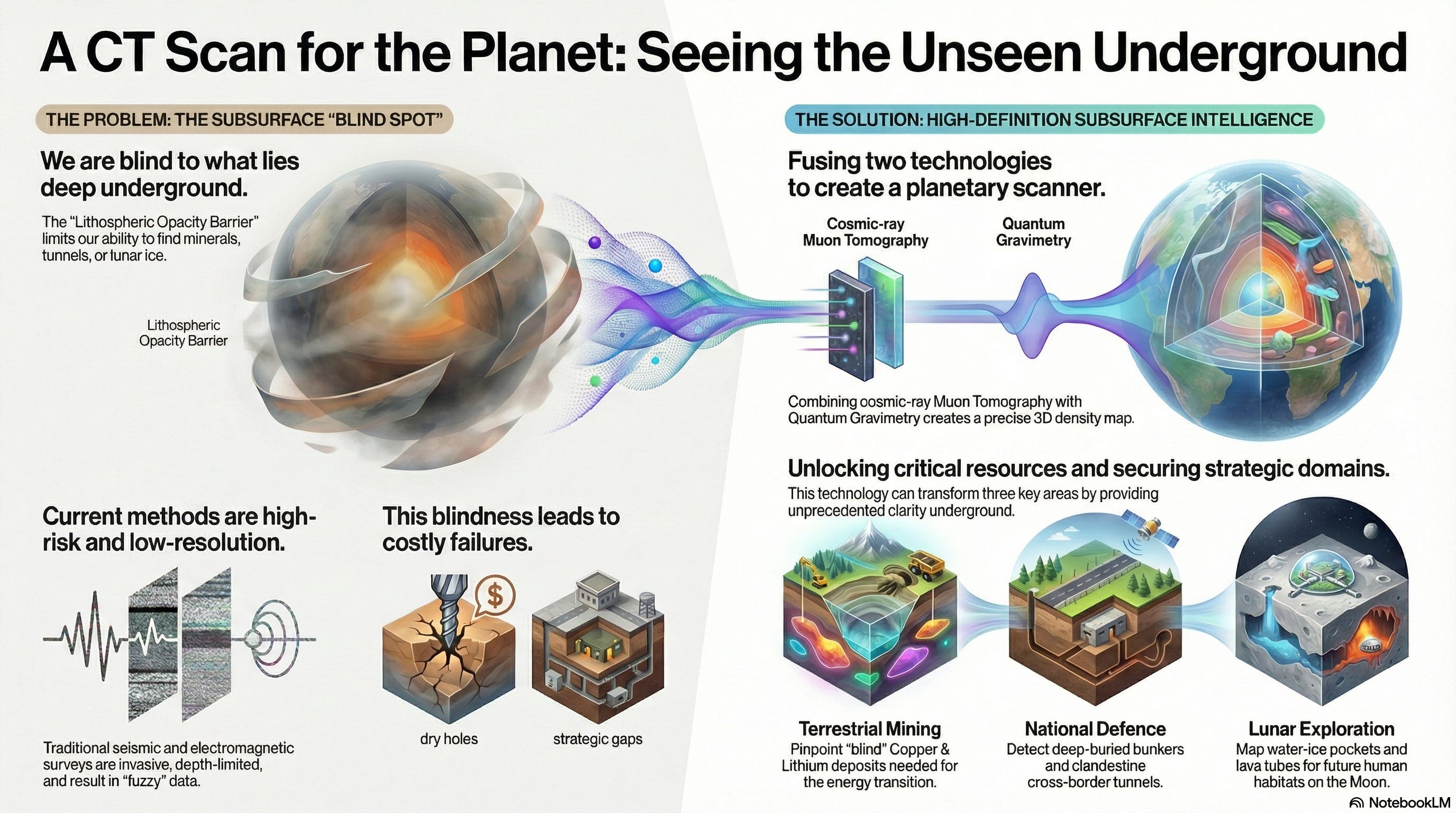
Our ability to “see” into the solid earth to locate strategic minerals, clandestine tunnels, or lunar ice remains limited by the “Opacity Barrier.”
Current geophysical methods are either environmentally invasive, depth-limited, or plagued by low-resolution “fuzzy” data.
The Subsurface Insight Alliance (SIA) is a proposed strategic consortium formed to break this barrier. By fusing Muon Tomography and Quantum Gravimetry, SIA could provides a “CT scan for the planet.”
This could move us from a world of “blind drilling” and “geological guesswork” to a new era of High-Definition Lithospheric Intelligence.
The SIA could aim to address the challenge of mass detection across three key domains:
Terrestrial Mining: Identifying the “blind” Copper and Lithium deposits required for the global energy transition, hidden deep beneath thick overburden where traditional sensors fail.
National Defense: Eradicating the “subterranean blind spot” by detecting deep-buried bunkers, clandestine cross-border tunnels, and the movement of heavy assets through precise density change monitoring.
Lunar Exploration: Providing the critical “prospector’s map” for the Artemis era locating stable lava tubes for human habitats and mapping the volume of water-ice pockets in Permanently Shadowed Regions (PSRs).
I. The “Lithospheric Opacity” Barrier
SIA could address the fundamental physical limitations of traditional geophysical surveying, which often relies on active seismic sources (explosives/vibrations) or electromagnetic induction that struggles with depth and resolution.
The Overburden Limitation: Traditional sensors lose resolution as depth increases. Discovering “blind” ore bodies i.e. deposits with no surface expression under 500m+ of cover is currently a high-risk, high-cost exercise for miners.
The “Dry Hole” Economic Drain: In mineral exploration, the ratio of drill-holes to discovery is low. Each “dry hole” costs millions. There is a benefit for high-fidelity density mapping to “point the drill” with surgical precision.
The Shadow Zone in Defense: Deep-buried structures (hardened bunkers) and clandestine tunnels are generally invisible to satellite imagery and SAR (Synthetic Aperture Radar), creating a strategic “blind spot” in underground domain awareness.
The Lunar Resource Gap: Identifying water-ice in Permanently Shadowed Regions (PSRs) is currently limited to surface spectroscopy or orbital neutron counting. To build a lunar economy, there is value in mapping the volume and depth of ice within the regolith without heavy drilling rigs.
II. The Potential Technical Stack
A multi-modal sensor fusion framework that combines cosmic-ray physics with ultra-sensitive quantum measurements to create a “CT scan” of the Earth’s crust.
Atmospheric Muon Tomography (Muography): Utilizing naturally occurring subatomic particles (muons) created by cosmic rays. As muons pass through the Earth, they are absorbed by dense materials (metal ores/concrete) and pass through voids (cavitites/ice).
Cold-Atom Quantum Gravimetry: Using laser-cooled atoms in a vacuum to measure infinitesimal changes in the local gravitational field. This could allow for the detection of mass anomalies (voids or high-density deposits) from the surface with unprecedented stability.
Subsurface Bayesian Fusion Engine: A software layer that overlays Muon flux data (directional) with Gravimetric maps (scalar) to resolve “ghost images” and produce a 3D density voxel map.
Resilient Sensor Housing: Specialized “Borehole-Hardened” casings designed to survive high-pressure, high-temperature (HPHT) environments in deep mining and the extreme cryo-conditions of the Lunar poles.
III. Intellectual Property (IP) Generation
“Universal Density Atlas”: A standardized library of muon-attenuation and gravity-gradient signatures for strategic minerals (Copper, Lithium, Cobalt) and common subterranean construction materials.
Dynamic Background Subtraction Algorithms: Software that filters out “noise” from lunar tides, atmospheric pressure changes, and groundwater fluctuations to isolate the static signal of a buried target.
“Shadow-Link” Protocol: A low-bandwidth, high-security data standard for transmitting 3D subsurface maps from remote field sites (or the Moon) via satellite to central command centers.
Muon-Capture Optimization Models: Geometric layouts for detector arrays that maximize “time-to-image,” reducing the observation period required to identify a subsurface void from months to days.
IV. Alternative Approaches & Competitors
1. The Legacy Seismic Industry
Companies: Schlumberger, CGG, PGS.
The Model: Relying on reflected sound waves to map strata.
The Bottleneck: Requires massive energy input (thumper trucks or explosives). It is environmentally invasive and often yields “fuzzy” results in complex hard-rock environments typical of mineral mining.
SIA Value: Passive sensing. SIA could use the universe’s natural background radiation (muons) and the Earth’s own gravity, requiring zero active “poking” of the ground.
2. Space-Based Gravity Missions
Missions: GRACE (NASA/DLR), GOCE (ESA).
The Model: Using two satellites to measure gravity changes from orbit.
The Problem: Low resolution. These missions are useful for mapping melting ice sheets or tectonic plates, but they cannot find a 50m wide copper deposit or a hidden bunker.
SIA Value: “Close-Proximity” sensing. By placing sensors on the surface or in boreholes, SIA could provide the “High-Definition” zoom that orbital assets lack.
3. Emerging “Point” Muography Startups
Companies: Ideon Technologies (Canada), Muon Vision (US).
The Problem: These firms often focus on a single modality (Muography only).
SIA Value: Sensor Fusion. By combining muography with quantum gravity, the consortium could eliminate “false positives” (e.g., a small dense rock appearing like a large deep one).
V. Potential Consortium Deliverables
1. The “SIA-Probe” Multi-Modal Sensor String (Hardware)
The primary physical deliverable could be a modular, ultra-slim sensor assembly designed for deployment in standard NQ (76mm) or HQ (96mm) diameter boreholes, as well as lunar lander deployment tubes.
Technical Specification: A vertical array of high-resolution Scintillating Fiber (SciFi) Muon Trackers coupled with a Cold-Atom Interferometry (CAI) quantum gravity chip. The unit could feature an active thermal management system using Thermoelectric Coolers (TECs) to maintain the quantum vacuum chamber at critical stability while submerged in high-heat terrestrial mines or cryogenic lunar regolith.
Commercial Utility: This probe could eliminate the need for expensive, large-diameter “specialty” shafts. It could allow mining companies to turn every exploratory drill hole into a permanent “observatory,” providing a continuous, 360-degree density scan of the surrounding 500-meter radius, and transform a one-dimensional “point sample” into a three-dimensional “volume scan.”
2. The “Deep-Sight” Voxel Engine & SaaS (Software)
A cloud-based “Subsurface Operating System” that performs real-time sensor fusion of muon flux and gravity gradient data to generate a high-fidelity digital twin of the earth’s interior.
Technical Specification: A Bayesian Inversion Engine that ingests directional muon-loss data and scalar gravitational anomalies to resolve “density voxels” at a resolution of 1kg/m³. The software could utilize a Convolutional Neural Network (CNN) trained on Rio Tinto’s geological libraries to automatically classify anomalies as “Sulphide Ore,” “Lava Tube Void,” or “Reinforced Concrete Structure.”
Commercial Utility: Provided via a secure, “Air-Gapped” web portal for defense users or a collaborative cloud for mining teams. It could reduce the “Time-to-Insight” from months of manual geophysical processing to a real-time, 3D heat map. For defense, it could provide an “Automated Threat Alert” when a new subterranean void (tunneling activity) is detected.
3. The “Lunar Ice-Map” Integration Kit (Mission Blueprint)
A space-qualified, radiation-hardened hardware and deployment package specifically designed for the Commercial Lunar Payload Services (CLPS) missions.
Technical Specification: A mass-optimized version of the SIA-Probe (under 15kg) featuring a Piezo-Electric Sonic Drill for low-gravity deployment. The kit could include a Gold-Coated MLI (Multi-Layer Insulation) shield to survive the 40K temperatures of the Moon’s South Pole and a low-power S-Band Telemetry Link to beam subsurface density profiles back to the Gateway station.
Commercial Utility: This could provide a “turn-key” solution for lunar prospectors. Instead of guessing where to mine for water-ice based on surface shadows, companies could use the SIA-Map to identify the exact depth and volume of sub-regolith ice pockets.
4. The “Lithospheric Transparency” Protocol (Certification Framework)
Developed in partnership with the British Geological Survey (BGS) and the National Quantum Computing Centre (NQCC), this framework could establish a global standard for non-invasive subsurface auditing.
The Deliverable: A formal regulatory manual titled “The SIA-Alpha Standard,” which defines the metadata requirements for “Density-Based Resource Verification.” It could include a blockchain-backed Chain-of-Custody for geophysical data to prevent “ore-grade tampering” in mining stock exchanges.
Commercial Utility: For mining, it provides a “Certified Resource Report” that banks can use to de-risk loans for deep-mine construction. For defense, it creates a standardized “Subterranean Domain Awareness” (SDA) language, allowing NATO allies to share density-map data seamlessly to identify shared underground threats.
VI. Example Consortium Partners
1. Geoptic (Muography Specialists)
The “Particle Physics Engine”: Deep Imaging via Cosmic Rays
Business Case: Geoptic could transition muography from a niche academic tool (used for volcanology or archaeology) into a high-cadence industrial utility. By leveraging atmospheric muons, they could provide the “directional” component of the SIA-Probe, allowing users to look “sideways” through rock from a single borehole or tunnel.
Value Contributed: Spun out of the University of Sheffield, Geoptic could brings the hardware for tracking cosmic-ray muons and the “attenuation models” required to translate particle counts into density maps.
Value Received: Potentially direct access to “Deep-Mine Test Beds” (Rio Tinto) to calibrate sensors against known geological “ground truths,” progressing their technology from in expedited timelines.
Potential Alternatives: Ideon Technologies (Canada), which has a strong mining focus, or Muon Vision (USA).
2. Delta g (Quantum Gravimetry)
The “Quantum Precision Engine”: High-Sensitivity Gravity Cartography
Business Case: Delta g commercializes cold-atom interferometry to measure the local gravitational field. While muons provide the “shape” of an anomaly, Delta g’s sensors could provide the “mass,” allowing the consortium to distinguish between a water-filled cavity and a solid ore body.
Value Contributed: Cutting-edge “Gravity Cartography” hardware that utilizes laser-cooled atoms in a vacuum. This technology is immune to the “drift” found in mechanical spring-based gravimeters, allowing for long-term monitoring of moving assets (e.g., submarines or heavy armor).
Value Received: Strategic funding and engineering support to “ruggedize” fragile quantum lab equipment into the borehole-hardened SIA-Probe capable of surviving the thermal shocks of the Lunar south pole.
Potential Alternatives: Muquans/Exail (France) or Atomionics (Singapore).
3. Rio Tinto (The Mining Anchor)
The “Commercial Infrastructure”: Terrestrial Scaling & Ore Targets
Business Case: As the energy transition accelerates, Rio Tinto faces a “Depth Crisis” where most easy-to-find surface minerals are becoming exhausted. SIA technology could reduce the “Discovery Cost per Tonne” by eliminating the need to drill speculative “blind” holes through 500m+ of barren overburden.
Value Contributed: A multi-billion dollar exploration pipeline, access to active deep-mine shafts for sensor deployment, and the “Geological Ground Truth” (core samples) required to validate the SIA Bayesian Fusion Engine.
Value Received: Exclusive “first-look” at high-grade strategic mineral deposits (Copper, Lithium, Nickel) hidden under thick cover, providing a massive competitive advantage in securing the global battery supply chain.
Potential Alternatives: BHP or Anglo American. Rio Tinto could be the primary choice due to their established “Mine of the Future” initiative and existing R&D focus on autonomous and remote sensing.
4. Ministry of Defence (MOD) / DSTL
The “Strategic Guardian”: Subterranean Domain Awareness (SDA)
Business Case: The modern battlespace is moving underground. The MOD requires a way to detect “Deep-Buried Hardened Targets” (DBHTs) and clandestine tunnels that are currently invisible to satellite SAR or traditional signals intelligence.
Value Contributed: Formal “Statement of Requirements” for subterranean threat detection, access to secure defense testing sites (e.g., Salisbury Plain), and high-level funding for “Rapid Portability” (developing a sensor that can be deployed by a drone or UGV).
Value Received: A decisive technological edge in subterranean warfare and a non-intrusive method to verify nuclear treaty compliance by monitoring the density of missile silos without physical entry.
Potential Alternatives: DARPA (USA) or DGA (France).
VII. Sample Work Packages (WPs)
WP 1: The Borehole Quantum Core (Miniaturization)
Objective: To compress the complex laser and vacuum architecture of Delta g’s Cold-Atom Interferometer (CAI) into a ruggedized, NQ-diameter (76mm) form factor capable of deep-borehole deployment.
Example Partners: Delta g (Quantum Lead), Fraunhofer UK (Photonics Integration), Rio Tinto (Field Validation).
Example Deliverables:
The Atom-on-a-Chip Vacuum Cell: A ceramic-to-metal bonded ultra-high vacuum (UHV) chamber that replaces bulky glass carboys, maintaining 10^-10 mbar pressure despite external borehole pressures exceeding 100 bar.
Ruggedized Laser Injection Module: A vibration-insensitive optical bench utilizing Photonic Integrated Circuits (PICs) to deliver the precise cooling and trapping frequencies required to reach the Bose-Einstein Condensate (BEC) state in the field.
The Gravity-Drift Compensator: An onboard software-hardware loop that uses high-frequency MEMS accelerometers to subtract the “noise” of seismic vibrations and drilling activity, isolating the static quantum gravity signal.
WP 2: The Cosmic-Ray “Flashlight” (Upward Muography)
Objective: To develop a horizontal “Sensing Tray” for Geoptic’s muon trackers that can be deployed within existing underground tunnels to map density anomalies above the sensor (e.g., detecting surface-launched missiles or clandestine excavation).
Example Partners: Geoptic (Muography Lead), CERN (Sensor Heritage), MOD (Operational Requirements).
Example Deliverables:
SciFi-Tiled Detector Array: A modular tray of Scintillating Fiber (SciFi) sensors read out by Silicon Photomultipliers (SiPMs), providing sub-millimeter tracking of muon trajectories to pinpoint high-density “shadows” in the overburden.
Dynamic Muon-Flux Correction Engine: A real-time atmospheric modeling tool that adjusts data for changes in barometric pressure and solar activity, ensuring that a “detected mass” is a physical threat and not a weather-induced signal fluctuation.
Intrinsically Safe (ATEX) Housing: A specialized explosion-proof casing that allows the detector to operate in methane-rich coal mines or sensitive military munitions depots without risk of ignition.
WP 3: Lunar Cryo-Hardening (Extreme Environment Adaptation)
Objective: To re-engineer the SIA-Probe’s structural and electronic components to survive the 40K (-233°C) environment of Lunar Permanently Shadowed Regions (PSRs) for ice-mapping missions.
Example Partners: STFC RAL Space (Thermal Testing), Geoptic (Radiation Shielding), Airbus Defence and Space (Lunar Systems).
Example Deliverables:
“Cryo-Bottle” Thermal Shield: A multi-layered vacuum flask utilizing active Aerogel insulation and radioisotope heating units (RHUs) to keep the quantum laser and Muon electronics within their operational temperature window (+10°C) while the exterior is at 40K.
Regolith-Coupled Piezo-Drill: A low-power, high-frequency percussive deployment system designed to “vibrate” the SIA-Probe into frozen lunar regolith without the high torque requirements of traditional rotary drills.
The Secondary-Muon Calibrator: A specialized algorithm that accounts for the unique muon production rate on the Moon where muons are generated by cosmic ray “spallation” directly in the top meter of soil rather than in a thick atmosphere.
WP 4: The Subsurface Transparency Standard (Compliance & Audit)
Objective: To establish a legal and technical framework that validates non-invasive density data for use in international mining finance and defense treaty verification.
Example Partners: British Geological Survey (BGS) (Data Governance), London Metal Exchange (LME) (Reporting Standards), IAEA (Verification Advisory).
Example Deliverables:
The “SIA-Alpha” Reporting Protocol: A comprehensive manual defining the minimum “Confidence Interval” required for a muography/gravimetry survey to be legally recognized as a “Proven Mineral Resource” under JORC or NI 43-101 codes.
Blockchain-Backed Density Ledger: A tamper-proof digital record that logs raw particle counts and gravity gradients directly from the sensor to a distributed ledger, preventing the “salting” or manipulation of exploration data for stock fraud.
The Non-Intrusive Verification (NIV) Toolkit: A set of pre-vetted sensor configurations and data-sharing protocols designed for the United Nations to monitor underground nuclear test sites or chemical weapon facilities without requiring physical access to the interior.
VIII. Strengths, Limitations, & Risks
A. Core Strategic Strengths
The “Double-Blind” Advantage: Unlike traditional seismic or electromagnetic surveying, the SIA’s dual-modality sensors (Muon + Quantum) are entirely passive. This could allow for clandestine mapping in defense contexts and “interference-free” prospecting in active mining sites where electrical noise usually blinds conventional tools.
Sovereign Physics Cluster: The consortium could leverage the UK’s unique position as a leader in Cold-Atom Research (University of Birmingham/Delta g) and High-Energy Particle Physics (Sheffield/Geoptic). This could creates a “National Moat” around the IP.
Multi-Domain Amortization: The R&D costs for miniaturizing quantum sensors could be spread across high-CAPEX mining, defense, and space sectors. This could reduce the financial burden on any single partner while accelerating the TRL (Technology Readiness Level) through diverse environmental stress testing.
B. Structural Limitations
The Muon Integration Time: Muon tomography is a “long-exposure” technology. Unlike an instant X-ray, it requires the accumulation of particle counts over hours or days to resolve high-density objects deep underground. This makes it unsuitable for detecting fast-moving subsurface threats (e.g., rapid-transit vehicles) but ideal for static infrastructure.
Quantum Jitter & Noise: Cold-atom interferometers are incredibly sensitive to local vibrations. In an active mining environment with heavy machinery or on a lunar lander with active cooling pumps, “vibration leakage” can wash out the quantum signal, requiring complex active-damping hardware.
Depth-Resolution Trade-off: While Muons can penetrate kilometers of rock, the resolution of the resulting 3D voxel map degrades with depth. Pinpointing a 1-meter wide tunnel 500 meters down requires significantly longer dwell times and a higher density of sensors than surface-level mapping.
C. Critical Risks & Mitigation Strategies
Operational Risk (Signal Attenuation): In ultra-deep deployments (2km+), the muon flux may be too low to provide actionable data. Mitigation: The consortium could utilize “Bayesian Fusion,” where the Quantum Gravimeter provides the primary mass anomaly signal, and the weak Muon flux is used merely as a “directional filter” to constrain the gravity inversion.
Environmental Risk (Sensor Drift): Extreme thermal gradients in the Lunar South Pole could warp the optical alignment of the quantum lasers. Mitigation: The use of “Photonic Integrated Circuits” (PICs) could ensure that the entire laser-trapping system is etched onto a single chip, eliminating the risk of mechanical misalignment due to thermal expansion.
Geopolitical/Regulatory Risk: Subsurface transparency technology could be classified as “dual-use” under ITAR or UK Export Controls, limiting the ability to sell the technology to international mining firms. Mitigation: The consortium could establish a “Sovereign-Data-Tier” where the hardware is sold globally, but the high-fidelity inversion software (the “Brain”) remains hosted on secure UK servers.
IX. The ROI & Strategic Interest
1. The “Blind” Discovery Multiplier
Traditional mining exploration has a “success rate” for deep deposits of less than 1%. SIA could aim to move the needle to 10%+.
Drilling Cost Avoidance: A single exploratory diamond drill hole to 1,000 meters costs approximately £150,000–£250,000. By using the SIA-Probe to scan a volume of rock before drilling, a firm like Rio Tinto could eliminate five “dry holes” per site, representing a direct saving of £1M+ per exploration campaign.
Strategic Mineral Security: For the UK Government, the ROI could be measured in the security of the “Green Supply Chain.” Enabling the domestic or allied discovery of ultra-deep Lithium and Copper deposits ensures the UK is not reliant on adversarial supply chains for the EV transition.
2. Cross-Sector Economic Spillover
The SIA could act as a bridge between the Midlands Quantum Hub and the South-West Mining & Space Clusters.
The “Deep-Tech” Toll-Booth: By establishing the “SIA-Alpha Standard” for density reporting, the consortium could create a new professional services market. Just as “certified accountants” audit financial books, “certified geophysicists” using SIA tech could audit the “underground books” of mining companies before they go public on the London Stock Exchange.
Defense Capability Leap: The MOD could gain a “first-mover” advantage in Subterranean Domain Awareness (SDA). The ability to map deep bunkers without overflights or ground intrusion provides a strategic deterrent value that is difficult to quantify but vital for national security in an era of “hardened” asymmetric threats.
3. Lunar “Ice-Rush” Infrastructure
The SIA-Probe could be a “Golden Spike” for the lunar economy.
In-Situ Resource Utilization (ISRU): Every kilogram of water-ice found on the Moon is worth approximately $100,000 (the cost of launching that mass from Earth). If an SIA-enabled mission locates a 1,000-tonne ice pocket in a lava tube, it effectively “unlocks” local resources for life support and rocket fuel.